
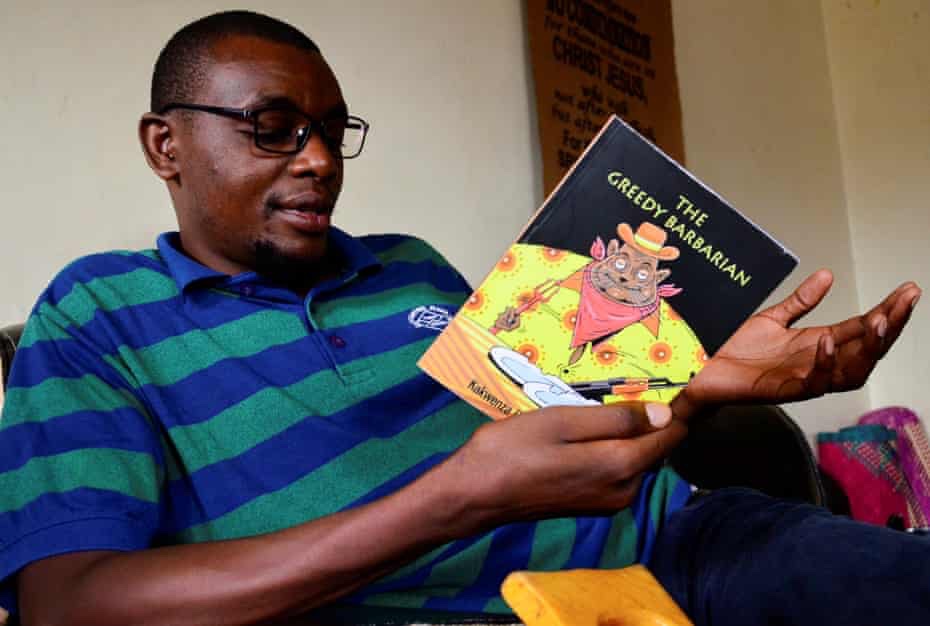
The award-winning author was arrested and tortured for his work – and then tortured again for writing about his detention. Now he smuggles his latest banned book into Uganda to ensure it is read
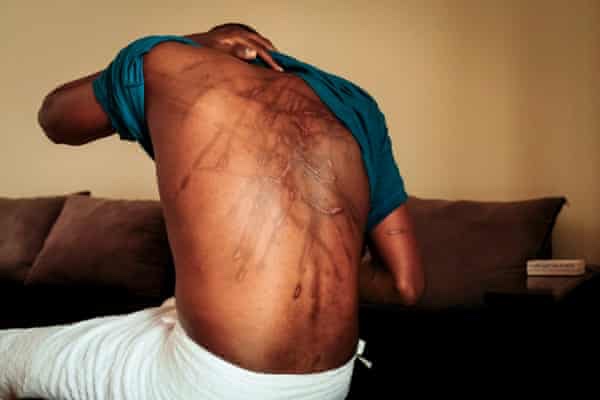
Kakwenza Rukirabashaija tries to keep his scars covered around his children. Even in the height of summer he never takes off his long-sleeved shirt and trousers. He is worried that evidence of the extensive, brutal torture he endured before fleeing Uganda, etched permanently into his body, would terrify them. The damage is so bad that he washes in the dark to avoid seeing them himself.
“The scars are not painful, but they trigger trauma whenever I am in the bathroom and look at myself in the mirror. So I decided to turn off the light when I shower to avoid seeing them,” says the satirical writer, who was this month given the Václav Havel award for creative dissent.
His back is a crisscross of welts and his thighs are pockmarked with craters where his flesh was ripped away. Fractures in his ankles, viciously beaten more than a year ago, may take years to fully heal, doctors have told him.
“You know children are very inquisitive. They ask what happened to you. So even when it is sweltering hot outside, I try by all means to cover my body,” he says.
Rukirabashaija details his ordeal in a new book, The Savage Avenger. It is a chronicle of an abusive system and testimony to the power of the pen.
He was targeted and forced into exile.
It infuriated Ugandan authorities, and he was seized again. So, like reflections in a gruesome hall of mirrors, his third and most recent book is an account of the detention and torture he suffered for writing the second book. I have to keep going, I have to keep pushing until Uganda gets a better person to lead it
The persecution derailed his career as a novelist, turning him into a chronicler of abuse and forcing him to flee the country, fearing for his life. His passport had been confiscated but he made it out through a route that he says in the book must stay secret for now, and found refuge in Germany.
He carries on writing mostly for his children, who are aged nine, five and three.
He went public about the family’s situation a year ago, and the passports were issued after an outcry, including an investigation by the Uganda Human Rights Commission. They are now united in Germany, and Rukirabashaija says they help keep him going.

“I want to make a better world for them, not in exile but back in Uganda,” he says. “So I have to keep going, I have to keep pushing until Uganda gets a better person to lead it. I don’t want my children to judge me in future as a sellout.”
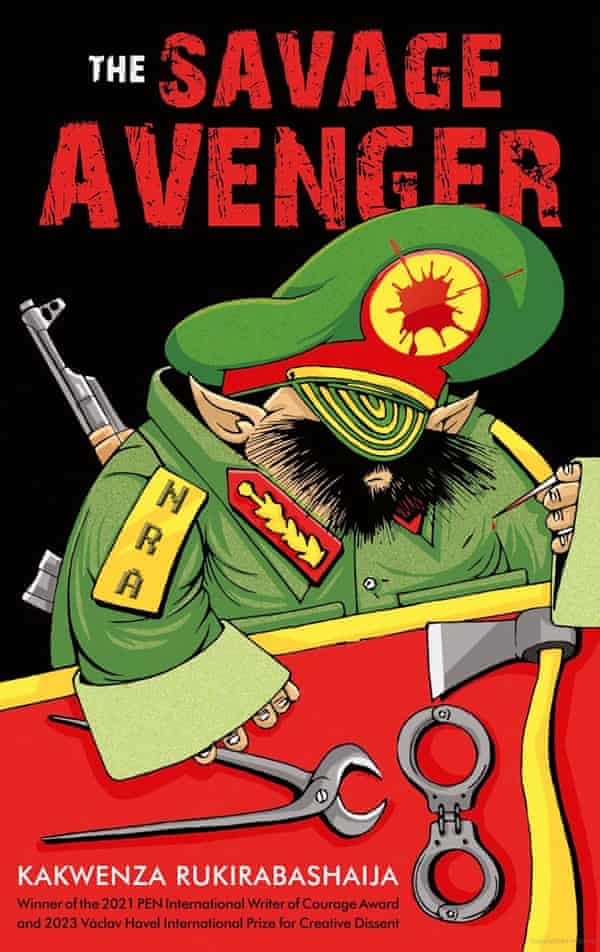
The Savage Avenger, Kakwenza Rukirabashaija’s latest book
He also wants to raise awareness abroad of abuses he and others have endured. Uganda is a key western ally in East Africa, and has received billions of dollars of development and security assistance from the UK and US, even as human rights failings have worsened in the country.
The book is brutally honest on that front, with devastating pictures of Rukirabashaija’s injuries to illustrate and support his account. It is equally open about his post-traumatic stress disorder (PTSD), and the support he needs from a therapist.
“Sometimes I can have two weeks when I am very fine, then I get down for the next week – it really hits me.” He has got a lot more sympathy since he was published, he says, from people who had not previously understood the intensity of his torture ordeal.
But the book is also often funny. Rukirabashaija’s sense of humour was one of the few things to escape unscathed, perhaps even sharpened. He uses it to attack the people who held and tortured him, but also writes affectionately about those who have helped him, and his new home in Germany.
A place where people love beer and long philosophical discussions was always going to feel something like home to a Ugandan, he says, although it is taking longer for him to adjust to the food.
“Really, we want to return home,” he says. The government has tried to invite him back, but for now he does not think that would be safe. “I can’t return home when the things that pushed me to exile still exist there.”
So instead, he keeps up a furious pace of activism, to avoid becoming irrelevant at home, the fate of many exiles who fade into the past – and the hope of the dictators who banish them.
“That is the reason I wake up early every morning: to interact with Ugandans, read the newspapers,” he says. “I don’t want to miss anything that goes on in Uganda.”
Invest or Donate towards HICGI New Agency Global Media Establishment – Watch video here
Email: editorial@hicginewsagency.com TalkBusiness@hicginewsagency.com WhatsApp +256713137566
Invest or Donate towards HICGI New Agency Global Media Estab lishment – Watch video here
Follow us on Social Media , just type “HICGI News Agency”
 HICGI News Agency