
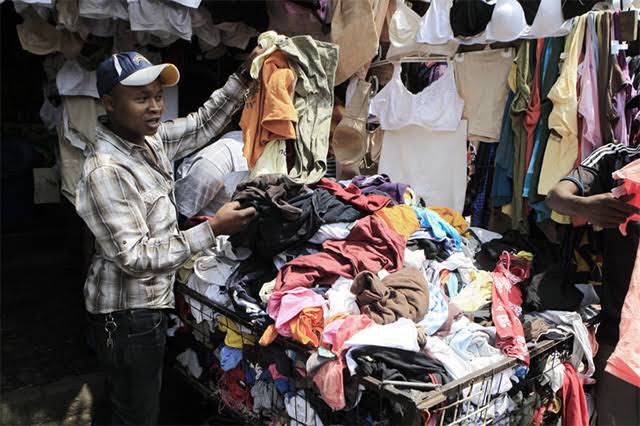
The ban on the importation of used clothing by President Museveni is a direct attack on 16 million vulnerable Ugandans, according to the National Economic Empowerment Dialogue (NEED).
The political party headed by Joseph Kabuleta stated that this move will cause high levels of unemployment leading to insecurity.

NEED is appealing to every Ugandan who benefits from used garments to raise their voice in unison and negate this delusional government policy.
Museveni recently banned the importation used clothings, arguing that it hinders the growth of the local textile industry and that the clothes primarily belong to deceased Westerners.
While it is true that Uganda has traditionally imported large quantities of used clothing, local manufacturers complain that the dumping of second-hand apparel swamps the market, undermining Uganda’s ability to climb the value chain of the cotton and textile industry.

Museveni has defended this ban by saying that the clothes belonged to dead Westerners and that it stifles the development of local textile industries.
“They are for dead people. When a White person dies, they gather their clothes and send them to Africa,” he said.
According to Oxfam, a British charity, approximately 70% of donated garments from Europe and the United States end up in Africa.
It is unclear how many of these donations come from deceased individuals.
Museveni expressed his concerns during the groundbreaking ceremony for nine factories in the Sino-Uganda Mbale Industrial Park, stating that local clothing producers struggle to penetrate the market due to the dominance of used clothing imports.
However, for NEED, this move is a direct attack on the majority of Ugandans, especially the 16 million vulnerable poor who he purports to help in his scam Programme Parish Development Model as he spends Shs 1 million on his personal clothing daily.
The NEED national treasurer, Charles Basajja, criticised Museveni’s ban as evidence of the President’s detachment from the majority of Ugandans.
“It is on record that he spends one million shillings daily on his personal clothing, as per the current budget. This move directly targets the 16 million vulnerable poor individuals [according to the government] that he claims to assist through his Parish Development Model scam,” Basajja stated.
He further acknowledged that Museveni is striving to achieve a “Middle Income Status” class which he believes doesn’t exist in Uganda.
“Many livelihoods in Uganda depend on small businesses, especially those involved in the second-hand goods and clothing trade, which directly or indirectly employ over one million Ugandans,” he highlighted.
NEED argues that promoting foreign investors is detrimental to the country’s economic growth.
Instead, the government should create an enabling environment to empower local investors by eliminating obstacles that hinder the establishment of domestically-owned factories.
Incentives offered to foreign investors, such as tax holidays and free land, should also be extended to benefit local businesses.
Basajja believes that this approach will enhance production levels and generate more employment opportunities.
“First, we need to uplift our youth and the vulnerable poor Ugandans economically before the government considers banning used clothes,” he concluded.
The East African Community agreed in 2016 to a complete ban on used clothing imports by 2019, but Rwanda was the only country to enact it.
The United States in 2018 suspended Rwanda’s right to export clothing duty-free to the United States, one of the benefits of the United States’ tariff and quota-free African Growth and Opportunity Act (AGOA), as a result.
 HICGI News Agency