
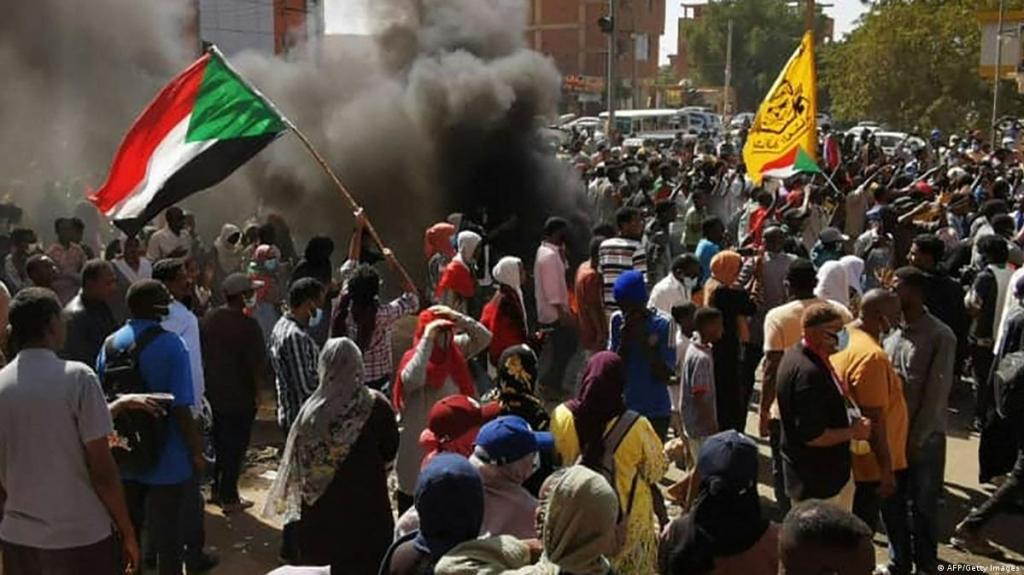
The Sudanese people have been unwaveringly committed to achieving democracy. However, despite their persistent efforts, stable democratic governance has yet to be established in Sudan. This is partly due to foreign pressures that have hindered their progress.
In 2019, President Omar al-Bashir was overthrown in a historic revolutionary episode, but the political transition failed to maintain a democratic path for the country.
Afterwards, a violent war erupted between two generals, causing chaos and destruction. Currently, the main concern for the Sudanese people is to survive, but once the conflict is resolved, there will be a need to address the future governance and politics of the country. It is important to have a clear vision of what the future should look like.

A crucial aspect of resolving Sudan’s numerous problems is a democratic transformation. However, any such transformation should focus on meeting the needs of the Sudanese people and not be shaped by external forces. The United States has attempted to influence the post-Bashir transition, but it has a long history of unsuccessful efforts to promote democracy in Sudan and its neighboring countries. Additionally, the US itself is currently facing challenges in upholding key democratic indicators domestically.
Over the past few decades, the United States has been actively promoting its own version of democracy to countries located in the Global South, including Sudan. This effort has involved the collaboration of American diplomats, think tanks, and non-governmental organizations (NGOs) working together to encourage foreign governments to uphold democratic values.
Specifically, these organizations have worked to press foreign governments to hold free and fair elections, protect freedom of speech, and uphold human rights. In addition to advocating for these values, American NGOs have also provided resources and training to local civil society groups to help them monitor elections and hold their governments accountable for any violations of democratic principles.
Overall, the US’s efforts to promote democracy in the Global South have been ongoing and multifaceted, reflecting a commitment to promoting democratic values and institutions around the world.
That drive has largely failed to produce any tangible results for two reasons.
Democracy in the US has been declining, with all three pillars of democracy promotion witnessing a regression. Over the past decade, there have been claims of foreign interference, accusations of stolen elections, and political turmoil that have raised concerns that elections may no longer ensure a peaceful transfer of power in the country.
Free speech has recently faced significant challenges. In the midst of the COVID-19 pandemic, as well as the conflicts in Ukraine and Gaza, numerous individuals have been removed from social media platforms, defamed, and even terminated from their jobs for expressing views that don’t align with the official narrative. Additionally, there has been an increase in book bans across the country, and an alarming trend of censoring critical voices on social media.
The US has also seen a spotty human rights record domestically, which was reflected in a 2023 UN report highlighting the US’s failure to abide by many of its obligations under the UN Covenants on Civil and Political Rights. On the international arena, the US has continued to support Israel’s mass murder of Palestinian civilians in Gaza, despite growing evidence that it is committing war crimes and possibly genocide.
The promotion of democracy in the United States has been influenced by the country’s economic and political goals. To facilitate the transition towards democracy, the US requires nations to accept the International Monetary Fund (IMF) and World Bank’s oversight of their economies, which are both Western-controlled organizations. Additionally, the US expects countries from the Global South to align their foreign policies with those of the US.
Submitting to demands often comes at the expense of national sovereignty and citizens’ interests, contradicting the very idea of democracy.
It is suggested that countries in the Global South avoid adopting the US model of democracy as it is primarily designed to maintain US dominance.
The United States and Western model of democracy, which is characterized by its narrow focus, has not been effective in Sudan. Whenever this model has been implemented in Sudan after the overthrow of a military regime and during a period of political openness, it has failed to address the country’s complex problems and has been swiftly replaced.
During the 2000s, the United States intensified their efforts to promote democracy in Sudan. This was happening as the country’s second civil war was coming to an end. The US had a significant influence on the regional peace process, which resulted in the 2005 Comprehensive Peace Agreement between Sudan’s government and the rebel Sudan People’s Liberation Movement (SPLM). Both sides were under pressure to agree to a democratic transformation, either in a united Sudan or in separate components if southern Sudanese chose to secede in a referendum.
Despite investing enormous political capital in the project, the peace agreement and process served to strengthen al-Bashir’s government.
In the decade that followed, the Sudanese government’s inability to address the concerns of the politically and economically disadvantaged populations worsened poverty and fueled clashes in the outlying regions of Darfur, the Nuba Mountains, southern Blue Nile, and eastern Sudan.
Sudan’s underdeveloped market failed to meet the needs of the impoverished population, let alone address the economic issues in the periphery.
It was not considered a priority by Khartoum and many in the opposition elite to have the state take a leading role in addressing poverty in the country. Their understanding of democracy was limited to merely replacing the current dictator.
The trade union movement was suppressed, weakening the political opposition. Professional groups took over, focusing on political reforms rather than addressing the economic grievances of the majority and implementing the necessary economic restructuring of the country.
The reason behind the failure of the post-2019 transition becomes evident upon analyzing the situation. Although Abdalla Hamdok’s transitional government took over after the overthrow of al-Bashir’s regime in 2019 and claimed to be a democratic government, it was actually under the control of the military. The government formulated its economic and foreign policies based on the demands of the United States, and did not pay much attention to the voices of the revolutionary street that brought it to power.
Believing that the market was crucial to ending Sudan’s economic crisis, the government pursued IMF austerity policies that further reduced living standards and eroded public support.
This period in Sudanese history is significant to consider as the Sudanese people contemplate the future of their nation.
It is important for them to not only discuss how to remove the generals and end the war, but also to consider what kind of democratic path they want their country to take, one that is not influenced by US pressures.
Invest or Donate towards HICGI New Agency Global Media Establishment – Watch video here
Email: editorial@hicginewsagency.com TalkBusiness@hicginewsagency.com WhatsApp +256713137566
Follow us on all social media, type “HICGI News Agency” .
 HICGI News Agency