
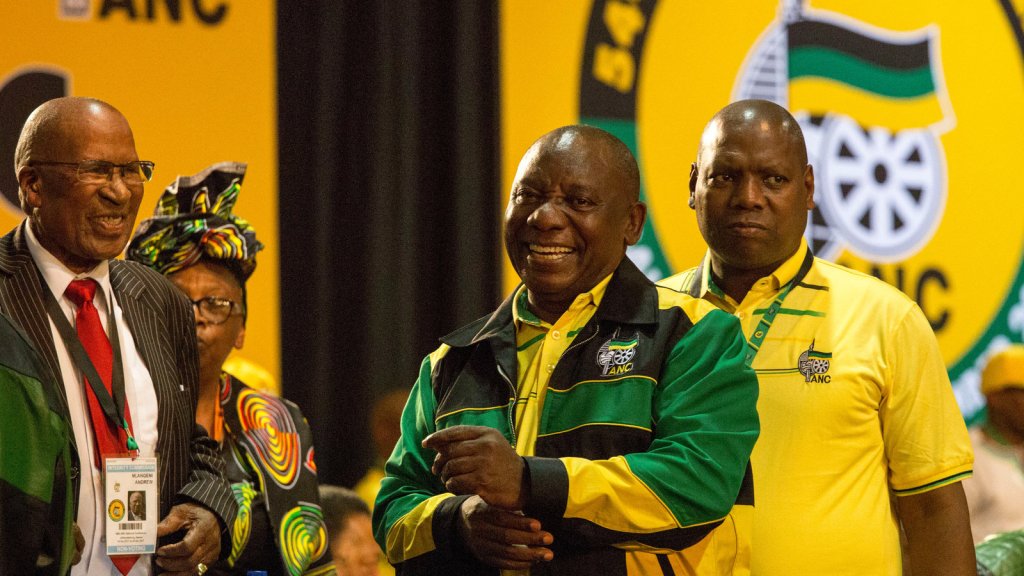
South Africans will go to polls on Friday 29 May to elect a new National Assembly, which will then choose the next president. The ruling African National Congress (ANC) is betting on retaining its parliamentary majority but faces the biggest challenge since it came to power in 1994.
Voters say they are disappointed with poor service delivery, unemployment, crime and power cuts.

Pollsters expect the ANC to lose its legislative majority for the first time since Nelson Mandela took power at the end of apartheid 30 years ago.
If this happened, President Cyril Ramaphosa – or an ANC successor for the top job – would be unable to stay on without a coalition, since South Africa’s parliament elects the president.
The campaign has already started, and Ramaphosa is travelling nationwide to meet with voters.
On Monday, South Africa’s second most popular party, the Democratic Alliance (DA), said that it would not rule out a deal with the African National Congress should the ANC fail to get the majority it needs to retain power in May elections, according to its leader.
“It would depend on which ANC you’re dealing with and what their programme of action is,” DA leader John Steenhuisen said, declining to disclose whether any talks had already taken place.
“I’m not ruling out anything, depending on what the election results are,” Steenhuisen added.
between the EFF and the ANC,” he said.
The DA is seen as a pro-business party, whereas businesses and wealthy individuals dislike the EFF, which is popular with poor and Black South Africans.
The EFF promises to nationalise industries and fix inequalities in land ownership.
“I won’t sit back and just watch the country handed over to the radical socialists,” Steenhuisen said.
“If the [opposition coalition] doesn’t get over the line, we may have to look at the least worst option.
If in power, the DA would seek to pursue its policy of privatising the power sector rather than rely on state provider Eskom and eliminating red tape to make it easier for the private sector to operate, Steenhuisen said.
He also reiterated the DA policy of abandoning the ANC’s flagship Black Economic Empowerment scheme, which he called “racial bean counting”, in favour of one focused solely on reducing poverty, regardless of skin colour.
Race is a divisive issue in South Africa, and the DA is still seen by many as the party of white privilege.
Invest or Donate towards HICGI New Agency Global Media Establishment – Watch video here
Email: editorial@hicginewsagency.com TalkBusiness@hicginewsagency.com WhatsApp +256713137566
Follow us on all social media, type “HICGI News Agency” .
 HICGI News Agency