
It is often overlooked that the April 26-29, 1994 election that brought the African National Congress (ANC) government to power in South Africa was on the brink of violence before the last minute.
An 11th-hour agreement on 19 April brought the Zulu-majority Inkatha Freedom Party (IFP) into the contest. Inkatha had been boycotting the process and challenging the ANC in violent street protests.
The peaceful election brought enormous relief to the country and the world.
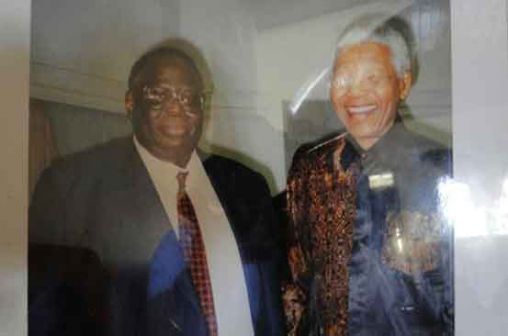
A Kenyan, Washington Okumu, alternately described as a professor or a diplomat, was credited with the negotiation. But few observers knew who he was.
In his memoir, the US ambassador to South Africa in 1994, Princeton Lyman, reflected on Okumu’s mysterious appearance, saying, “It is still not clear who invited Okumu to the mediation – perhaps the OAU (Organisation of African Unity), perhaps Inkatha. In the end, no one cared.”
Soon, Okumu receded from view. I vaguely remembered him because I had been with the United Nations mission that observed the election. Teaching about the election reminded me of him.
In 2016, my research assistant, Aidea Downie, and I travelled to Bondo, western Kenya, for interviews. Over 13 hours of conversation, Okumu told us about his life and intervention in South Africa. He also gave us a copy of his unpublished memoir, The African Option.
Neither the interviews nor the manuscript were clear or consistently truthful, but they provided clues for further research, which filled in this history.
His is a remarkable story. He found his way to Pretoria through the efforts of Christian conservatives who expressed moral reservations about South Africa’s post-apartheid interim constitution. Their efforts got him into an international mediation team that could have suggested revisions to it. The constitution went unchanged, but Okumu became essential to South Africa’s first democratic election.
Okumu made his way to Pretoria in April 1994 because of his long connection to American and British backers.
It seems he became an asset to the CIA, the American spy agency, when he was studying at Harvard in the 1950s. Returning to Kenya, he took work as a civil servant. He was imprisoned in 1968 on corruption charges. In prison, he became a Christian.
In 1971, American and British supporters found him a mid-level position at the UN Industrial Development Organisation in Vienna. This is as close as he ever came to serving as a diplomat.
While he was working for the UN, he began attending the National Prayer Breakfast in Washington, DC, then organised by a private Christian network known as the Fellowship. Its annual meeting functioned as a conservative side-channel to US foreign relations. The Fellowship was seeking to protect southern Africa from communist influences, which meant supporting the apartheid government.
Mangosuthu Buthelezi – the leader of the KwaZulu homeland in South Africa who founded Inkatha as a cultural organisation in 1975 – also attended. Okumu said they became friends there.
The Fellowship arranged for Okumu to travel to Pretoria in 1976 to meet prime minister BJ Vorster, who was attempting overtures to the rest of Africa. Okumu carried a message from Vorster to Tanzania President Julius Nyerere. Nyerere, however, was unwilling to negotiate with the apartheid government.
Okumu lost his UN job in 1985. He had a few years of irregular employment, including a temporary position as a lecturer, which is the closest he ever came to being a professor.
In 1988, Okumu took a position with the Newick Park Initiative, a UK thinktank founded by social entrepreneur Michael Schluter to promote Christian principles in post-apartheid South Africa.
Invest or Donate towards HICGI New Agency Global Media Establishment – Watch video here
Email: editorial@hicginewsagency.com TalkBusiness@hicginewsagency.com WhatsApp +256713137566
Follow us on all social media, type “HICGI News Agency” .
 HICGI News Agency