
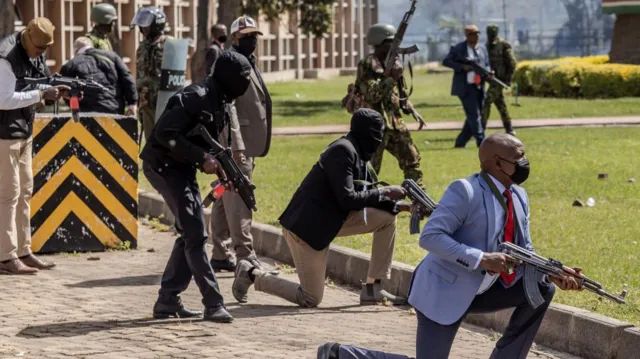
The violent events in the Kenyan capital this week, along with the government’s harsh response to protests, led to the spread of rumors. These rumors aggravated public anger and worsened an already tense situation.
On Tuesday, citizens watched in horror as a bloody day unfolded in Nairobi.
The country’s police watchdog is currently investigating allegations that officers shot and killed protesters outside the national parliament during a day of demonstrations, resulting in at least 23 reported deaths.

Within hours many Kenyans began to hear reports of another, even more brutal incident – an alleged massacre of civilians in Githurai, a residential suburb 14km (nine miles) north-east of central Nairobi.
The story quickly took hold on social media, where some people claimed more than 200 had been killed.
Reports referencing the rumours emerged in the media, followed on Wednesday by statements by reputable organisations calling for an independent inquiry. When protesters returned to the heart of Nairobi on Thursday, many spoke of the alleged massacre in Githurai as a reason.
But a BBC investigation has found no evidence of mass killings in Githurai – raising questions about how readily misinformation can spread amid a crisis.
Here we unpick how the story unfolded.
The first sense of anything significant taking place in the suburb emerged on Tuesday evening.
It had been a chaotic day across Kenya, with tens of thousands attending protests in central Nairobi which quickly escalated, leading to the storming of parliament, the shooting dead of protesters, looting and attacks on police.
After the shocking violence outside and inside parliament the demonstrators began to disperse, many headed towards their homes on the city’s outskirts.
Githurai is a densely populated residential area on the Thika Highway, the main road north from the city centre.
It has rows of formal housing as well as areas of informal settlements, home to tens of thousands of commuters who make the daily trip into central Nairobi.
As dusk fell many Githurai residents suddenly became aware of a significant presence of police and what many believed were the military.
Communications were patchy on Tuesday evening, with internet outages across Kenya and mobile phone signals periodically going down.
But as news of events in Githurai emerged, some videos did make their way to social media.
BBC Verify has managed to authenticate several videos posted by six different online users and from different locations around the area.
They show evidence of heavy and continuous gunfire in Githurai, around the main roundabout on the Thika Highway.
In one video, we see security forces advancing towards the protesters and some can be seen shooting – it is unclear from the video whether at the protesters or in the air, and it is impossible to know whether the guns were firing live rounds, rubber bullets or blanks.
We are yet to come across any verifiable video or image of people killed around that time.
A graphic image circulating online shows a body with at least eight bullet holes, but the nature of how it was taken makes it challenging to verify because it is taken at very close range and there are no clearly identifiable location points.
In one video clip, which we were able to authenticate by verifying identifiable locations, people can be seen walking towards Githurai.
Smoke can be seen rising from the area from a distance as the person filming walks towards the suburb. Those walking alongside the person filming are raising their hands up to show they do not pose any danger.
Another video filmed nearby the roundabout shows dozens of people gathered around the area and running away from the scene as gunfire can be heard.
In some of the videos, you can see what looks like vehicles belonging to the military or police on the road, and in two of the clips those filming talk about the road having been blocked by protesters.
Although the details are hard to verify, it is clear that a major security operation took place in the suburb.
But an analysis of social media shows misinformation about what had happened was already starting to take hold.
BBC Verify found that old videos filmed in 2022 were being reshared on social media, purporting to show protesters walking along a street carrying flaming torches at this week’s protests.
The discovered that it was recorded in Ghana two years ago. This is not the first time it has been misrepresented.
Despite the incomplete understanding of what happened in Githurai, as Kenyans woke up on Wednesday morning reports began to spread of an alleged massacre.
It was discussed by radio DJs, reported as rumour by some Kenyan newspapers and widely discussed online. The word “Githurai” was trending on social media sites, including X.
The state-funded Kenya National Commission on Human Rights said it had “received unverified reports of scores of residents who were killed by the stray bullets”, which it said it would investigate.
And later that day the allegations were given new credibility when they were referred to directly by a leading legal organisation, the Law Society of Kenya (LSK) – a body which represents the country’s lawyers and works to promote the rule of law.
 HICGI News Agency