
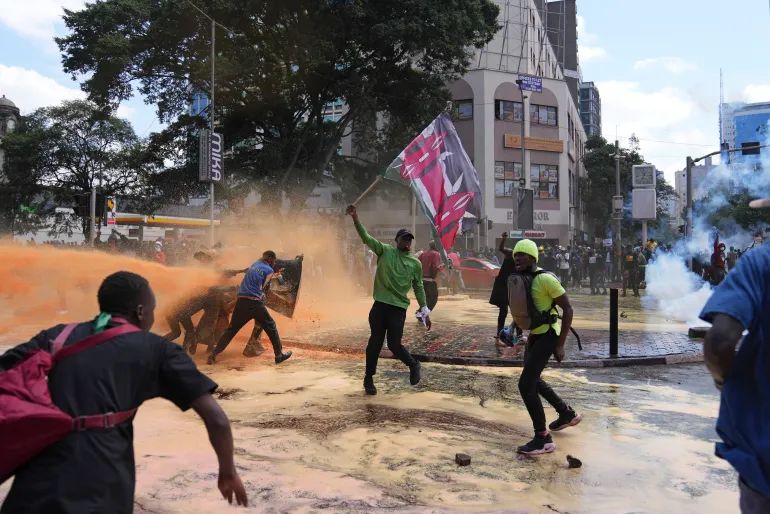
A Kenyan court has suspended a police ban on protests in the capital, stating that citizens have a right to demonstrate peacefully.
Before the High Court’s decision on Thursday, police had barred protests in Nairobi indefinitely, saying they lacked leadership that would ensure peaceful demonstrations.
The judge issued a “conservatory order” to prevent the ban from being enforced, pending a final ruling on the case. The court said it will hold another hearing on July 29.

The suspension came before a planned protest, in which demonstrators were expected to march to the president’s office calling for his resignation over poor governance.
The acting police inspector general, Douglas Kanja, said in a statement that the lack of leadership had “made it difficult to enforce safety protocols”.
Protesters were yet to be spotted on Thursday, but major roads leading to the president’s office remained barricaded by the police.
Kenya has seen a month of protests that started with calls for legislators to vote against a controversial finance bill that was proposing higher taxes amid a cost-of-living crisis and ballooning public debt.
At least 50 people have died since the protests began on June 18, according to the Kenya National Commission on Human Rights.
President William Ruto said he would not sign the finance bill that was passed by parliament on June 25 – the day protesters stormed and set fire to part of the building, prompting legislators to flee.
In addition to scrapping the annual finance bill, including the tax hikes, Ruto has also sought to engage with some protesters, hosting an event on social media platform X with young Kenyans last week.
But this has failed to appease some demonstrators, who have continued to call for him to step down, using the hashtag #RutoMustGo and staging smaller rallies across Kenyan cities.
Kenya’s public debt amounts to 10 trillion shillings ($78bn), around 70 percent of its gross domestic product (GDP).
The government’s decision to borrow more will result in the fiscal deficit rising from 3.3 percent to 4.6 percent, according to Ruto.
 HICGI News Agency