
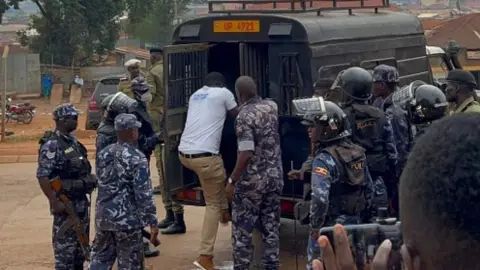
Uganda’s main opposition leader, Bobi Wine, says security forces have surrounded his party’s headquarters in Kampala before an anti-government protest.
Soldiers and police had transformed the National Unity Platform (NUP) offices into “a military barracks” and “violently arrested” some party officials, he said.
Police did not confirm the arrests, but reportedly said that they had taken “precautionary steps” to prevent “mobilization for the protest.”
Uganda’s President Yoweri Museveni warned on Saturday that organisers of the planned march to parliament were “playing with fire”.

Young Ugandans are using online platforms to rally support for a march demanding an end to high levels of corruption and poor governance.
They were partly inspired by their counterparts in neighboring Kenya, whose recent mass protests forced their president to scrap plans to increase taxes.
Bobi Wine, a former music star whose real name is Robert Kyagulanyi, denied the NUP was organising the protest in Uganda.
However, he said his party supported “every effort to protest against injustice, corruption and misrule”.
On X, he accused the security forces of being “cowards” who had also blocked roads leading to the offices of the NUP in Kampala.
Police spokesperson Kituuma Rusoke told AFP news agency that the NUP’s “activities raised a red flag and we took precautionary measures”.
Bobi Wine is the strongest challenger to Mr Museveni, who has held office for almost 40 years.
He is popular amongst young people and has been arrested numerous times.
He was first elected to parliament in 2017, and ran against Mr Museveni in the 2021 election, which was marred by state repression.
Meanwhile, protesters in Kenya have threatened to occupy the main international airport in the capital, Nairobi, on Tuesday.
The protesters are demanding President William Ruto’s resignation, and justice for victims of police brutality.
At least 50 people have been killed and 413 injured since the demonstrations started on 18 June, according to the state-funded Kenya National Commission on Human Rights.
Some protesters stormed parliament on 25 June setting part of it on fire and stealing the mace, the symbol of the legislature’s authority.
On Sunday, Mr Ruto said the protest organisers could not remain “anonymous”, and should “step forward and tell us what is this violence going to achieve”.
“Enough is enough,” he said.
Kenya’s main opposition leader Raila Odinga has expressed solidarity with the protesters, saying there had to be justice for victims before any talks with the government could take place.
Mr Odinga’s position could undermine Mr Ruto’s attempt to include members of the opposition in his cabinet – a move which he hopes will help end the youth-led protests.
 HICGI News Agency