
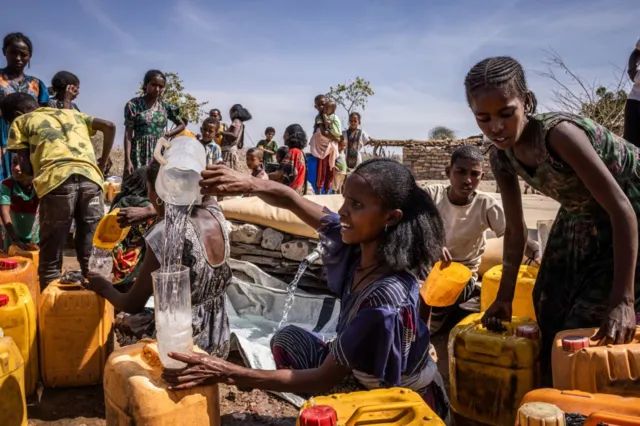
A humanitarian crisis is unfolding in the north of Ethiopia, driven by drought, crop failure and continued insecurity in the aftermath of a brutal war.
With local officials warning that more than two million people are now at risk of starvation, the BBC has gained exclusive access to some of the worst affected areas in Tigray province, and analysed satellite imagery to reveal the full scale of the emergency the region now faces.
The month of July is a critical period for food security, when farmers need to plant crops to take advantage of the seasonal rains.

The satellite images we have identified show that reservoirs, and the farmlands they help irrigate, have dried up because the rains failed last year. They now need to be replenished by seasonal rains if farmers are to stand any hope of a successful season later in the year.
The images below are of the Korir dam and reservoir, about 45km (28 miles) north of the regional capital, Mekele.
A small lake with an artificial barrier, known as a micro-dam, is clearly visible in the first photograph, taken in June 2023. Below the dam is fertile land irrigated by the reservoir.
Systems such as this have been able to support more than 300 farmers growing wheat, vegetables and sorghum – a grain crop.
The lower image shows the same area in June 2024, with the reservoir empty and parched fields.
Without adequate rainfall, the irrigation system cannot operate and farmers are unable to survive off the land.
“Even though our dam has no water, our land will not go anywhere,” says Demtsu Gebremedhin who used to farm tomatoes, onions and sorghum.
“So we don’t give up and we hope we will go back to farming.”
Children facing malnutrition
The BBC has spoken to doctors at a hospital in the town of Endabaguna, some 20km (12 miles) south of Shire about their growing concerns.
“We’ve been treating increasing numbers of children in recent months,” says the hospital’s medical director, Dr Gebrekristos Gidey.
One woman – 20-year-old Abeba Yeshalem – gave birth prematurely as a result of malnutrition, he says.
 HICGI News Agency