
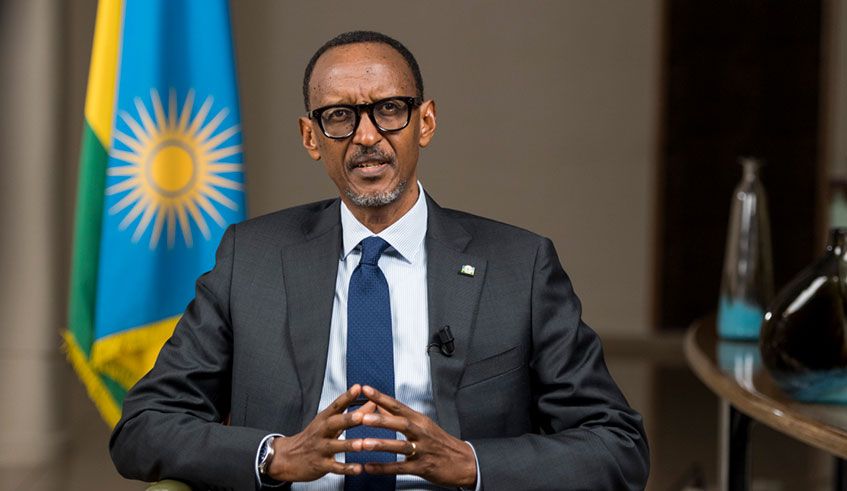
Paul Kagame has been sworn in for a fourth term as Rwanda’s president after winning 99% of the vote in last month’s election.
While some hail Mr Kagame for bringing peace and stability to his country after the 1994 genocide, others accuse him of running a repressive regime in a country where ordinary people are afraid to openly criticise him.
Rights groups say the margin of his electoral victory is proof of the lack of democracy in Rwanda.
Only two candidates were allowed to stand against Mr Kagame in the 15 July election.

Throughout his four presidential elections, he has consistently secured at least 93% of the vote. The inauguration ceremony was held in the packed Amahoro National Stadium in Kigali, which has a capacity of 45,000 and was attended by numerous African heads of state among the thousands present.
In his oath of office, Mr. Kagame committed to upholding peace and national sovereignty, and to fostering national unity. He also vowed not to exploit the powers given to him for personal gain, declaring, “Should I fail to honor this oath, may I be subjected to the rigors of the law.”
Mr. Kagame has been the dominant force in Rwanda since his rebel forces took control at the end of the genocide that resulted in the deaths of around 800,000 ethnic Tutsis and moderate Hutus, overthrowing the genocidal regime. Since then, Rwanda has enjoyed relative stability, with Mr. Kagame aiming to transform the country into the “Singapore of Africa.” Kigali is noted for being one of Africa’s cleanest cities, hosts the African Basketball League in partnership with the NBA, and welcomed international events like the Commonwealth Heads of Government Meeting in 2022, along with concerts by stars such as Kendrick Lamar.
Although Mr. Kagame frequently criticizes the West, he has also sought strategic alliances, such as the now-defunct agreement with the former UK Conservative government to deport asylum seekers to Rwanda. Despite improvements in Rwanda, Mr. Kagame faces accusations of destabilizing the neighboring Democratic Republic of Congo (DR Congo). A UN report released just before the July election revealed that around 4,000 Rwandan troops were in DR Congo, allegedly supporting the M23 rebel group, intensifying tensions between the two nations.
Under Mr. Kagame’s leadership, Rwandan troops have twice invaded DR Congo, claiming they were targeting Hutu militias connected to the 1994 genocide. Congolese President Félix Tshisekedi was notably absent from the inauguration. In his speech, Mr. Kagame seemed to blame Mr. Tshisekedi for not doing enough to combat Rwandan rebels in DR Congo, suggesting that without changes, mediation efforts would be ineffective. He appeared determined not to bow to external pressure regarding support for the M23 rebels.
 HICGI News Agency