
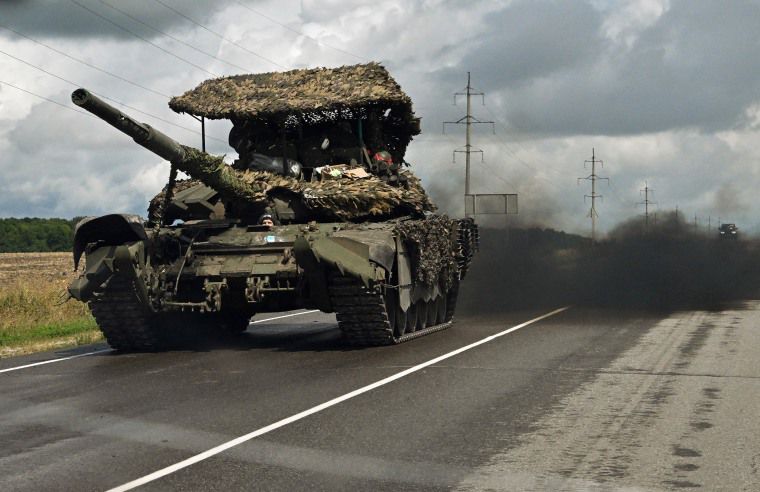
While “Z” serves as a symbol of Russia’s invasion, a triangle has become the emblem of Ukraine’s bold counteroffensive. Marked on the sides of every supply truck, tank, or personnel carrier heading toward the Russian border in the Sumy region, this symbol represents a significant Ukrainian effort. This offensive has reclaimed hundreds of square kilometers of Russian territory and noticeably boosted both momentum and morale within Ukraine’s war effort.
The Russian official responsible for the Kursk border region has reported that 28 settlements are now under Ukrainian control, with nearly 200,000 Russians displaced from their homes. Tomash, who has just returned from Ukraine’s cross-border operation, along with his comrade “Accord,” describes the experience with a casual “cool.” Their drone unit had spent two days facilitating the cross-border incursion.
Tomash, taking a break for coffee at a petrol station, admits, “We had orders to come here, but we didn’t fully understand what that entailed.” Their mission involved suppressing the enemy’s communication and surveillance capabilities to clear a path for the incursion.

The exact amount of Russian territory now under Ukrainian control remains unclear. There is skepticism regarding Commander-in-Chief Oleksandr Syrskyi’s claim of 1,000 square kilometers. While Russia’s defense ministry asserted on Tuesday that Ukrainian advances had been stopped, they have been proven wrong before. Despite the uncertainty, it is evident that Kyiv remains committed to this high-risk military strategy.
The level of activity in the neighboring Sumy region is unlike anything I’ve seen since the 2022 liberation, when there was a sense of momentum in Ukraine.
It’s undoubtedly a welcome departure from the grinding war of attrition of the last 18 months, but to label it a success or failure would be premature.
The offensive’s goal is unclear, but President Volodymyr Zelensky aims to target sites from which Russia can launch attacks on Ukraine to bring “a just peace” closer.
But Kyiv is deploying some of its best troops.
Fit soldiers gather around muscular vehicles, politely declining to talk; some look exhausted.
Months of planning went into compelling Moscow to relocate troops from other parts of the Ukrainian front line, a soldier in Russia reveals over the Telegram messaging app.
“The element of surprise was effective,” he said. “We entered easily with little resistance. On August 6, the initial groups crossed at night in multiple directions.”
“Almost immediately they reached the western outskirts of the city of Sudzha,” he adds.
With operations like this, secrecy suits the soldiers carrying them out. The same cannot be said for civilians.
On both sides of the border, tens of thousands are being evacuated after an increase in air strikes and fighting.
“The Russian civilians we encounter don’t resist,” explains the soldier. “We don’t touch them, but they either treat us sharply, negatively, or not at all.”
“They also deceive us about the positions of Russian troops,” he adds.
The soldiers we speak to confirm that Russian forces have indeed been redeployed from the eastern front line, including the Kharkiv, Pokrovsk and Toretsk directions.
But none of them are reporting a slowing of Russian advances, yet.
Vladimir Putin has promised a “worthy response” to the first capture of Russian territory since World War Two.
But any fear he intended to spread has not reached the dusty border settlements habitually bombed by his forces.
Misha and his friend Valera pass us in their orange Lada in the village of Stetskivka.
“I want them to take it [Kursk region] and do this!” says Misha, making a twisting gesture with his hands.
“They should take everything, even Moscow!”
It’s an anger anchored in being on the receiving end of Russia’s relentless full-scale invasion which began in February 2022.
“Russia attacked first, not us,” chimes in Valera with his window down. “Now our guys have responded and shown what we’re capable of. We’d have captured it earlier if we’d had permission.”
Ukraine, it seems, finally has the Western green light it had been yearning for to strike across the border.
The stakes are still dauntingly high, as illustrated by new defences being built on the outskirts of Sumy city.
Until last week, the area had been fearing a Russian offensive in Ukraine’s north. If Ukraine’s incursion fails, those worries could be realised quickly.
Ukrainian forces were, and still are, outnumbered by the Russian aggressors.
“For us to keep hold of this Russian territory we need two things,” writes our Ukrainian soldier on enemy soil.
“More towns like Sudzha under our control, and reserves,” he says.
“Our front line is already bursting at the seams, and it’s not clear where we will get them.”
For Kyiv, the logic or hope is that Russia is forced to switch focus from fighting on Ukrainian soil to its own.
Some in Ukraine believe this counter-offensive could even boost its position in any future peace negotiations.
It could equally push talks even further away.
 HICGI News Agency