
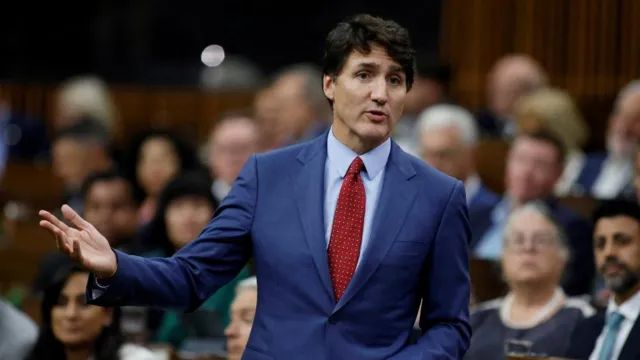
Canadian Prime Minister Justin Trudeau is set to confront a no-confidence vote in parliament, a motion that could potentially topple his Liberal government and prompt a new election. However, the motion is widely expected to fail, as key opposition parties have indicated their refusal to support it.
This no-confidence vote, scheduled for Wednesday afternoon, marks the first in a series anticipated from the opposition Conservative Party, which has been capitalizing on Trudeau’s declining approval ratings.

Over the past few months, Trudeau’s popularity has plummeted, with recent polls showing his approval dropping from 63% at the beginning of his term to just 28% in June. This decline is largely attributed to concerns over housing affordability and rising living costs.
Trudeau, who has led Canada for nine years, currently heads a minority government. His administration’s stability was bolstered by a coalition agreement with the New Democratic Party (NDP), which collapsed earlier this month when NDP leader Jagmeet Singh criticized the Liberals as “too weak” and “too selfish” to govern effectively. The loss of support from the NDP has intensified scrutiny on Trudeau’s leadership.
In the upcoming vote, the Conservative Party, which holds 119 seats, is expected to support the motion. However, both the NDP and Bloc Québécois, who together hold a significant number of seats, have announced their intention to vote against it.
The Liberal Party, with 153 seats, will also oppose the motion. To pass, the no-confidence vote would require a majority of the 338 members of parliament.
As Trudeau prepares for the vote, he will also be hosting French President Emmanuel Macron, highlighting the tensions in Canadian politics as his government faces significant challenges.
Despite the likelihood of the motion failing, the increasing pressure on Trudeau to step down reflects the turbulent political landscape in Canada, particularly as his party suffered losses in crucial by-elections in Toronto and Montreal this summer.
 HICGI News Agency