
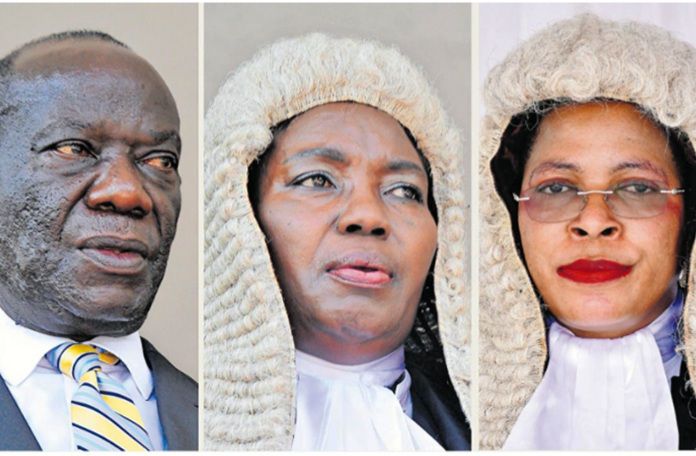
The role of Speaker of Parliament in Uganda has long been central to the country’s democratic processes. However, recent events and critiques have cast doubt on the fairness and independence of the individuals who have occupied this pivotal position.
Former Speakers Edward Ssekandi and Rebecca Kadaga, along with the current Speaker Anita Among, have come under scrutiny for their handling of parliamentary affairs, with critics accusing them of exacerbating the country’s democratic challenges.

Anita Among: A Speaker Under Fire
In recent weeks, the actions of Speaker Anita Among have drawn significant criticism, particularly after a chaotic incident in Parliament. The House was stormed by security forces, turning the legislature into a battleground as Members of Parliament (MPs) clashed both verbally and physically. Critics argue that Among’s leadership style has stifled genuine parliamentary debate and escalated tensions within the chamber. The use of force by security forces in Parliament has raised alarm, with many questioning the Speaker’s role in allowing such an environment to persist.
Among’s tenure has also been marked by accusations of aligning too closely with the executive branch, undermining the independence of Parliament. In instances where the interests of the ruling government were at odds with parliamentary deliberations, Among’s actions have sometimes been perceived as subservient to President Yoweri Museveni’s wishes, further eroding the public’s trust in the institution.
Rebecca Kadaga: A Promising Start, A Controversial End
Former Speaker Rebecca Kadaga, who served as Speaker from 2011 to 2021, entered the position with high expectations. Initially, Kadaga was hailed for her strong leadership and vocal stance on ensuring the autonomy of Parliament. Her supporters viewed her as a champion of the institution’s independence, and many hoped she would foster more vibrant democratic debate.
However, Kadaga’s legacy has been tainted by several controversial actions during her tenure. One of the most criticized was her handling of the controversial age limit bill in 2017. Despite widespread opposition, Kadaga oversaw the passage of the bill, which removed the presidential age limit, a move that paved the way for President Museveni to extend his rule beyond the constitutional age cap. Kadaga’s decision to push the bill through Parliament, despite protests from both within and outside the House, led to accusations that she was dancing to the tunes of the executive, rather than upholding parliamentary independence. Dr. Nabwiso, a prominent commentator, argues that Kadaga began with many promises but ended up disappointing her critics and allies alike.
Kadaga’s tenure was also marked by accusations of authoritarianism, as she sometimes employed heavy-handed tactics to maintain control of Parliament. Her detractors claim that, over time, she became less responsive to opposition voices and increasingly aligned herself with the President’s agenda. Critics argue that this shift contributed to a stifling of democratic discourse in Uganda.
Edward Ssekandi: A Legacy of Submission to Executive Control
Edward Kiwanuka Ssekandi, who served as Speaker and he also faces criticism for his perceived subordination to President Museveni’s directives. One of the most contentious moments of Ssekandi’s tenure came in May 2005, when he allowed military forces to enter Parliament to expel then-Major General Henry Tumukunde. Tumukunde had been a vocal critic of the government, and his removal from Parliament was seen by many as a political maneuver aimed at silencing dissent within the legislature.
Ssekandi’s tenure was also marked by his unwavering support for the ruling party and the executive, which led to accusations that Parliament was functioning more as a rubber-stamp institution rather than a body capable of holding the government to account. His critics argue that Ssekandi’s leadership enabled a culture of executive dominance over Parliament, further entrenching the country’s authoritarian governance structure.
A Deep-Rooted Problem: Institutional Failures and Personal Actions
While structural and institutional problems in Uganda’s democracy undoubtedly play a role in the current malaise, the actions of individual Speakers of Parliament have, in many ways, compounded these issues. The recurring pattern of Speaker-led alignment with the executive has led to a situation where Parliament, rather than serving as a check on the power of the President, has often been complicit in consolidating that power.
The office of the Speaker, which should ideally be a pillar of democratic oversight, has at times been a key player in the erosion of parliamentary independence. Whether it is Anita Among’s recent handling of the parliamentary storm, Rebecca Kadaga’s controversial passage of the age limit bill, or Edward Ssekandi’s submission to presidential authority, the history of Speakers in Uganda reflects an ongoing struggle between maintaining institutional autonomy and succumbing to executive influence.
As Uganda moves forward, the question remains: can the Speaker of Parliament ever be truly independent, or will the institution continue to be a tool in the hands of the executive? The answer may depend not only on the individuals who occupy the position but also on the broader political and institutional reforms needed to restore the integrity of Uganda’s democracy.
Invest or Donate towards HICGI New Agency Global Media Establishment – Watch video here
Email: editorial@hicginewsagency.com TalkBusiness@hicginewsagency.com WhatsApp +256713137566
Follow us on all social media, type “HICGI News Agency” .
 HICGI News Agency