
By Anastasios Gordon Sekandi, Ernest Benjamin Kivumbi and AU Press Unit. EAT 22:15. Thursday, January 09, 2025.

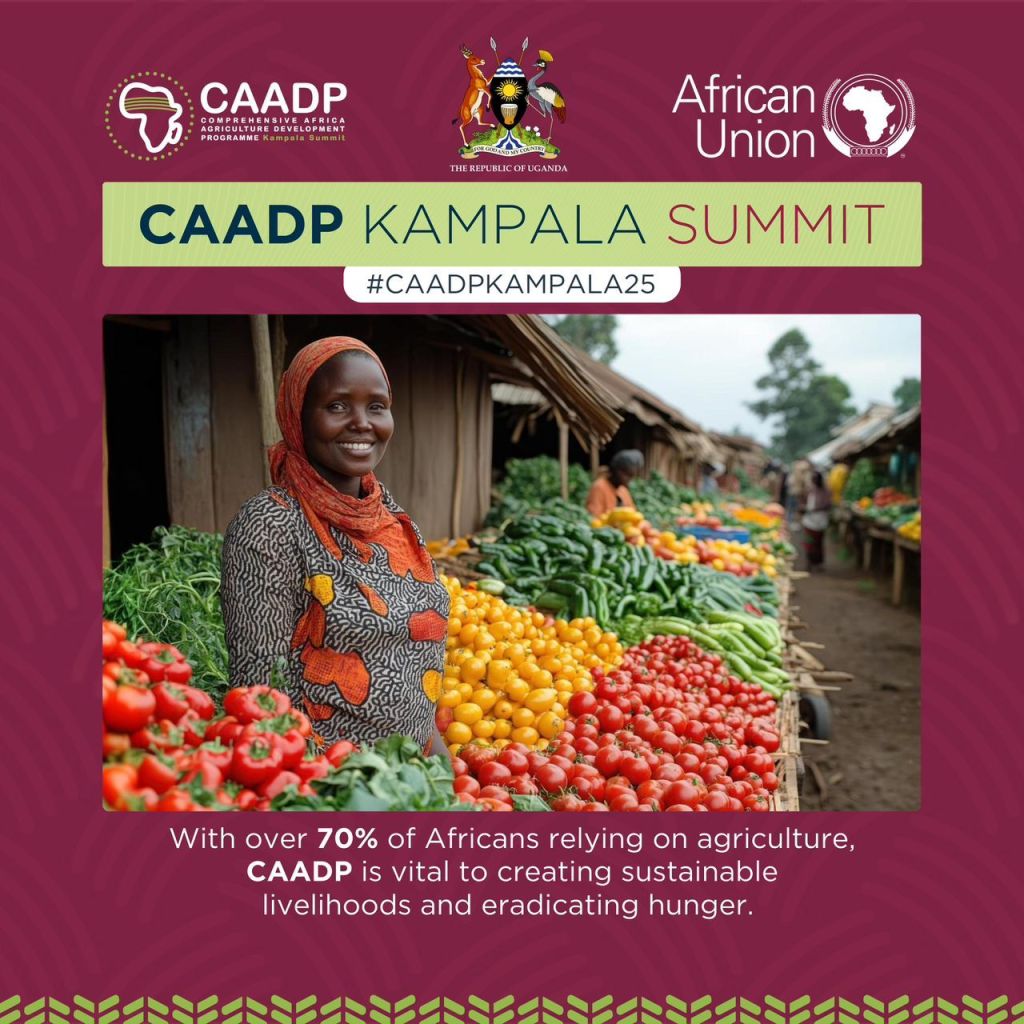
MUNYONYO, UGANDA-Ministers of Agriculture from the African Union’s (AU) 55 member states have convened in Kampala, Uganda, for a three-day Extraordinary Summit aimed at advancing agricultural transformation and strengthening food systems across the continent. The summit, taking place in Uganda’s capital, will culminate in the adoption of the Kampala Declaration and a groundbreaking 10-year strategy and action plan designed to accelerate the implementation of the Malabo Declaration on Accelerated Agricultural Growth and Transformation for Shared Prosperity and Improved Livelihoods, which was originally adopted in 2014.
The new Comprehensive Africa Agriculture Development Programme (CAADP) Strategy and Action Plan, spanning 2026–2035, has been in development for the past 10 months under the directives of African Heads of State and Government. This initiative aims to address key challenges in agriculture, strengthen resilience in food systems, and enhance livelihoods across the continent. The adoption of this strategy is expected to be a pivotal step toward achieving Africa’s long-term agricultural and food security goals.

The drafting of the strategy was a collaborative effort involving a diverse range of stakeholders, including Regional Economic Communities (RECs), African experts and researchers, farmers’ organizations, development partners, parliamentarians, private sector groups, women in agriculture, and youth organizations. Following its development, the draft underwent a comprehensive review process, including evaluations by the African Union’s Specialized Technical Committee (STC) on Agriculture, Rural Development, Water, and Environment (ARDWE). The finalized strategy aligns with the 2021 African Common Position to the United Nations Food Systems Summit and serves as a framework for advancing sustainable agri-food systems across the continent.
The CAADP Strategy and Action Plan aims to harness resources to drive economic growth, enhance food security, and improve livelihoods, all while addressing the challenges posed by climate change in adherence to CAADP principles. The plan focuses on stimulating investment, fostering strategic partnerships, and empowering vulnerable smallholder farmers, ensuring their inclusion in Africa’s agricultural transformation journey.

The 10-year strategy is closely aligned with the African Union’s Agenda 2063, which envisions a prosperous Africa driven by inclusive growth and sustainable development. A key focus of Agenda 2063 is achieving food security and nutrition, transforming agriculture into a leading driver of economic growth, and reducing the continent’s dependence on food imports.
Africa’s food security challenges remain acute, compounded by climate change, conflicts, rapid population growth, and economic disruptions. Currently, over 280 million Africans face chronic hunger, while food systems struggle to keep pace with rising demand. The CAADP Strategy and Action Plan aims to tackle these challenges through the promotion of climate-resilient agriculture, improved infrastructure, reduced food waste, and enhanced regional trade in agricultural goods. By implementing these measures, the strategy seeks to position Africa to sustainably feed itself and foster long-term agricultural and economic resilience.

The Rt. Hon. Robinah Nabbanja, Prime Minister of the Republic of Uganda, emphasized Africa’s untapped agricultural potential, citing the continent’s rich soils, abundant arable land, vast freshwater resources, and a population where 60% are engaged in agriculture. However, she lamented the irony that Africa’s food imports cost up to USD 100 billion annually.
“This session of the Summit must deliver concrete proposals to help Africa overcome this undesirable situation,” she stated. “To secure our future as Africans, we must prioritize feeding ourselves.”
H.E. Ambassador Josefa Sacko, Commissioner for Agriculture, Rural Development, Blue Economy, and Sustainable Environment at the African Union Commission, highlighted the transformative potential of the CAADP strategy. She noted that the strategy is designed to:
●Boost food production and value addition,
●Expand intra-African trade,
●Create millions of jobs for youth and women,
●Build inclusive agrifood value chains, and
●Establish resilient and sustainable agrifood systems capable of withstanding shocks and stressors.
Ambassador Sacko further emphasized the importance of strengthening governance through evidence-based decision-making and enhancing accountability among stakeholders. She underscored the strategy’s commitment to inclusivity, ensuring that women, youth, and marginalized groups have equitable access to resources and opportunities within the agrifood sector. “This inclusive approach is vital for creating a thriving, self-reliant Africa,” she concluded.
H.E. Dr. Girma Amente, Minister of Agriculture of the Federal Democratic Republic of Ethiopia, highlighted Ethiopia’s success in integrating the Comprehensive Africa Agriculture Development Programme (CAADP) into its National Agricultural Investment Plan (NAIP). Dr. Amente noted that Ethiopia, under the leadership of Prime Minister Dr. Abiy Ahmed, the CAADP Champion, has prioritized public investment in agriculture to meet the program’s targets.
“The plan underscores the critical role of increased public investment in agriculture for achieving CAADP objectives. Ethiopia has substantially increased its agricultural budget allocation and consistently met the 6% annual growth target set by CAADP. Through the implementation of the NAIP, Ethiopia has achieved steady improvements in agricultural production, including higher crop yields, enhanced food and livestock output, and progress in meeting CAADP’s resilience targets,” he stated.
Hon. Frank Tumwebaze, Uganda’s Minister of Agriculture, Animal Industry, and Fisheries, who spearheaded the drafting of the CAADP Strategy and Action Plan as Chair of the AU’s Specialized Technical Committee on Agriculture, Rural Development, Water, and Environment, emphasized the urgency of transitioning from planning to execution.
“The planning phase of the Kampala CAADP Agenda ends with this Summit. We must now move into implementation and execution mode. Only by focusing on execution can we create meaningful impact for our continent and its people. We must act not just with the times but ahead of the times, leveraging advancements in technological research, building resilient agricultural systems to withstand climate change and other shocks, and fostering agro-industrialization,” Tumwebaze urged.
The second day of the summit, January 10, will focus on deliberations by Ministers of Foreign Affairs. The summit will conclude on January 11 with a meeting of Heads of State and Government, where the final adoption of the strategy is expected.
Invest or Donate towards HICGI New Agency Global Media Establishment – Watch video here
Email: editorial@hicginewsagency.com TalkBusiness@hicginewsagency.com WhatsApp +256713137566
Follow us on all social media, type “HICGI News Agency” .
 HICGI News Agency