
By Anastasios Gordon Sekandi – updated at 16:24 EAT Friday January 2025
South Africa and Rwanda’s already tense diplomatic relations have further deteriorated after President Cyril Ramaphosa accused the Rwandan-backed M23 rebel group of killing South African peacekeepers in eastern DR Congo.
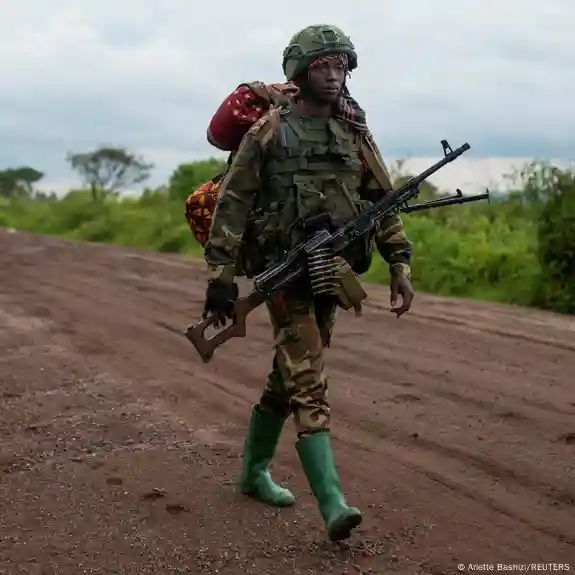
As the M23 rebels gained the upper hand on the battlefield, seizing most of Goma—the largest city in eastern DR Congo—South Africa escalated tensions with a diplomatic warning, declaring that any further attacks on its troops would be considered a ‘declaration of war.’
Rwandan President Paul Kagame swiftly hit back, accusing South Africa of being part of a ‘belligerent force’ engaged in ‘offensive combat operations’ to support the Congolese government in fighting ‘its own people.’

A total of 13 South African soldiers have been killed since last week as M23 rebels launched a swift advance toward Goma, a key trading hub on the Rwandan border.
This follows last year’s deadly clashes in eastern DR Congo, where seven South African troops lost their lives—marking one of the country’s most significant combat losses in recent history.

South Africa and Rwanda have long shared a strained relationship.
In 2014, tensions flared when South Africa expelled three Rwandan diplomats following an attack on the Johannesburg home of an exiled Rwandan dissident. In retaliation, President Paul Kagame’s government expelled six South African envoys.
Relations appeared to improve after President Cyril Ramaphosa visited Rwanda last year for the 30th anniversary of the 1994 genocide, which claimed around 800,000 lives. However, the recent escalation in DR Congo has reignited diplomatic friction between the two nations.
However, tensions have reignited following the deaths of South African soldiers deployed to eastern DR Congo in December 2023 as part of a regional peacekeeping mission under the Southern African Development Community (SADC).
South African soldiers form the backbone of the force known as SAMIDRC, which was deployed to the Democratic Republic of the Congo (DRC) with the mission of repelling armed groups like M23 and restoring peace to the mineral-rich region after decades of conflict.
The latest diplomatic fallout began with a post on President Cyril Ramaphosa’s X account, in which he confirmed speaking with Rwandan President Paul Kagame about the escalating violence. Ramaphosa stated that both leaders had agreed on “the urgent need for a ceasefire and the resumption of peace talks by all parties to the conflict.”
In a later statement, Ramaphosa insisted that the presence of South African troops in the DRC was not a “declaration of war against any country or state”—a remark seemingly directed at Rwanda. However, South Africa’s Defence Minister, Angie Motshekga, offered a slightly different perspective, telling reporters: “There have been no hostilities between us, but when they were firing above our heads, the president did warn them that if they continued, we would take it as a declaration of war.”
Ramaphosa went further on X, stating that South African peacekeepers had been killed in attacks carried out by M23 and—he notably added—the “Rwanda Defence Force (RDF) militia.”
This statement enraged Kagame, who accused South African officials, including Ramaphosa, of spreading “lies and distortions.”
“The Rwanda Defence Force is an army, not a militia,” Kagame responded on X. “President Ramaphosa has never given a ‘warning’ of any kind, unless it was delivered in his local language, which I do not understand. He did, however, ask for support to ensure that South African forces had adequate electricity, food, and water, which we will help facilitate.”
Kagame further claimed that Ramaphosa had personally told him that M23 was not responsible for the deaths of South African soldiers, instead blaming the Congolese army (FARDC).
The Rwandan leader also accused the regional peacekeeping force—comprising troops from Tanzania, Malawi, and South Africa—of being a “belligerent force” aligned with “genocidal armed groups” that threaten Rwanda. According to Kagame, they “have no place in this situation.”
Concluding his statement, Kagame dismissed South Africa’s role as a mediator, asserting that the country was in “no position to take on the role of a peacemaker.” He warned that if South Africa sought confrontation, Rwanda would be ready to “deal with the matter in that context any day.

Kagame’s remarks strongly suggested that he wants South Africa to scale back its involvement in the Democratic Republic of the Congo (DRC), where its military presence dates back to the late 1990s.
South Africa first joined the UN peacekeeping mission, MONUSCO, after the fall of apartheid in 1994. At the time, its military was transitioning from a “highly effective apartheid wartime force” to a “peacetime force” struggling with budget cuts and “a lack of political direction,” according to Thomas Mandrup, an associate professor at Stellenbosch University.
While South Africa has framed its involvement in the Democratic Republic of the Congo (DRC) as an effort to “contribute to the stability” of a fellow Southern African Development Community (SADC) member, defence analyst Dean Wingrin argues that economic interests have also played a key role in its decision.
“The DRC is a major trading partner for us, particularly because eastern DRC is so rich in minerals. We import a significant amount of minerals from there, so South Africa has a vested interest in a peaceful DRC,” Wingrin told the local media.
While MONUSCO’s mission has primarily focused on peacekeeping, escalating tensions in the region led to the establishment of the Force Intervention Brigade (FIB) in 2013. Unlike traditional peacekeeping forces, the FIB was tasked with “actively engaging” the numerous armed groups in eastern DRC.
Initially, this intervention was successful in pushing back M23, one of the most prominent rebel groups. A key factor in this success was South Africa’s deployment of its Rooivalk attack helicopters, which had a “devastating effect” on M23 in a short period, according to Wingrin.
As a result, the rebels were effectively driven out of eastern DRC—until their recent resurgence, during which they have seized large swathes of territory.
This time, however, South Africa’s military has been unable to halt M23’s advance due to a critical loss of airpower.
“Unfortunately, South Africa’s defence budget has continued to decline over the years, and the air force could no longer afford to maintain the Rooivalk fleet,” Wingrin said.
“We’re missing that vital air cover that would have been invaluable just days ago—but now, it’s far too late,” he added.

Mr. Mandrup echoed similar concerns, arguing that South Africa deployed its troops in 2023 despite warnings that “it lacked the necessary capabilities, the defence force was in shambles, and it was facing an opponent far better equipped than in 2013.”
He noted that withdrawing the troops at this stage would be extremely difficult, as “the forces are locked down and trapped in two bases.”
“They can’t get out, they have no air cover or reinforcements, and they can’t even evacuate the wounded,” he said.
President Cyril Ramaphosa appeared to acknowledge the dire situation, recently describing the region as “tense, volatile, and unpredictable.” His spokesperson told the local News24 website that any decision to withdraw South African troops would ultimately rest with SADC, as the mission had been authorized by the 16-member regional bloc.
Meanwhile, Daily Maverick quoted unnamed sources suggesting that SADC leaders are likely to decide at a summit on Friday to withdraw troops following the intense battles that saw M23 rebels capture Goma.
“We need all parties to agree to a ceasefire. Then, we need a clear roadmap for peace talks. Once those talks resume in earnest and a ceasefire is in place, we can begin a gradual withdrawal,” a South African source was quoted as saying.
For Wingrin, the crisis demands “serious introspection” from the South African government regarding its military engagement in the DRC.
“Is this a mission they are willing to pursue at all costs? And what is it worth to South Africa to see its sons and daughters dying so far from home?” he asked.
Ramaphosa now faces a difficult choice—keep South African troops in the DRC and risk further casualties or endure the humiliation of pulling them out, likely after negotiating a safe exit with Rwanda.
Invest or Donate towards HICGI New Agency Global Media Establishment – Watch video here
Email: editorial@hicginewsagency.com TalkBusiness@hicginewsagency.com WhatsApp +256713137566
Follow us on all social media, type “HICGI News Agency” .
 HICGI News Agency