
HICGI News Agency – Updated at 1709 EAT on Wednesday 19th February 2025
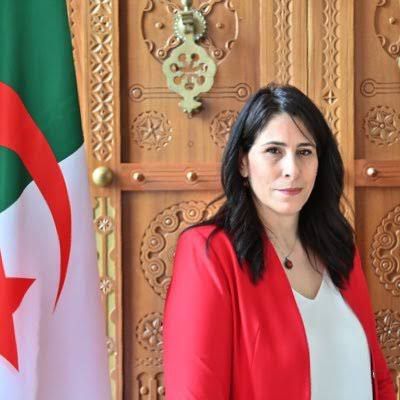
The Election of Algeria to the vice president of the African Union Commission has an important cecular meaning and a historical message according to the Algerian ambassador to Uganda H.E Mourad Amokrane. This election has very well concretized the principle of the historical leaders “Africa for Africans”.
Algerian diplomat Selma Malika Haddadi managed to win on February 15th in Addis Ababa, the highly coveted post of vice president of the African Union, against Moroccan Latifa Akherbach, with 33 votes to 22.
Algeria inflicts a new resounding diplomatic defeat of Morocco. Algerian candidate Selma Malika Haddadi won, on Saturday, February 15th, the post of vice president of the commission of the African Union (AU) against her Morrocan rival, Latifah Akharbach.
The duel between the two, even overshadowed the election of the presidency of the African Union, (Pan-african political organization bringing together, 55 member states) , which went to Djibouti’s Ali Mahmoud Youssouf.
Former ambassador to Kenya and Sudan, the new vice president will be responsible for issues of Peace, Security, and economic development. A frik indicates that this election, according to observers, “demonstrates a growing influence of Algerian diplomacy in Africa”
The 47 year old Algerian diplomat brilliantly beat the Moroccan candidate at the end of a vote in which she found herself the only candidate in the seventh round. For Algeria, this is a resounding diplomatic success, especially since It was achieved against a country whose strategy consisted of blocking Selma Malika Haddadi’s path with methods that shocked, many African diplomats and Heads of State present in a Addis Ababa. Morocco wanted to make Salma Malika haddadi lose.
“Morroco wanted to make the Algerian candidate lose, by all means. It did not present a candidate to win but to block the Algerian diplomat’s path to the African Commission. This is unprecedented, ” an Algerian Source is surprised.
Initially, four North African countries each presented a candidate: Algeria, Morocco Egypt, and Libya.
The Libyan representative withdrew in the first round and the Egyptian was eliminated in the third round. In the sixth round Selma Malika ousted the Moroccan candidate to find herself alone in the running of the seventh round and win the elections hands down.
In it’s Diplomatic battle Egypt, played and lost. It’s tried to take advantage of the Algerian- Moroccan rivalry to seize this position but its strategy did not work.
Morrocan Maneuvers against Algeria in Addisababa.
Faced with Algeria’s chances of success, Morrocco tried everything to convince African countries not to vote for Selma Malika Haddadi. To block the Algerian diplomat’s path, the kingdom offered to withdraw with Algeria, to let the Egyptian candidate win. But Algerian response was scathing: “It’s a completion and it’s up to the ballot boxes to decide. “
Morocco which dispatched, its Minister of Foreign Affairs and the head of foreign intelligence, returned covered in shame from Addis Ababa. “The Makhzen tried everything to convince African countries to vote against Algerian candidate. It gave gold bars, envelopes, full of money not to mention commitments to take care of luxury hotels.” some sources report.
Morocco returned empty-handed from Addis Ababa:
The Morrocan strategy of inflicting a diplomatic defeat on Algeria has shattered against the aula of Algerian diplomacy in Africa. It’s attempts to corrupt African countries, including the continent’s powerful ones have failed.
Algeria under the leadership of President Abdelmadjid Teboune, current president of the African Peer Review Mechanism, who traveled to Addis Ababa to chair this mechanism has granted a sum of 1 million dollars for the proper functioning of this AU mechanism.
AU Summit: Signing of a Memorandum of Understanding on the Financial Contribution Decided by Algeria for the APRM:
A Memorandum of Understanding on the contribution of 1 million dollars, decided by Algeria for the benefit of the African Peer Review, Mechanism (APRM) in order to promote good governance in Africa was signed on Sunday in Addis Ababa by the Secretary of State, to the Foreign Affairs, in charge of African Affairs. Selma Bakhta Mansouri and the Executive Director of the Continental Secretariat of the Mechanism, Marie- Antoinette Rose Quatre, on the sidelines of the work of the 38th Summit of the African Union.
The signing of the memorandum of understanding follows the announcement made by the president of the Republic, Mr. Abdelmadjid Teboune, during the 34th Summit of Heads of State and Government of the African Peer Review Mechanism held on Friday, under his presidency to support this evaluation mechanism with a voluntary contribution of 1 million dollars.
The secretary of State reiterated, on the occasion Algeria’s commitment as a founding member of the APRM and under the good leadership of the president of the republic, to reactivate the mechanism to face the challenges of governance in Africa. In particular, the concentration of the supremacy of the law, the fight against corruption and the promotion of democratic values.
Expressing her “immense gratitude” to Algeria, which decided to make a voluntary contribution to support the APRM. Ms. Rose Quatre, reaffirmed that this gesture testifies to “Algeria’s unwavering dedication to African Unity and cooperation”.
“I would like to express my sincere gratitude to Algeria for each confidency in the APRM and for it’s unwavering commitment to pan-africanism, African Renaissance and the rapid realization of the aspirations of our people as set out in our African Union Agenda 2063.” She stressed in a statement to the Press.
According to Ms. Rose Quatre, the contribution of the African of the Algerian government to this instrument will certainly enable the APRM to fulfill its mandate, and Achieve its tangible results.
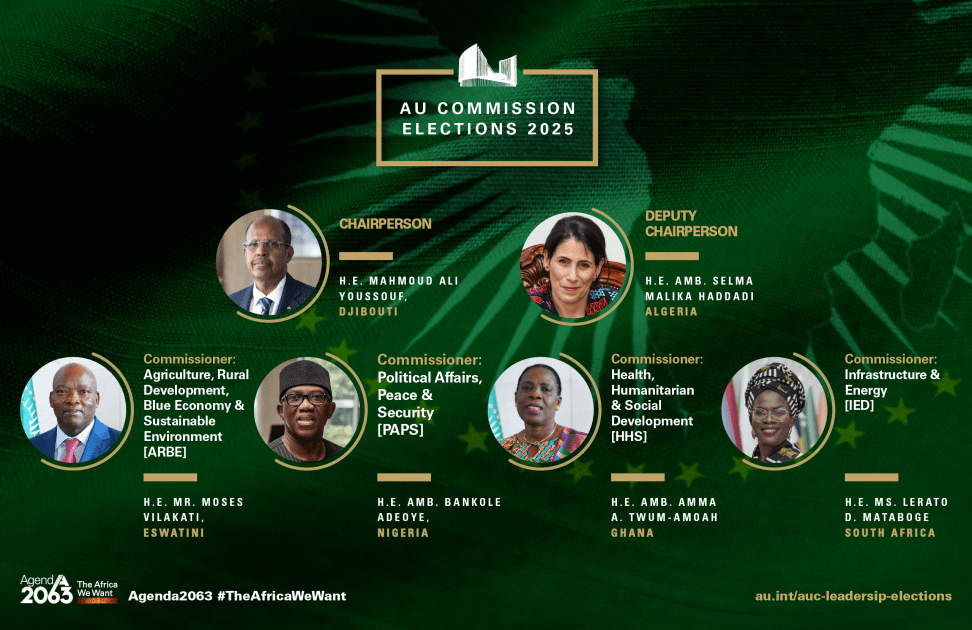
H.E. Mahmoud Ali Youssouf, (Djibouti, Eastern Region) was elected as the Chairperson of the African Union Commission. He will be to be deputised by H.E. Selma Malika Haddadi (Algeria, Northern Region). Both mandates are for four years, renewable once.
The two leaders were elected and sworn in at the 38th Ordinary Session of the Assembly of Heads of State and Government that took place from 15 to 16 February 2025. Both elected officials garnered the required two thirds majority votes of the 49 member states eligible to vote. 6 AU member states are under sanctions and therefore ineligible to vote.
60-year-old H.E. Mahmoud Youssouf will take over from the outgoing Chairperson H.E. Moussa Faki Mahamat (Chad, Central Region) who has served for two consecutive terms since 2017. H.E. Mahmoud Youssouf is the Minister of Foreign Affairs for the Republic of Djibouti and has previously served as both the Chairperson of the Council of Ministers of the Arab League and the Organisation of Islamic Cooperation (OIC) among key other roles. He was competing against H.E. Raila Amolo Odinga, Former Prime Minister of the Republic of Kenya and H.E. Richard Randriamandrato, Former Foreign Affairs Minister of the Republic of Madagascar.
The Chairperson of the AUC is the Chief Executive Officer, legal representative of the AU and the AU Commission Chief Accounting Officer. The Chairperson is elected by the Assembly for a four-year term, renewable once. The Chairperson’s functions, include, among others, the overall responsibility for the Commission’s administration and finances; promoting and popularising the AU’s objectives and enhancing its performance; consulting and coordinating with key stakeholders like Member States, Regional Economic Communities (RECS), and development partners, among other stakeholders; appointing and managing Commission staff; and acting as a depository for all African Union and the Organization of African Unity treaties and legal instruments.
H.E. Selma Malika Haddadi will take over from H.E. Dr. Monique Nsanzabaganwa (Rwanda, Eastern Region) who was elected in 2021, becoming the first female Deputy Chairperson. 47-year-old, H.E. Selma Haddadi is career diplomat and the current Ambassador of Algeria to Ethiopia and the Permanent Representative to the African Union and the United Nations Economic Commission for Africa, UNECA. She is also a legal expert.
In line with the principle of gender rotation which dictates that if the Chairperson of the AU Commission is male, the Deputy Chairperson is female and vice versa, all male candidates competing for the Deputy Chairperson post were disqualified after the election of H.E Mahmoud as Chairperson, leaving Ms. Latifah Akharbach (Morocco), Ms. Hanan Morsy (Egypt), and Ms Najat Elhajjaji (Libya) as the other contestants competing with H.E. Selma Haddadi for the position of Deputy Chairperson. Following the withdrawal of the candidate from Libya, only 3 of the female candidates participated in race for Deputy Chairperson.
The Deputy Chairperson assists the Chairperson in the execution of his or her functions, to ensure the smooth running of the AU Commission, and oversees administration and finance functions. The Deputy acts as the Chairperson in his/ her absence.
The elections of the African Union Commission are governed by the AU Assembly Rules of Procedure and the AU Commission Statutes. The Deputy must not be from the same region as the Chairperson of the Commission. Additionally, the regions that provide the Chairperson and Deputy Chairperson do not contest for Commissioner positions of the African Union.
The elections of the Chairperson and Deputy Chairperson were held after the elections and appointments of the AU Commission Commissioners during the 46th Ordinary Session of the Executive Council of Ministers of Foreign Affairs- on 12 February 2025. Commissioners are elected for a four-year term, renewable once. 4 out of the 6 Commissioner positions available were elected. The following Commissioners were elected:
Amb. Bankole Adeoye (Nigeria, Western region) was re-elected to head the Political Affairs, Peace and Security (PAPS) department. In March 2021, he became the first Commissioner to lead the amalgamated Political Affairs, Peace and Security portfolios, which had hitherto, been two separate departments. He previously served as Nigeria’s Permanent Representative to the AU and UNECA and Ambassador to Ethiopia and Djibouti. He has also served as Chief of Staff for the African Union Development Agency (AUDA- NEPAD); Director of Corporate Services, and Coordinator, Partnerships & External Relations, as well as the Director in the International Organizations Department of the Ministry of Foreign Affairs of the Federal Republic of Nigeria.
Mr. Moses Vilakati (Eswatini, Southern region) was elected to head the Agriculture, Rural Development, Blue Economy and Sustainable Environment (ARBE) . He has served as a minister in Eswatini in both the Ministry of Tourism and Environmental Affairs, and the Ministry of Agriculture. Previously, he served as the Project Director at the Eswatini Water and Agricultural Development Enterprise among other accomplishments. He takes over from H.E. Josefa Leonel Correia Sacko (Angola, Southern Region) who served for two terms.
Ms. Lerato Mataboge (South Africa, Southern region) was elected as the Commissioner for Infrastructure and Energy (I&E) department. Ms Mataboge is a global policy and trade and investment facilitation expert and is currently the Deputy Director-General in the South African Department of Trade, Industry and Competition. Prior to this role, she founded and was CEO of Trade Invest Africa. She also serves on the Board of the Export Credit Insurance Corporation of South Africa (ECIC) as a non-Executive Director and is a member of the Finance and Investment Committee. She takes over from H.E. Amani Abou-Zeid (Egypt, Northern Region) who served for two terms.
Amb. Amma Twum-Amoah (Ghana, Western region) elected as Commissioner for Health, Humanitarian Affairs and Social Development (HHS) .
She is the former Ambassador of the Republic of Ghana to Djibouti, Eritrea, Ethiopia, Somalia and South Sudan and the Permanent Representative to the African Union. She previously served as the Director, Economic, Trade and Investment Bureau of Ghana’s Ministry of Foreign Affairs and Regional Integration and served as the Minister Plenipotentiary/Special Government Projects at the Embassy of Ghana in Washington, D.C., U.S.A, among other senior positions. She takes over from H.E. Amb. Minata Samate Cessouma (Burkina Faso, Western Region)
The elections for the Commissioner for Economic Development, Trade, Tourism, Industry and Mining (ETTIM) and Commissioner for Education, Science, Technology and Innovation (ESTI) were postponed. The incumbent Commissioners namely H.E. Amb. Albert Muchanga and H.E. Prof. Mohammed Belhocine respectively, will continue to serve in their current positions until the elections are conducted.
A Panel of Eminent Africans composed of five (5) personalities, one for each of the 5 regions of Africa, oversees the pre-selection of candidatures for the senior leadership of the AU Commission. The Panel of Eminent Africans, technically assisted by an independent African consultancy firm, develops job profiles and competency requirements for the senior leadership of the Commission. The assessment process for candidates vying for the positions of Commissioners is based on the skills and competencies identified for each portfolio.
Profile of H. E selma malika haddadi

Click here to read Selma’s Profile https://au.int/en/AUC_Elections_2025_Candidates
 HICGI News Agency