
By Earnest Kivumbi Benjamin & Rodney Muhumuza – Updated at 1259 EAT on Saturday 05th April 2025.
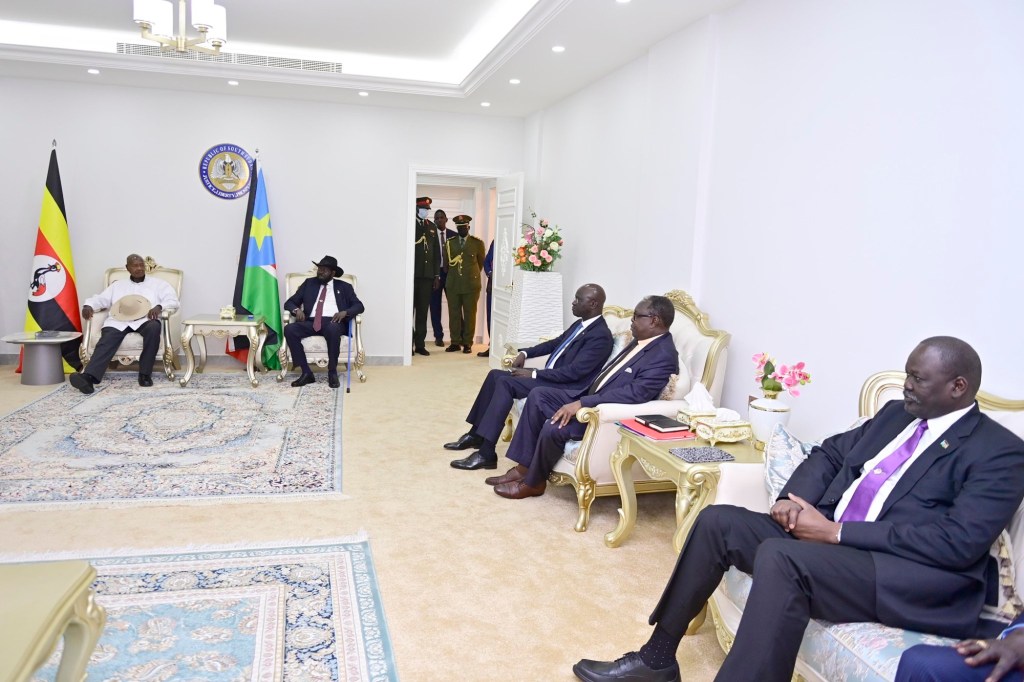




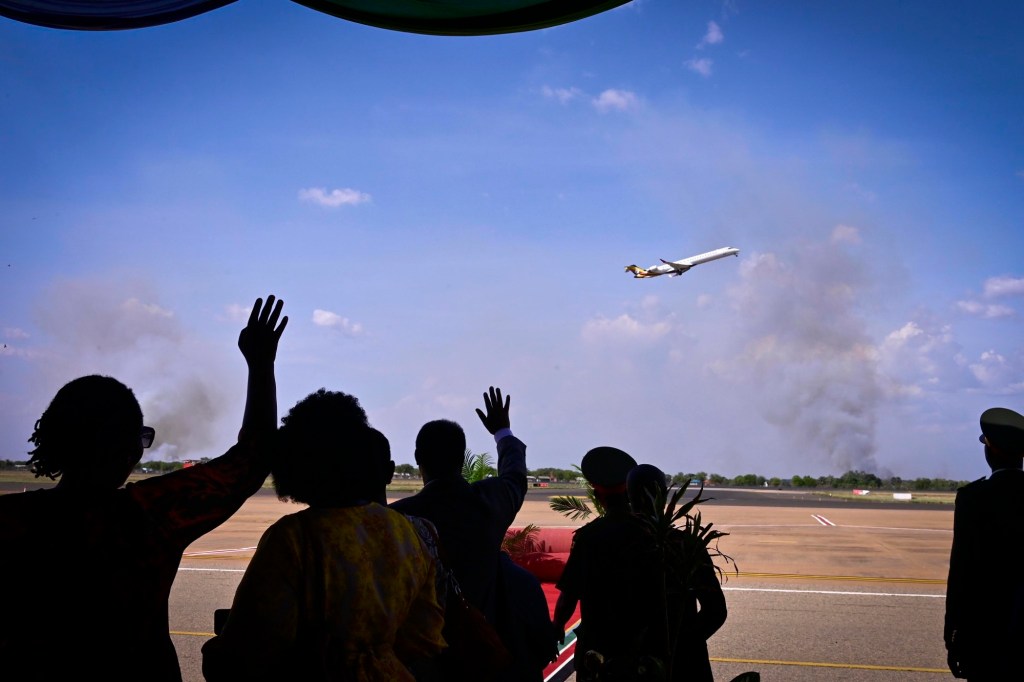
President Yoweri Kaguta Museveni on Friday departed South Sudan where he was on a two working State Visit at the invitation of His Excellency Salva Kiir Mayardit. During his visit, the two leaders held productive discussions on critical matters of peace, security, and the socio-economic landscape. A key focus was on harmonising trade policies and boosting cross-border trade between Uganda and South Sudan.
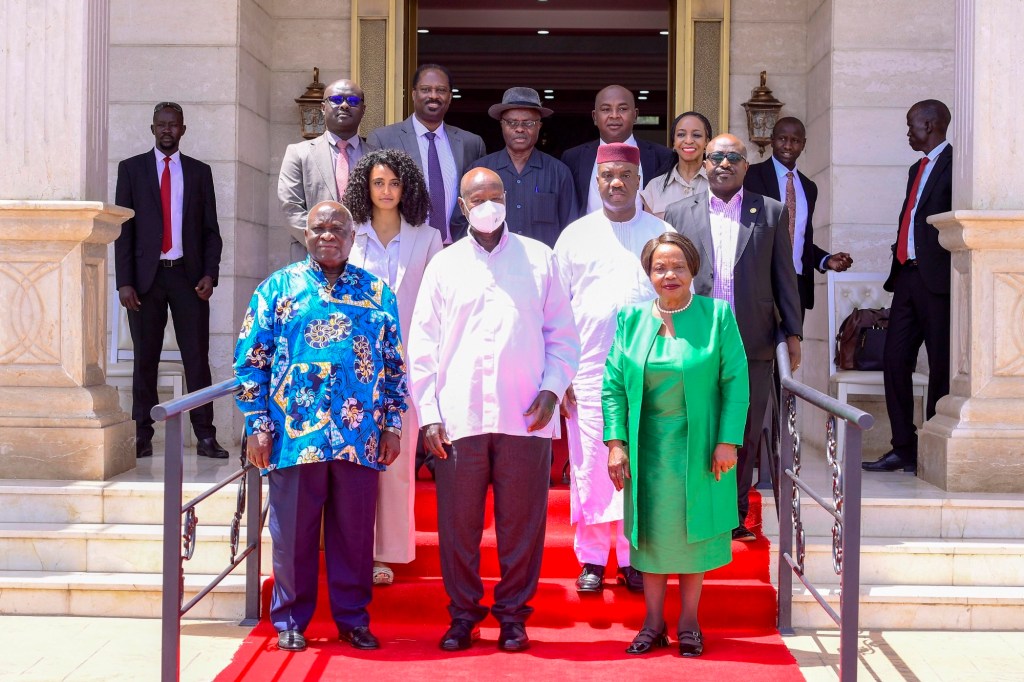
Before departing Juba, President Museveni met with a delegation from the African Union’s Panel of the Wise, led by former Burundian President H.E. Domitien Ndayizeye. Their discussions centred on the current security situation in South Sudan and the African Union’s role in supporting the peaceful implementation of the peace agreement.
Earlier, President Museveni also engaged with leaders of various political parties in South Sudan to exchange views on the political process and the way forward.
“I would like to thank His Excellency, President Salva Kiir, for his warm hospitality,” said President Yoweri Kaguta Museveni.

Tensions Escalate in South Sudan Following Arrest of Vice President Riek Machar
Tensions are on the rise in the oil-rich East African nation of South Sudan following the arrest of Vice President Riek Machar in the capital, Juba. His detention on Wednesday came after the arrests of several of his allies within the government and military, including the deputy chief of the army.
In response, Machar’s political faction declared on Thursday that the 2018 peace agreement—which has been the cornerstone of relative stability since the country’s brutal civil war—has effectively collapsed. This development has raised fears of renewed conflict, as government forces loyal to President Salva Kiir clash with soldiers and armed militias aligned with Machar.
What’s Behind the Rift Between Kiir and Machar?
President Salva Kiir and Riek Machar are long-time figures in the Sudan People’s Liberation Movement (SPLM), the former rebel group that led South Sudan to independence from Sudan in 2011. However, their relationship has been marked by deep ethnic and political divisions. Kiir belongs to the Dinka ethnic group—the country’s largest—while Machar hails from the Nuer, the second-largest.
Their rivalry dates back to the 1990s, when Machar led a breakaway faction that was accused of betrayal. During that period, forces loyal to him were involved in a massacre in Bor, targeting the Dinka population—an act that deeply angered Kiir and the SPLM’s late founding leader, John Garang. Although the two leaders later reunited in the fight for independence, the wounds of that betrayal never fully healed.
Analysts suggest the two remain locked in a fragile coexistence. Machar is seen as waiting his turn to assume the presidency, while Kiir has maintained a firm grip on power. Their power struggle erupted violently in 2013 when Kiir dismissed Machar from the vice presidency, citing an alleged coup plot. The resulting civil war killed an estimated 400,000 people.
What Does Machar Want?
Machar has held the position of vice president intermittently since 2011, but South Sudan has yet to hold national elections. As a result, he remains a deputy without real executive power.
His long-standing ambition to lead the country is also rooted in a tribal prophecy that foretells a left-handed man with a gap in his front teeth—attributes Machar possesses—rising to lead the nation. While it may seem superstitious, the prophecy continues to fuel his personal and political aspirations.
Tensions have further escalated due to repeated postponements of elections. The next vote is now scheduled for December 2026—security permitting—and Machar is expected to run. He has accused Kiir of undermining the unity government by unilaterally firing officials and violating the terms of their power-sharing agreement.
What’s in the 2018 Peace Deal?
The 2018 peace agreement, brokered with international support including from the United States, allowed Machar to return to Juba and resume his role as Kiir’s deputy. A key provision was the formation of a unified national army, integrating forces loyal to both leaders.

However, progress has been slow. Kiir has been accused of stalling the unification process by conducting irregular military recruitments and purging officers perceived as disloyal. Meanwhile, Machar’s forces remain fragmented across the country, and he lacks control over South Sudan’s powerful internal security apparatus.
The situation worsened in March when a Nuer militia known as the White Army seized a government garrison in Nasir, a Machar stronghold in Upper Nile state. A UN helicopter sent to evacuate government forces came under attack, leaving dozens dead, including a high-ranking general. Though the violence remains concentrated in Upper Nile, the International Crisis Group warns that “the tinder is dangerously dry elsewhere.”
How Has Kiir Maintained Power?
President Kiir’s hold on power is bolstered by a close alliance with Ugandan President Yoweri Museveni. In 2013, Museveni deployed Ugandan special forces to Juba, preventing Machar’s troops from taking the capital. Once again, Museveni has reportedly sent troops to support Kiir—despite a UN arms embargo—framing the move as a stabilizing force in the fragile peace process.
Kiir also maintains control over the National Security Service (NSS), a feared domestic intelligence agency with sweeping powers, including warrantless arrests. The NSS reports directly to the president and is regularly accused of silencing dissent and operating beyond legal oversight.

According to Human Rights Watch, the NSS plays a central role in repressing opposition voices. The Sentry, a Washington-based watchdog, describes the agency as “particularly ruthless, secretive, and well-funded,” adding that fear of the NSS is pervasive across South Sudan.
 HICGI News Agency