
By Faith Barbara N Ruhinda Updated at 1241 EAT on Friday 13 June 2025
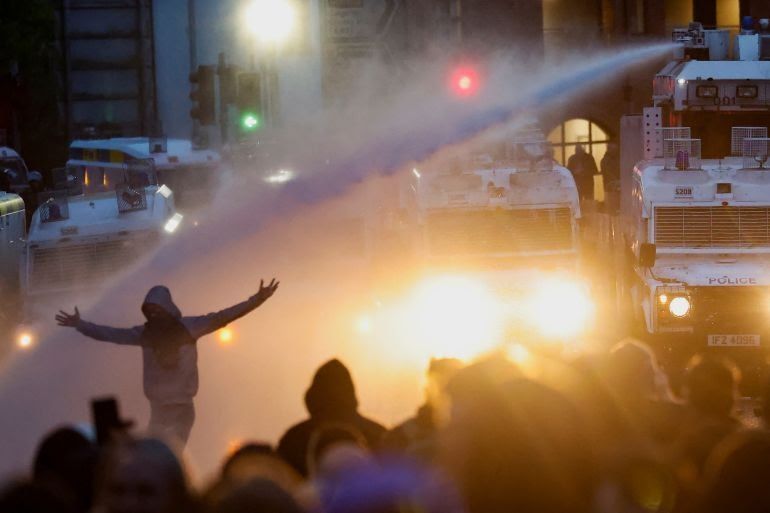
Anti-immigration protests escalated into violent clashes with police across several Northern Ireland towns this week, marking a fresh wave of unrest in the UK.
For the fourth consecutive night, disturbances continued on Thursday. In Portadown, County Armagh, protesters hurled bricks and debris from a derelict building at police officers.
Around 40 police officers have been injured and 15 people arrested amid ongoing unrest in Northern Ireland.
The protests began on Monday in Ballymena a town of about 31,000 people, located 40km (25 miles) northwest of Belfast after two 14-year-old Romanian boys were arrested on suspicion of sexually assaulting a teenage girl.

The most intense violence erupted on Tuesday, when hundreds of masked rioters in Ballymena attacked police, setting buildings and vehicles ablaze. On Wednesday, a smaller group continued the disorder, throwing rocks, fireworks, and petrol bombs at officers. Police responded with water cannon in an attempt to disperse the crowd.
Masked rioters also set fire to a leisure centre in Larne about 30km (19 miles) from Ballymena where some immigrant families had been given shelter following the earlier unrest.
According to police, several masked individuals later broke away from the main protest, eracting barricades and targeting private properties housing immigants. They also attacked officers with smoke bombs, fireworks, bottles, and bricks triggering violent clashes that have continued for several days.
In response to the unrest, some residents placed Union flags or signs in their windows reading “British household” and “locals live here” in an attempt to avoid being targeted.
The identities of the hundred of masked and hooded induviduals who attacked immigrant households and businesses remain unclear.
Historically, this kind of unrest has largely occurred in unionist strongholds like Ballymena. However, media reports suggest that this time, some Catholic residents also joined the protests.

Northern Ireland has a long history of sectarian conflict between unionists—mostly Protestants who support remaining part of the United Kingdom and nationalists, primarily Catholics who advocate for reunification with the Republic of Ireland.
Paramilitary groups were deeply involved in the conflict known as The Troubles, a violent period that lasted from the late 1960s until 1998. It ended with the Good Friday Agreement, which introduced a power-sharing government aimed at reconciling the divided communities.
Despite the peace deal, some unionist factions continue to oppose aspects of the agreement, and long-standing grievances remain unresolved.
The Police Service of Northern Ireland (PSNI) stated that, at this stage, there is no evidence of unionist paramilitary involvement in the recent violence. However, a report published last month by the independent human rights organisation Committee on the Administration of Justice (CAJ) suggests a possible connection.
The study, titled Mapping Far Right Activity Online in Northern Ireland, examined seven anti-immigrant protest incidents across the region since 2023, highlighting patterns of online mobilisation and extremist rhetoric.
Immigration appears to be the central concern driving the protests. Since 2015, over 1,800 Syrian refugees have been resettled in Northern Ireland through the Syrian Vulnerable Persons Resettlement Scheme renamed the Vulnerable Persons Relocation Scheme (NIRRS) in 2020. Broader immigration levels have also been rising.
Democratic Unionist Party (DUP) Assembly Member Paul Frew reports that tensions around immigration had been building in Ballymena for some time, with some residents feeling “frightened about illegal immigration.”
These fears have been compounded by long-standing frustrations over austerity policies and cuts to welfare services since the 2008 global financial crisis. Housing shortages and deteriorating living conditions, in particular, have fueled resentment.
However, experts warn that these grievances are being exploited to scapegoat migrants. Daniel Holder of the Committee on the Administration of Justice (CAJ) said the situation is being distorted by a narrative of “mass uncontrolled migration that simply is not factually true.”
“There is a level of discontent that people are taking to the streets,” said Dr. Ruth McAreavey, a sociologist specialising in migration and social policy. She noted that austerity measures, which have significantly eroded the welfare state, have only deepened this unrest.
“The lack of resources hinders the integration of different social groups and undermines efforts to build social cohesion,” she added. “People feel they’re not in control like things are happening to them, rather than experiencing a more natural, organic process of change.”
Invest or Donate towards HICGI New Agency Global Media Establishment – Watch video here
Email: editorial@hicginewsagency.com TalkBusiness@hicginewsagency.com WhatsApp +256713137566
Follow us on all social media, type “HICGI News Agency” .
 HICGI News Agency