
By Faith Barbara N Ruhinda Updated at 1230 EAT on Monday 16 June 2025
Israeli military spokesperson Brigadier General Effie Defrin stated that Israel has achieved full aerial control above Tehran. He also claimed that Israeli forces have destroyed one-third of Iran’s surface-to-surface missile launchers.
These remarks were made during a media briefing, highlighting Israel’s military advancements in the region.
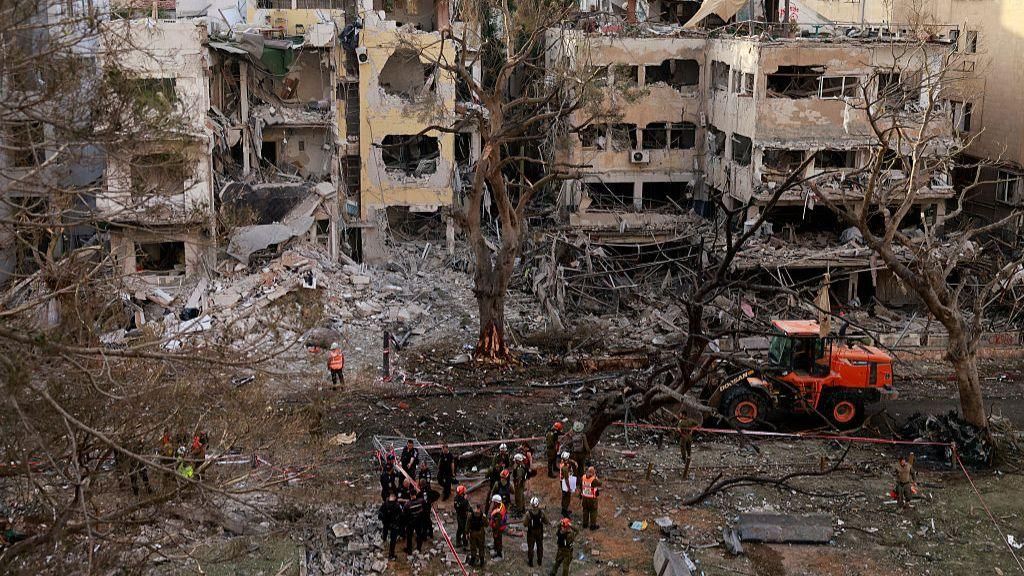
Israel says eight people were killed overnight by Iranian attacks on residential districts in Tel Aviv, Haifa and other cities. The total number of people killed since Friday stands at 24, according to the Israeli PM’s office and Israeli media.
Health officials say nearly 300 people have been admitted to hospital.
Iran says more than 200 people have been killed there since Israel started the conflict on Friday.
Iranian President Masoud Pezeshkian has reiterated the country’s longstanding position regarding its nuclear program, emphasizing that Iran does not seek to develop nuclear weapons.

He affirmed this stance during a parliamentary session on June 16, 2025, underscoring that Iran’s doctrine, grounded in a religious edict (fatwa) issued by Supreme Leader Ayatollah Ali Khamenei, prohibits the production and use of weapons of mass destruction, including nuclear arms.
President Pezeshkian also called for national unity in the face of external aggression, urging all Iranians to “stand together, persevere, and confront the criminal aggression to which Iran is subjected.”
He emphasized that despite the challenges posed by recent attacks, Iran would not yield to external pressures and would continue to pursue its right to peaceful nuclear technology.
In response to international concerns, Iran’s Foreign Ministry announced on the same day that the parliament is preparing legislation to withdraw from the Nuclear Non-Proliferation Treaty (NPT). However, the ministry reiterated that Iran opposes the development of weapons of mass destruction, indicating that the move is not a shift toward nuclear armament but rather a response to perceived violations of the treaty by other parties.
These developments occur amid escalating tensions between Iran and Israel, with both nations engaging in reciprocal missile strikes, resulting in significant casualties and infrastructure damage.
The international community continues to monitor the situation closely, with calls for de-escalation and renewed diplomatic efforts to prevent further conflict.
Iran’s Foreign Ministry spokesperson, Esmail Baghaei, has issued a firm statement regarding the continuation of nuclear negotiations with the United States. He emphasized that for talks to proceed, the U.S. must unequivocally condemn Israeli attacks on Iran, which Tehran views as acts of aggression. Baghaei labeled the U.S. as “complicit” in these actions, suggesting that Washington’s support for Israel undermines the trust necessary for meaningful dialogue.
Additionally, Baghaei confirmed that Iran’s parliament is preparing legislation to withdraw from the Nuclear Non-Proliferation Treaty (NPT).
He stated that such a decision would be “binding,” signaling a significant shift in Iran’s nuclear policy. Despite this, Iran maintains its stance that its nuclear program is peaceful and does not seek to develop nuclear weapons.
These developments come amid escalating tensions between Iran and Israel, with both nations engaging in reciprocal missile strikes. The international community continues to monitor the situation closely, with calls for de-escalation and renewed diplomatic efforts to prevent further conflict.
Satellite images from Planet Labs PBC, analyzed by The Associated Press, have revealed significant damage to Iran’s Tabriz Airfield following an Israeli Offensive Counter Air (OCA) strike on June 13, 2025.
The images show a direct hit along the runway, rendering it unusable in the short term. Additional damage is visible at multiple sites within the base, indicating a targeted attack on military infrastructure. The facility in Tabriz is a known missile base, and its damage is part of a broader Israeli campaign against Iran’s missile and nuclear sites.

The Natanz nuclear enrichment facility, southwest of Tehran, also sustained extensive damage, with several buildings destroyed or heavily damaged, although underground enrichment halls appeared unaffected.
Iran has not publicly acknowledged the extent of the damage, though it has confirmed Israeli strikes in the area.
The attacks have led to heightened tensions between Iran and Israel, with both nations engaging in reciprocal missile strikes, resulting in significant casualties and infrastructure damage.
The international community continues to monitor the situation closely, with calls for de-escalation and renewed diplomatic efforts to prevent further conflict.
China has reiterated its call for de-escalation amid the ongoing conflict between Israel and Iran.
Foreign Ministry spokesperson Guo Jiakun emphasized that all parties should “immediately take measures to cool down the tensions” to prevent further regional instability. He also stated that China is “willing to play a constructive role” in facilitating dialogue and negotiations .
These remarks follow a series of diplomatic engagements by Chinese officials. On June 14, Foreign Minister Wang Yi held separate phone conversations with his counterparts from Iran and Israel. During these talks, Wang reiterated China’s support for Tehran and expressed Beijing’s readiness to assist in de-escalating tensions in the region .
China’s involvement in Middle Eastern diplomacy has been increasing. In 2024, China brokered a historic agreement among 14 Palestinian factions in Beijing, leading to the formation of a unity government aimed at governing Gaza and the West Bank . This move was seen as part of China’s broader strategy to position itself as a neutral mediator in regional conflicts.
While China’s efforts are welcomed by some, others question its ability to influence outcomes, given its close ties with Iran and its complex relationship with Israel. Nevertheless, China’s diplomatic initiatives reflect its growing role in global conflict resolution.
Invest or Donate towards HICGI New Agency Global Media Establishment – Watch video here
Email: editorial@hicginewsagency.com TalkBusiness@hicginewsagency.com WhatsApp +256713137566
Follow us on all social media, type “HICGI News Agency” .
 HICGI News Agency