
By Faith Barbara N Ruhinda Updated 2048 EAT on Thursday 3 June 2025
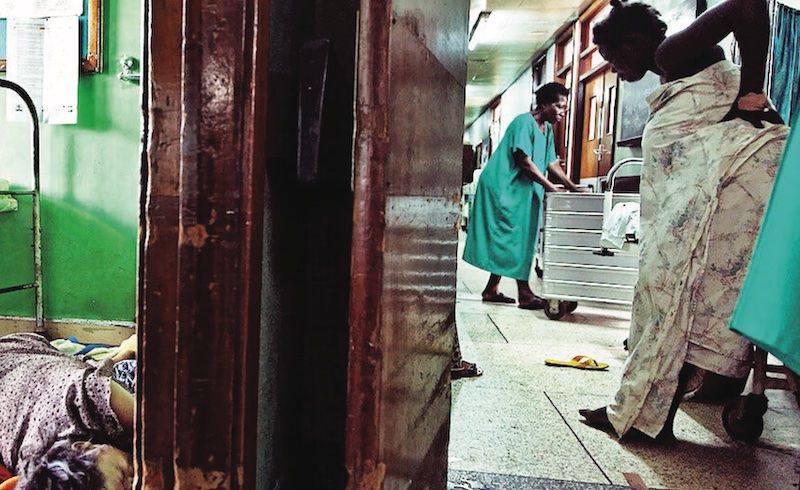
Despite being Uganda’s national referral hospital, Mulago often operates at more than twice its intended capacity on a daily basis. While reports of patients lying on cold ward floors for lack of beds may seem exaggerated to some, a visit to the hospital reveals this grim reality firsthand.
What should be a shocking exception has become routine. Due to the overwhelming number of patients particularly in the general wards many struggle to receive timely attention from doctors or nurses on duty.
Joseph Bizimungu, a boda boda accident victim, shared his experience. When we met him, he had been admitted for three days. “My carer has to struggle just to get the attention of a doctor,” he said, visibly frustrated. “It’s not easy here you wait, and wait, and sometimes no one comes.”
Sometimes I have to literally beg and follow the doctors around just to get them to attend to my brother’s excruciating pain.
The other challenge we face is that we are never sure of whether or not we shall have a bed every now and then because at one time you have it, and before you know it, it’s being taken away from your patient,” said Asiimwe Bizimungu’s sister.

Mulago is widely perceived as a free public hospital, accessible to all. But for many patients, that belief quickly unravels upon arrival. In reality, few services come without cost.
Essential medical supplies including medicines, surgical gloves, cannulas, oxygen, and even sutures are frequently out of stock.
Families, often already struggling financially, are forced to purchase these items from private pharmacies at steep prices.
This harsh reality shatters the illusion that care at Mulago is largely free. For many, the cost of survival becomes a heavy burden.
Patients scheduled for surgery at Mulago are frequently turned away due to the unavailability of essential surgical supplies. In some wards, desperate relatives can be seen rushing from pharmacy to pharmacy, prescriptions in hand, in search of basic antibiotics or painkillers.
“Sometimes, even accessing services as basic as blood tests or X-rays can be a serious challenge here,” said Saidi Kamoga, a patient. “For those who can afford the Shs 150,000 for a CT scan, the struggle doesn’t end there you still have to wait in a long queue, while your patient suffers in pain.”
One of the hospital’s most pressing and persistent issues is human resource overload. On any given day, a single doctor may be tasked with caring for more than 70 patients. A junior physician at Mulago, who requested anonymity, described the situation as unsustainable.
“Some wards operate with one nurse responsible for 30 to 40 patients. That’s wild,” he said. “The staff are trying, but they’re completely overstretched.”

It’s not just the patients and healthcare providers who suffer caregivers face their own hardships.
Many are forced to sleep on ice-cold verandas due to a lack of designated accommodations. On top of that, they are frequently removed from the wards throughout the day, leaving their loved ones unattended for hours at a time.
Joyce Nabweteme, who has spent weeks at the hospital caring for her ailing father, described the ordeal of being repeatedly forced out of the wards.
“Most times, we’re not even warned they just rush us out for hours,” she said. “It wouldn’t be such a big problem, but by the time you return, some of your belongings are missing or misplaced. You end up having to buy things all over again. It makes everything more stressful and more expensive.”
Despite its many challenges, Mulago Hospital has shown signs of progress. In 2023, it made history by performing Uganda’s first successful kidney transplant, marking a significant milestone in the country’s medical advancement.
The hospital also secured government funding for specialised care through the Ministry of Health, offering hope for improvements in critical services.
The government also secured an $88 million loan from the African Development Bank to support the renovation and modernisation of Mulago Hospital. While infrastructure upgrades are slowly taking shape, critics argue that the core systemic problems remain largely unaddressed.
Budget shortfalls continue to cripple essential services, while mismanagement, flawed procurement processes, and corruption have led to the diversion or wastage of critical resources.
They call for a comprehensive overhaul of hospital governance, including improvements in supply chain management, fair remuneration for medical staff, and stricter accountability mechanisms particularly from hospital leadership to parliament.
Invest or Donate towards HICGI New Agency Global Media Establishment – Watch video here
Email: editorial@hicginewsagency.com TalkBusiness@hicginewsagency.com WhatsApp +256713137566
Follow us on all social media, type “HICGI News Agency” .
 HICGI News Agency