
By Tola Fasika Negash & Faith Barbara N Ruhinda Updated at 2018 EAT on Sunday 6 July 2025
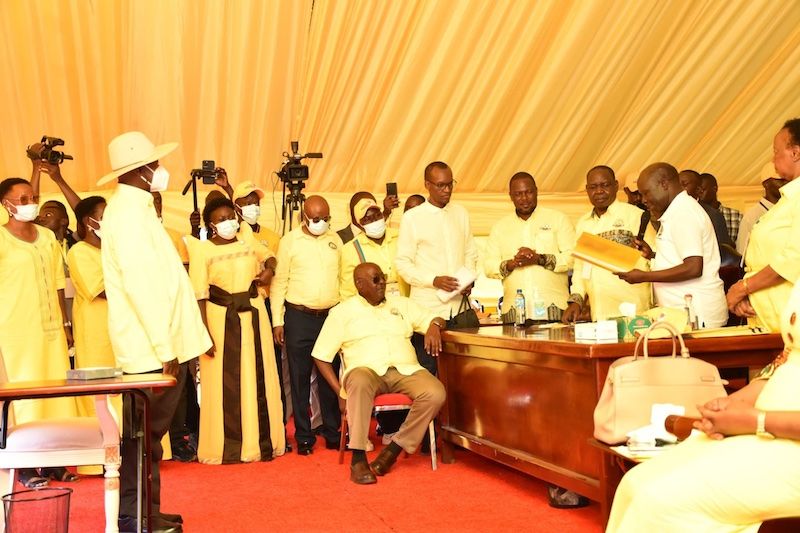
President Yoweri Kaguta Museveni has outlined six key pillars he says will guide Uganda’s development in his next presidential term, following his official nomination as the National Resistance Movement (NRM) presidential flag bearer for the 2026 general election.
Museveni was today formally nominated by Dr. Tanga Odoi, chairperson of the NRM Electoral Commission, at the party’s headquarters in Kampala. He was unopposed.
In addition to securing the party’s presidential nomination, Museveni was also nominated unopposed as chairperson of the NRM a position he currently holds.
Speaking shortly after the nomination, Museveni expressed gratitude to his legal team and seconders who helped gather endorsement signatures from across the country.
He acknowledged the effort involved in fulfilling all nomination requirements and reiterated his commitment to advancing Uganda’s development agenda.

He noted that Uganda’s continued transformation must be anchored on six fundamental pillars: peace, development, wealth creation, job creation, access to essential services such as healthcare and education, and spirituality.
Museveni said these elements would form the core of his agenda in the upcoming term, aimed at consolidating past gains and accelerating progress across sectors.
President Museveni emphasised that the six development pillars are essential for any country aspiring to achieve sustainable growth and long-term stability. He warned against threats to national peace, asserting that Uganda will not tolerate actions that risk dragging the country back into conflict.
“Peace and security are prerequisites for development and wealth creation,” he said.
Addressing the issue of poverty, Museveni argued that wealth and poverty are largely personal experiences.
While the government is responsible for providing infrastructure and public goods, he maintained that individuals and households must actively engage in wealth creation. He noted that, despite national progress, poverty remains deeply entrenched in many urban ghettos.
Museveni also criticised the mindset among some youth who, he said, remain idle while waiting for government jobs instead of exploring other opportunities.
He called for stronger support for private sector investment and cautioned that operational challenges are deterring some investors ultimately limiting job creation and economic expansion.
On the issue of poverty, President Museveni reiterated his long-standing view that wealth and poverty are primarily individual experiences. While the government is responsible for providing infrastructure and shared public goods, he argued that it is up to individuals and households to take initiative in pursuing economic success. He noted that despite the country’s broader progress, poverty remains deeply rooted in many urban ghettos.
Museveni criticised the mindset among many youths who, he said, remain stagnant while waiting for government jobs, rather than seeking out alternative opportunities.
He called for increased support for private sector investment, warning that operational challenges are discouraging some investors and hindering job creation.
He emphasised the need to create a more enabling environment to stimulate employment and drive economic growth. In closing, Museveni urged Ugandans to base their political choices on historical and practical realities not on emotion.

President Museveni cited the murder of former Chief Justice Benedicto Kiwanuka as a stark example of the lawlessness that defined Uganda’s past, underscoring the need for continued stability. He noted that since the National Resistance Movement (NRM) came to power in 1986, the government has focused on three core priorities: liberation, stabilization, and modernization.
Highlighting Uganda’s progress over nearly four decades, Museveni pointed to economic diversification, infrastructure expansion, and growing value addition in key sectors such as agriculture, mineral processing, and even automobile manufacturing. He reported that Uganda’s economy has grown 16-fold since 1986—lifting the country out of the Least Developed Countries (LDC) category.
However, the President acknowledged that more could be achieved if corruption were effectively tackled. He expressed optimism that Uganda is on the verge of attaining middle-income status, with the economy projected to reach a GDP of Shs 500 billion—a milestone he described as a “qualitative leap,” contingent on improved governance and accountability.
Museveni also revealed growing interest from international investors, including those eyeing opportunities to manufacture gold jewellery locally, leveraging Uganda’s reserves of high-grade gold.
As he embarks on his bid for a seventh presidential term, Museveni appealed for divine guidance and pledged to work closely with NRM party structures to ensure Uganda fully participates in the ongoing global transformation one he said Africa largely missed during Europe’s industrial revolution.
He will now face contenders from other political parties in the 2026 general election.
Invest or Donate towards HICGI New Agency Global Media Establishment – Watch video here
Email: editorial@hicginewsagency.com TalkBusiness@hicginewsagency.com WhatsApp +256713137566
Follow us on all social media, type “HICGI News Agency” .
 HICGI News Agency