
By Faith Barbara N Ruhinda Updated at 1426 EAT on Wednesday 9 July 2025
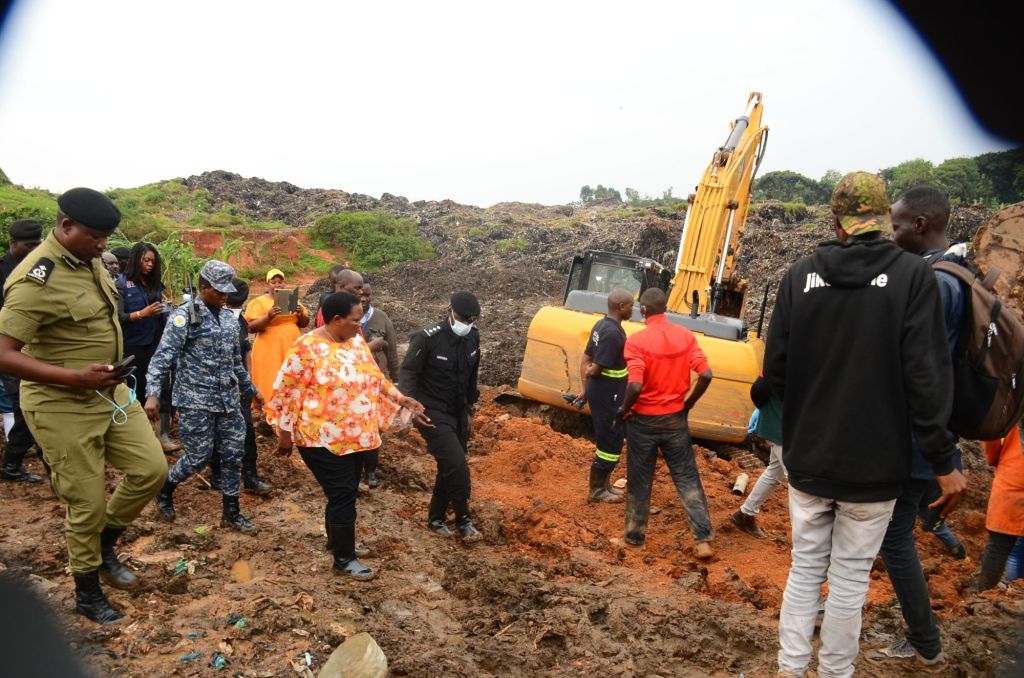
Last week, the Kasangati Magistrate’s Court formally committed former KCCA Executive Director Dorothy Kisaka and her deputy, David Luyimbazi, to the High Court to face trial for manslaughter over the August 10, 2024, waste slide at Kiteezi Landfill (KLF) that claimed 35 lives.
As GEOFREY SERUGO reports, the Kiteezi collapse was a catastrophic outcome of chronic government neglect, multijurisdictional dysfunction, and regulatory failure that have plagued the site for more than a decade.
The prosecution of Kisaka and Luyimbazi follows an investigative report by Anne Twinomugisha Muhairwe, Deputy Inspector General of Government (IGG).
Kiteezi Landfill’s operational permit expired back in 2013. Despite this, the National Environment Management Authority (NEMA) refused to renew the license but, paradoxically, permitted KCCA to carry on operating under informal grace periods and unofficial communications.
Kiteezi Landfill’s operational permit expired back in 2013. Despite this, the National Environment Management Authority (NEMA) refused to renew the license but, paradoxically, permitted KCCA to carry on operating under informal grace periods and unofficial communications.

That tolerance lasted eleven years, despite NEMA having clear legal authority under the NEMA Act to shut down the facility. Meanwhile, leachate treatment at Kiteezi ceased in 2015, and critical landfill management practices including daily waste compaction, slope stabilization, and drainage system maintenance were abandoned around the same time.
What’s more, KCCA has submitted annual budget requests since 2015 to decommission KLF, consistently stating the need for Shs 235 billion to transition to a modern, engineered landfill. However, the funding never materialized.
Records from Muhairwe’s report reveal that each year, KCCA’s requests were consistently classified as “unfunded priorities” by the Ministry of Finance and Parliament effectively sidelining the landfill’s decommissioning.
Meanwhile, the volume of waste arriving at Kiteezi surged to over 450,000 tonnes per year. This spike was fueled not only by Kampala but also by neighboring municipalities such as Wakiso, Mukono, Nansana, Entebbe, and Makindye Ssabagabo none of which had their own engineered landfill sites, placing unsustainable pressure on KLF.
“Facts I know show that Kiteezi, despite being overstretched and unlicensed, became a de facto national dumpsite, with KCCA left to shoulder the blame alone,” says Amanda Ngabirano, an urban planner and academic.
For broader context, when KLF’s environmental license expired in 2013, its continued operation fell into a grey area of regulatory ambiguity. Why NEMA failed to enforce its closure remains baffling especially as environmental and safety risks mounted, and the landfill edged closer to full saturation.
“It’s ironic that while NEMA had the authority to shut down the non-compliant facility under Section 129 of the NEMA Act, it chose not to out of ignorance, but because it tacitly accepted a harsh reality,” says environmentalist Charles Bbosa. “There was simply nowhere else to send the waste, and government had not funded an alternative.”
By 2015, leachate treatment systems had failed, daily cover had ceased, and dangerous waste cliffs had formed visible signs of a landfill in terminal decline. Multiple technical assessments including internal audits and environmental risk warnings repeatedly sounded the same alarm: Kiteezi was collapsing slowly but steadily.

Crucially, these engineering and operational failures fall under the statutory mandate of the Directorate of Public Health and Environment (DPHE), which had oversight of landfill operations, contractor supervision, site access, and environmental compliance.
Meanwhile, KCCA records reveal that the city was expected to maintain the collapsing landfill on an annual operational budget of just Shs 3.1 billion an amount experts say was barely sufficient for basic site upkeep, let alone the comprehensive structural overhaul the facility desperately needed.
In fact, the IGG report notes that over 60% of the waste received at Kiteezi Landfill came from outside Kampala including municipalities such as Wakiso, Mukono, Nansana, Entebbe, Kira, and Makindye Ssabagabo. These jurisdictions, the report acknowledges, had no functional landfills of their own and continued to rely on KLF with NEMA’s full knowledge.
Yet, despite this shared responsibility, not a single official from these local governments or national regulatory bodies has been charged.
At the heart of the prosecution’s case is the allegation that Dorothy Kisaka and David Luyimbazi negligently allowed Kiteezi Landfill to deteriorate, ultimately triggering the catastrophic collapse that claimed 35 lives.
“On April 18, 2024, the officer in charge of landfill management submitted a report to the accused persons and KCCA management outlining persistent issues at KLF,” reads the submission by Lino Anguzu, Assistant Director of Public Prosecutions.
“In the report, the officer noted that the continued operation of KLF beyond its capacity had led to significant challenges, jeopardizing public health, safety, and the environment.”
He highlighted the formation of dangerous waste cliffs, unstable slopes, and imminent risks to both the operational efficiency of waste management and the safety of surrounding communities. The report called for immediate interventions to prevent further escalation and to safeguard the well-being of nearby residents.
According to the prosecution, both Kisaka and Luyimbazi were either aware or ought to have been aware of this report, but failed to take any action. The document is expected to serve as key evidence during the trial.
Incidentally, many of the critical failures at Kiteezi occurred five to nine years before Kisaka and Luyimbazi took office in 2020. According to Edward Semambya, a structural engineer, the two inherited a system already in decline the product of years of chronic underinvestment, waste overloading from multiple jurisdictions, and institutional indifference by national authorities.
“To criminally indict the two officers who assumed leadership long after these failures had crystallized is to confuse causation with presence a logic that offends both legal doctrine and common sense,” Semambya argues.
“As such, he was directly responsible for overseeing the operations and management of KLF at the time of its collapse and immediately before,” state the pleadings filed by Lino Anguzu, Assistant Director of Public Prosecutions.
While the merits of the case are yet to be tested in court, all eyes now turn to the High Court as it prepares to weigh the evidence and determine whether individual accountability can be separated from a broader institutional failure more than a decade in the making.
Invest or Donate towards HICGI New Agency Global Media Establishment – Watch video here
Email: editorial@hicginewsagency.com TalkBusiness@hicginewsagency.com WhatsApp +256713137566
Follow us on all social media, type “HICGI News Agency” .
 HICGI News Agency