
By Faith Barbara N Ruhinda Updated at 2335 EAT on Saturday 12 July 2025
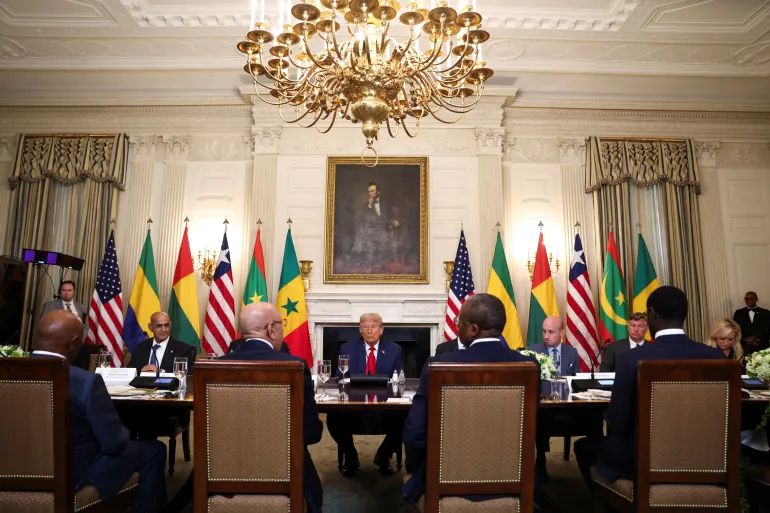
U.S. President Donald Trump met with leaders from five West African nations on Wednesday amid escalating trade tensions that could affect developing countries dependent on commerce with the United States.
Trump hosted the presidents of Gabon, Guinea-Bissau, Liberia, Mauritania, and Senegal at the White House for a series of talks and a working lunch. According to a White House official, the discussions were expected to focus on expanding business opportunities. Trump indicated that the five countries were unlikely to be affected by new U.S. tariffs.
During the lunch, President Trump described the visiting leaders as representing “very vibrant places with very valuable land, great minerals, great oil deposits, and wonderful people.”
“There’s a lot of anger on your continent. We’ve been able to solve a lot of it,” he added, referencing a recent peace agreement between the leaders of the Democratic Republic of the Congo and Rwanda, signed at the White House.
Trump also complimented Liberian President Joseph Boakai on his English-speaking abilities—despite English being the official language of Liberia.

“Liberia is a longtime friend of the United States, and we believe in your policy of making America great again,” Boakai said, before calling for increased U.S. investment in his country. “We just want to thank you so much for this opportunity.”
Trump responded by asking where President Boakai had acquired his English skills. “Such good English,” he remarked. “Where did you learn to speak so beautifully?”
Boakai appeared to chuckle before replying, “In Liberia.”
“In Liberia?” Trump asked.
“Yes, sir,” Boakai confirmed.
“That’s very interesting,” Trump said. “I have people at this table who can’t speak nearly as well.”
Trade and Investment in Focus
Liberia was founded in the 19th century by freed U.S. slaves, and while English is the official language, a number of Indigenous languages are also widely spoken.
During the meeting, Gabon’s President Brice Oligui Nguema emphasized his country’s openness to foreign investment. He told President Trump that Gabon aims to process its raw mineral resources locally but requires significant investment in energy infrastructure to make that goal a reality.
“We are not poor countries. We are rich in raw materials,” said Gabon’s President Brice Oligui Nguema. “But we need partners to support us and help us develop those resources through win-win partnerships.”
Senegal’s President Bassirou Diomaye Faye also highlighted investment opportunities in his country, particularly in the tourism sector. He pointed to potential projects such as a golf course as part of broader efforts to attract international investors.
Faye noted that the proposed golf course would be just a six-hour flight from New York, and playfully suggested that Trump could visit to showcase his golfing skills.
Earlier in the day, the U.S. International Development Finance Corporation (DFC) announced it would provide project development funding for the Banio Potash Mine in Mayumba, Gabon—an initiative aimed at helping the country reduce its reliance on imports.
“DFC’s efforts not only benefit the countries and communities where we invest, but also advance U.S. economic interests by opening new markets, strengthening trade relationships, and promoting a more secure and prosperous global economy,” said Conor Coleman, head of investments at the U.S. International Development Finance Corporation.
While the five nations represented at the White House account for only a small share of U.S.-Africa trade, they hold significant untapped natural resources, positioning them as potential strategic partners in the future.
Senegal and Mauritania are key transit and origin countries in migration routes, while, along with Guinea-Bissau, they face significant challenges in combating drug trafficking—both issues that have drawn concern from the Trump administration.
However, African Union officials have expressed skepticism about deepening trade ties with the United States amid what they describe as “abusive” tariff proposals and visa restrictions that disproportionately affect travelers from Africa.
In response, the top U.S. diplomat for Africa, Ambassador Troy Fitrell, dismissed allegations of unfair trade practices by the United States.
However, African Union officials have questioned how Africa could deepen trade ties with the United States amid what they describe as “abusive” tariff proposals and visa restrictions that largely target travelers from the continent.
The top U.S. diplomat for Africa, Ambassador Troy Fitrell, has dismissed allegations of unfair U.S. trade practices.
Earlier this month, U.S. authorities dissolved the U.S. Agency for International Development (USAID), announcing a shift away from what they called “a charity-based foreign aid model” toward a focus on partnerships with nations demonstrating “both the ability and willingness to help themselves.”
Research published last week in The Lancet medical journal warned that these cuts could lead to more than 14 million additional deaths by 2030.
Trump is expected to announce dates soon for a broader summit with African leaders, potentially scheduled for September to coincide with the United Nations General Assembly.
Invest or Donate towards HICGI New Agency Global Media Establishment – Watch video here
Email: editorial@hicginewsagency.com TalkBusiness@hicginewsagency.com WhatsApp +256713137566
Follow us on all social media, type “HICGI News Agency” .
 HICGI News Agency