
By Faith Barbara N Ruhinda Updated at 1351 EAT on Thursday 17 July 2025
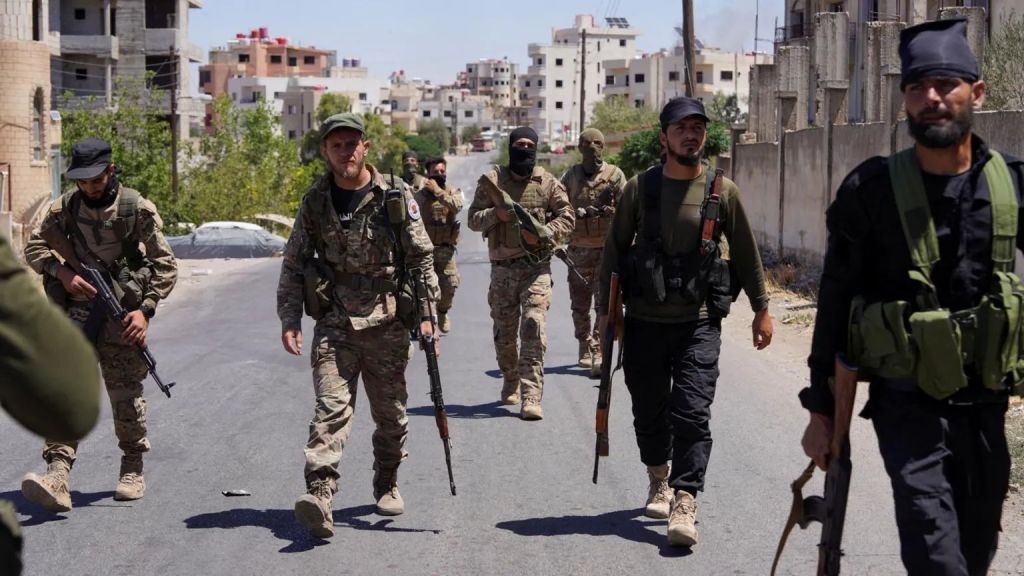
Syria’s interim president, Ahmed al-Sharaa, has declared it a “priority” to protect the country’s Druze population, following Israeli air strikes targeting government forces accused of attacking Druze communities in Suweida province.
In his first televised address since the strikes on Damascus on Wednesday, al-Sharaa also warned that Syrians “are not afraid of war.”
Syrian state media reported that government forces were withdrawing from Suweida under a ceasefire agreement brokered with Druze leaders. However, it remains unclear whether the truce will hold.
More than 350 people have reportedly been killed since sectarian clashes erupted Sunday between Druze militias and Bedouin tribes in the province.
The government responded by deploying forces to the predominantly Druze city of Suweida — the first such deployment since President Ahmed al-Sharaa’s Sunni Islamist movement led the rebel offensive that toppled Bashar al-Assad in December, bringing an end to 13 years of civil war.
However, the situation quickly escalated. Government troops were accused by local residents and activists of killing Druze civilians and carrying out extrajudicial executions, fueling further outrage and drawing sharp condemnation.

The Druze faith, an offshoot of Shia Islam with distinct beliefs and practices, is followed by communities in Syria, Lebanon, Jordan, Israel, and the Israeli-occupied Golan Heights.
In Syria, the Druze and other minority groups have remained wary of President Sharaa since his rise to power, largely due to his jihadist background. His Islamist faction, Hayat Tahrir al-Sham (HTS), is a former al-Qaeda affiliate still listed as a terrorist organization by the United Nations.
Those concerns have been deepened by repeated outbreaks of sectarian violence, including a deadly confrontation in May involving Druze militias, security forces, and allied Islamist fighters—an incident that also prompted Israeli military intervention.
In his televised speech early Thursday, Sharaa described the Druze as “a fundamental part of the fabric of this nation” and rejected what he called attempts to draw the community into the hands of “an external party.”
He claimed that government forces deployed to Suweida had “restored stability and expelled outlawed factions,” despite what he described as Israeli interventions that had “significantly complicated the situation” and led to “a large-scale escalation.”
“We are not among those who fear war. We have spent our lives facing challenges and defending our people,” Sharaa said. “But we have placed the interests of Syrians above chaos and destruction.”
He announced that security responsibility in Suweida would now be transferred to religious elders and selected local factions, citing “the supreme national interest.”
Sharaa concluded his address by pledging accountability: “The government is keen on holding accountable those who transgressed and abused our Druze people.”

Israeli Response and Strikes
On Wednesday, Israeli Prime Minister Benjamin Netanyahu addressed the country’s own Druze population, saying Israeli forces were “acting to save our Druze brothers and to eliminate the regime’s gangs.”
The Israeli military confirmed it had targeted the Syrian military’s headquarters in Damascus, a site near the presidential palace, armored vehicles en route to Suweida, and several weapons storage and firing positions in southern Syria.
“We are acting decisively to prevent the entrenchment of hostile elements beyond our borders, to protect Israeli citizens, and to prevent harm to Druze civilians,” said IDF Chief of Staff Lt. Gen. Eyal Zamir during a visit to the Golan Heights. He added: “We will not allow southern Syria to become a terror stronghold.”
Zamir also condemned a breach of the frontier after hundreds of Druze demonstrators crossed the heavily fortified border into Syria on Wednesday. “There is no room for disorder near the border fence,” he warned.
International Reaction and Rising Toll
U.S. Secretary of State Marco Rubio said Washington was in contact with all parties involved and had “agreed on specific steps that will bring this troubling and horrifying situation to an end.”
“This will require all parties to deliver on the commitments they have made — and that is what we fully expect them to do,” he said, without providing further details.
The UK-based Syrian Observatory for Human Rights (SOHR) reported that more than 350 people have been killed since violence erupted in Suweida on Sunday. The toll includes at least 79 Druze fighters, 55 civilians — 27 of whom were reportedly summarily executed by security forces — 189 government troops, and 18 Bedouin tribal fighters.
The figures could not be independently verified, though Syrian security officials estimated a similar death toll, close to 300.
Invest or Donate towards HICGI New Agency Global Media Establishment – Watch video here
Email: editorial@hicginewsagency.com TalkBusiness@hicginewsagency.com WhatsApp +256713137566
Follow us on all social media, type “HICGI News Agency” .
 HICGI News Agency