
Updated by Faith Barbara N Ruhinda at 1343 EAT on Tuesday 29 July 2025
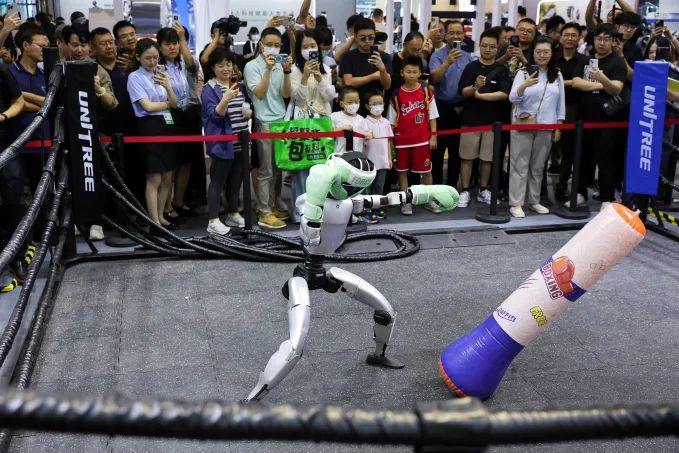
China has proposed a global action plan to govern artificial intelligence, just days after the United States laid out its own strategy aimed at cementing American leadership in the fast-evolving technology. AI has increasingly become a strategic lever in trade negotiations between the two economic giants.
Chinese Premier Li Qiang presented China’s vision for AI governance at the World Artificial Intelligence Conference (WAIC), an annual gathering in Shanghai that draws tech leaders from more than 40 countries.
Overall, global AI governance remains fragmented. Countries differ significantly, especially in areas such as regulatory concepts and institutional frameworks,” Premier Li Qiang said in his speech on Saturday.
“We should enhance coordination to establish a broadly accepted global AI governance framework as soon as possible.”
Li’s remarks came just days after the Trump administration released its 28-page AI action plan, which aims to cut “bureaucratic red tape” and solidify U.S. dominance in the sector.

While Li did not mention the United States by name, his remarks appeared to reference ongoing trade tensions between the two superpowers—particularly U.S. restrictions on advanced semiconductor exports, a critical component for developing and training AI systems, which has contributed to supply shortages in China.
“Key resources and capabilities are concentrated in a handful of countries and companies,” Li said. “If we resort to technological monopolies, controls, and restrictions, AI will become a game played by only a select few.”
AI chips have become a critical bargaining chip in trade negotiations between the U.S. and China, which continued this week with a meeting in Stockholm. Ahead of the latest talks, both sides appeared to make concessions: Washington lifted its ban on sales of a key Nvidia AI chip to China, while Beijing suspended its antitrust investigation into the American chemical company DuPont.
Speaking from Scotland on Sunday, Trump said the U.S. is “very close to a deal with China,” though he provided no additional details. The current deadline for reaching an agreement is August 12.
China has been unapologetic in promoting its AI ambitions. Home to more than 5,000 AI companies and boasting a core AI industry valued at 600 billion yuan ($84 billion) as of April 2025, the country is fully committed to its tech rivalry with the U.S.
This rapid growth is driven by massive investments from both government and private sectors. Between 2013 and 2023, state-backed venture capital firms poured an estimated $209 billion into AI-related businesses, according to research from the Massachusetts-based National Bureau of Economic Research. This year alone, public sector spending on AI is projected to exceed 400 billion yuan ($56 billion).

While China’s AI investment is substantial, it still lags far behind the U.S. in private sector spending.
In 2024, private AI investment in the U.S. reached $109.1 billion—roughly 12 times China’s $9.3 billion. However, China’s commitment to the AI race is evident in other ways. Since 2017, it has published more patents for generative AI inventions each year than all other countries combined, according to data from the World Intellectual Property Organization.
Despite its rapid growth, China’s private AI investment remains a fraction of that in the United States.
In 2024, U.S. private sector spending reached $109.1 billion—around 12 times higher than China’s $9.3 billion. Still, China’s determination is clear in other areas. Since 2017, it has led the world in generative AI patent filings, outpacing all other countries combined, according to the World Intellectual Property Organization.
All this investment is helping narrow the gap between the U.S. and China in the AI race.
Earlier this year, Chinese startup DeepSeek, founded just a year ago, shook Wall Street with the release of its R1 model—an AI system that reportedly outperformed counterparts from Meta and Anthropic. The model’s development cost? Just $5.6 million—a fraction of the budgets behind OpenAI’s ChatGPT (over $100 million) and Google DeepMind’s Gemini (close to $200 million).
The launch not only underscored China’s technical prowess but also highlighted its ability to innovate at a lower cost.
More recently, Chinese startup Moonshot drew fresh attention with the release of its Kimi K2 model earlier this month. Praised for its strong performance and low development cost, Kimi K2 reportedly outperforms some models from Google and OpenAI, further fueling momentum in China’s AI sector.
The country’s rapid AI expansion is now being viewed as economically viable. According to research from financial services firm Morgan Stanley, China’s AI industry is on track to break even within the next few years, with a projected return on investment of 52% as early as 2030.
Calls for responsible development are growing alongside these advancements. ASEAN Secretary-General Dr. Kao Kim Hourn recently urged the international community to adopt “robust governance” frameworks for artificial intelligence to guard against emerging threats such as misinformation, deepfakes, and cybersecurity risks.
Invest or Donate towards HICGI New Agency Global Media Establishment – Watch video here
Email: editorial@hicginewsagency.com TalkBusiness@hicginewsagency.com WhatsApp +256713137566
Follow us on all social media, type “HICGI News Agency” .
 HICGI News Agency