
Updated by Faith Barbara N Ruhinda at 1748 EAT on Wednesday 30 July 2025
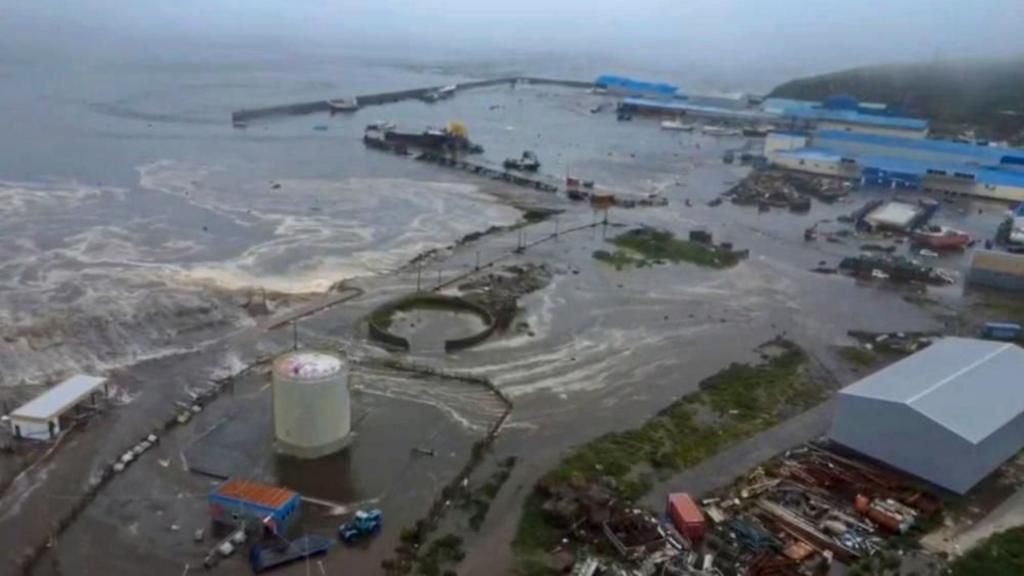
Vasily Berezhnoy has lived his entire life on Russia’s Kamchatka Peninsula, a region known for its seismic activity and volcanic eruptions — but he says he doesn’t remember tremors as powerful as those that struck today.
“People were in the streets — some in slippers, some in bathrobes, some holding their children. Some were hysterical,” he recalls.
“When the ground beneath your feet moves like a wave, when you see pipes and towers swaying — it’s terrifying, of course. You can never get used to that.”
The 8.8-magnitude earthquake struck near Kamchatka at approximately 11:25 a.m. local time (00:25 BST) on Wednesday, making it one of the most powerful earthquakes ever recorded in the region.
Sofia, a local high school student, says she was at home with her parents when the quake hit.
“Chaos broke out — the furniture started falling before our eyes, along with everything on it,” she says. “I wasn’t the only one panicking. Our neighbours, along with their pets, also rushed outside in a panic.”
Sofia adds that the panic extended to the roads, where desperate attempts to flee led to traffic jams and accidents.

Several South American countries with Pacific coastlines have issued tsunami alerts and advisories following the powerful earthquake off Russia’s Kamchatka Peninsula.
In Colombia, the National Unit for Disaster Risk Management downgraded its initial tsunami alert to an advisory for the Pacific coast. Authorities have warned of strong currents and waves expected to reach the shoreline between 10:00 and 12:00 local time (16:00–18:00 BST). Maritime traffic has been restricted, and preventive evacuations have been carried out in some coastal areas and beaches.
In Ecuador, a tsunami advisory was issued for the Galápagos Islands, prompting the suspension of all maritime activities. Beaches, docks, and low-lying coastal areas were evacuated. The country’s mainland coast remains under observation, though no immediate evacuation orders have been issued there.
Chile has taken the most drastic measures, issuing a red alert — its highest warning level — for Pascua Island (Easter Island). A tsunami alert remains in effect for much of the country’s northern and central coastline, while a precautionary advisory was extended to the southern regions of Aysén, Magallanes, and the Chilean Antarctic Territory.
Authorities across the region are urging residents and visitors in affected areas to avoid coastal zones, follow evacuation instructions, and remain alert until official all-clear notices are issued.

Sam Jackson, a tourist from Birmingham, was on Kaanapali Beach in Maui when he first received the tsunami alert.
“I was unsure and wanted to check whether this was a regular occurrence or a major tsunami warning,” he says. “I felt like something wasn’t right. I asked at the hotel, and they gave the impression I didn’t need to do anything.”
Still uneasy, Sam headed to a designated evacuation point, where he met a group of Americans. Together, they decided to move to higher ground on a nearby golf course.
“We were just looking to see if anything would happen, but we couldn’t see much,” he adds. “We got repeated updates, but after 6:45 p.m. local time, there were no further messages — not even one telling us to stay put.”
As time passed, people grew restless.
“Many returned to their hotels well before the all-clear, even though we were advised to wait.”
When the tsunami threat was eventually downgraded, Sam said he felt “extremely relieved.”
“It was a very surreal feeling,” he recalls. “It’s my last day here before I fly back, and I’ve spent it avoiding a tsunami.”
Several island nations across the South Pacific have downgraded or cancelled tsunami alerts issued after the powerful earthquake near Russia’s Kamchatka Peninsula.
In Tonga, authorities confirmed that the tsunami alert has been cancelled, stating that “the potential threat to all island groups has passed” and the overall threat level “has been deemed low.”
Fiji has also lifted its tsunami watch advisory. The government issued an “all clear,” announcing that “communities may now resume normal activities,” while urging the public to remain vigilant and continue monitoring official updates.
In the Cook Islands, the tsunami advisory has been cancelled as well. Officials reported “no longer a tsunami threat” and confirmed that “no significant impacts have been reported.”
Meanwhile, Samoa remains under a tsunami watch. The country’s Disaster Management Office noted continued “wave activity and strong coastal currents” in some areas, and is advising the public to stay away from the coast until further notice.
The National Tsunami Warning Center has cancelled the tsunami advisory previously in place for southern California, covering the stretch from the California–Mexico border to Rincon Point.
However, a tsunami warning remains in effect for the northern coast of California, from Rincon Point to Humboldt County, the agency confirmed.
Residents in the affected northern areas are advised to stay alert and follow official guidance until the warning is lifted.
Invest or Donate towards HICGI New Agency Global Media Establishment – Watch video here
Email: editorial@hicginewsagency.com TalkBusiness@hicginewsagency.com WhatsApp +256713137566
Follow us on all social media, type “HICGI News Agency” .
 HICGI News Agency