
Updated by Faith Barbara N Ruhinda at 1524 EAT on Tuesday 5 August 2025
Salt crusts crackle beneath Habibullah Khatti’s feet as he makes his way to his mother’s grave—one final visit before leaving behind his parched, crumbling island village in Pakistan’s Indus Delta.
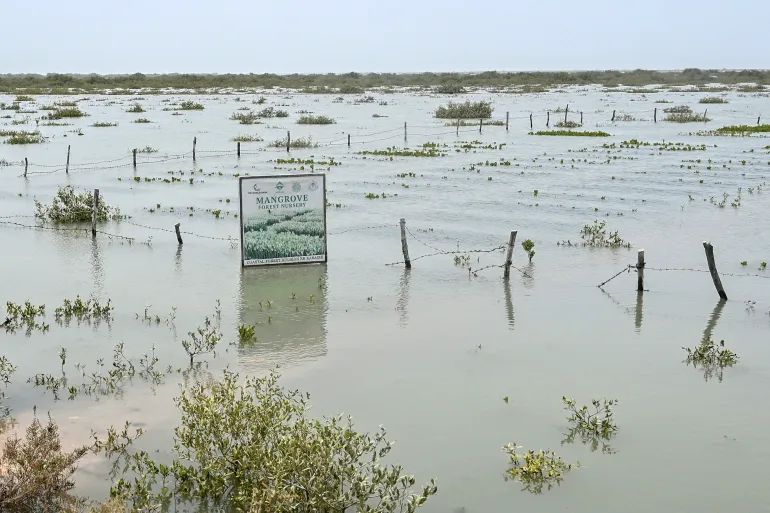
Once a thriving hub of fishing and farming, the delta is now in retreat. Seawater intrusion—where the Arabian Sea pushes inland into the Indus River—has devastated crops, wiped out fish stocks, and driven entire communities to the brink.
“The saline water has surrounded us from all four sides,” says Khatti, standing in Abdullah Mirbahar village in Kharo Chan, just 15 kilometers (9 miles) from where the Indus River spills into the sea.
As the fish disappeared, the 54-year-old tried to survive by working as a tailor. But now, only four of the village’s 150 households remain. “In the evening, an eerie silence takes over the area,” he says, as stray dogs wander through rows of abandoned wooden and bamboo homes.

Once home to around 40 villages, Kharo Chan has seen most of them swallowed by rising seawater. Its population has plummeted from 26,000 in 1981 to just 11,000 in 2023, according to census data.
Khatti is now preparing to move his family to Karachi, Pakistan’s largest city—already straining under the weight of economic migration, much of it from the collapsing communities of the Indus Delta.
He is far from alone. The Pakistan Fisherfolk Forum, which advocates for fishing communities, estimates that tens of thousands have already been displaced from the delta’s coastal districts due to rising salinity and dwindling livelihoods.
But the true scale of the crisis is even larger. More than 1.2 million people have been displaced from the broader Indus Delta region over the past two decades, according to a study published in March by the Jinnah Institute, a policy think tank headed by a former climate change minister.
According to a 2018 study by the US-Pakistan Center for Advanced Studies in Water, the downstream flow of freshwater into the Indus Delta has declined by a staggering 80 percent since the 1950s.
This dramatic reduction is the result of extensive irrigation canals, the construction of hydropower dams upstream, and the worsening effects of climate change on glacial and snow melt in the Himalayas—where the Indus River originates.
This reduced freshwater flow has led to devastating levels of seawater intrusion. Since 1990, water salinity in the region has increased by roughly 70 percent, rendering the soil too toxic for agriculture and severely depleting shrimp and crab populations—once the backbone of local livelihoods.
“The delta is both sinking and shrinking,” says Muhammad Ali Anjum, a conservationist with WWF in the region.
Fed by glaciers in Tibet, the Indus River winds through disputed Kashmir and stretches the length of Pakistan, nourishing around 80 percent of the country’s farmland.
Its tributaries are the lifeline of Pakistan’s agricultural economy. At its southernmost point, the river once formed a thriving delta—a complex web of mangroves, wetlands, farmland, and fishing zones built on sediment-rich deposits as it met the Arabian Sea.
But that balance has broken down. A 2019 study by a government water agency found that more than 16 percent of once-fertile deltaic land has turned barren due to saltwater encroachment.
In Keti Bandar, a coastal town now scarred by salinity, a white crust of salt crystals covers the ground. With no drinkable water left, boats haul freshwater in from several kilometers away, and villagers transport it home by donkey carts.
“Who leaves their homeland willingly?” asked Haji Karam Jat, whose house was swallowed by rising waters. He rebuilt farther inland, expecting more families to follow. “A person only leaves their motherland when they have no other choice.”

The transformation of the Indus River’s natural flow began under British colonial rule, with the construction of canals and dams—alterations that intensified with dozens of hydropower projects in recent decades. Earlier this year, several military-led canal projects on the Indus were halted after farmers in Sindh’s low-lying riverine areas staged protests, fearing further damage to their lands.
In response to the river basin’s ongoing degradation, the Pakistani government, together with the United Nations, launched the “Living Indus Initiative” in 2021. Among its efforts is a program to restore the delta by combating soil salinity and protecting local agriculture and ecosystems.
Meanwhile, the Sindh provincial government is spearheading a mangrove restoration project, aiming to revive these vital forests that act as natural barriers against saltwater intrusion. Yet, as mangroves are replanted in some areas, land grabbing and residential developments continue to clear forests elsewhere, undermining conservation efforts.
Neighbouring India now poses a looming geopolitical threat to the river’s future. In a dramatic move, it revoked the 1960 Indus Waters Treaty—an agreement that has governed the shared use of the Indus basin rivers for over six decades. India has since threatened to build dams upstream and permanently withhold water, a step Pakistan has condemned as “an act of war.”
For the communities of the delta, however, the loss is more than environmental or political—it is deeply personal.
“Alongside their homes, people have lost a way of life that was tightly bound to the delta,” said Fatima Majeed, a climate activist with the Pakistan Fisherfolk Forum. Her own family left Kharo Chan years ago, resettling on the outskirts of Karachi after her grandfather was forced to migrate.
Women, in particular, face steep challenges. “They’ve gone from stitching nets and packing the day’s catch to struggling to find any work in the cities,” she said.
“We haven’t just lost our land—we’ve lost our culture.”
Invest or Donate towards HICGI New Agency Global Media Establishment – Watch video here
Email: editorial@hicginewsagency.com TalkBusiness@hicginewsagency.com WhatsApp +256713137566
Follow us on all social media, type “HICGI News Agency” .
 HICGI News Agency