
By Faith Barbara N Ruhinda at 12:12 EAT on Monday 25 August 2025
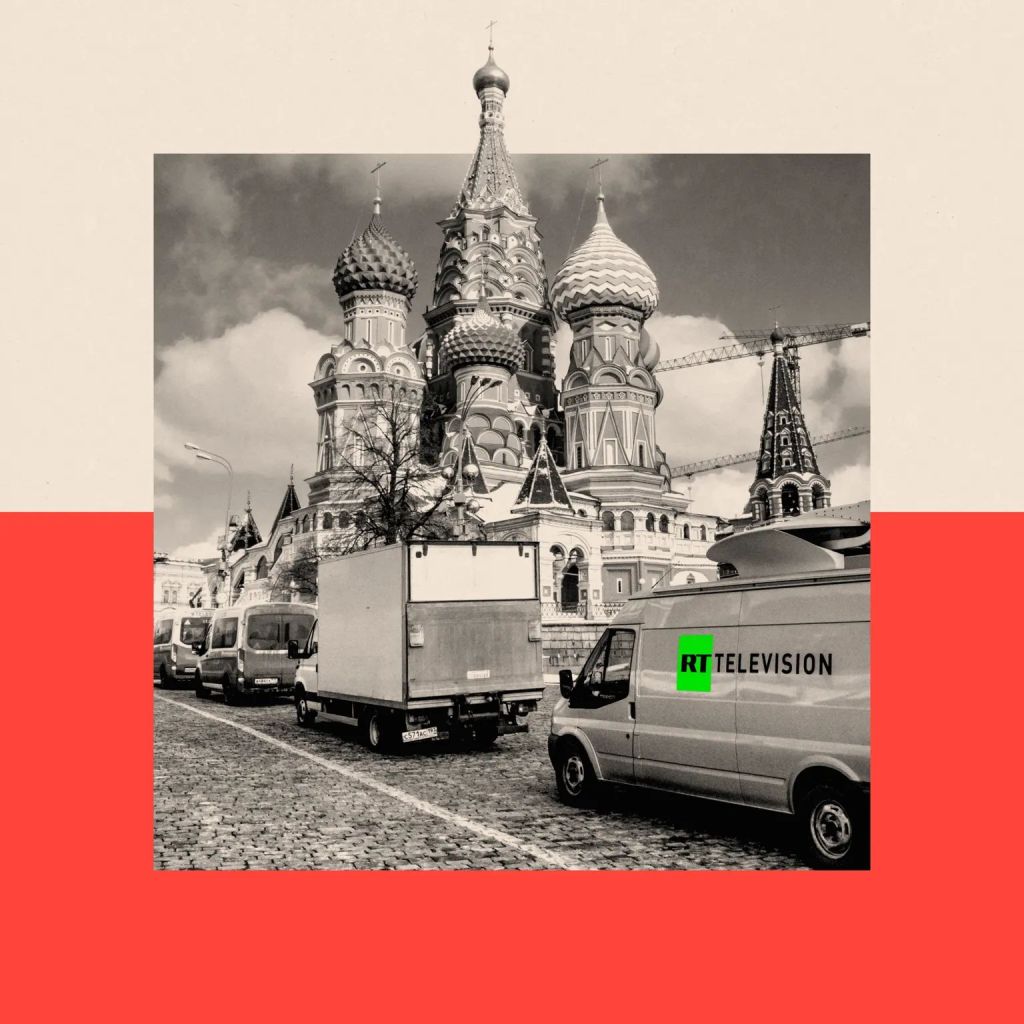
One Monday in June, Javier turned on his television expecting to hear music. Instead, the screen was filled with scenes of a warzone. A news report was airing on a channel he didn’t recognize.
“What’s happening?” he wondered. After 20 minutes, he switched it off. “I couldn’t connect with it.”
In the bottom corner of the screen, a green logo displayed the letters “RT.” A quick online search revealed it was Russia’s state-funded broadcaster, formerly known as Russia Today.
Javier lives in Chile, where it is alleged that Telecanal—a privately owned television station—has handed over its broadcast signal to RT, allowing the Russian state-backed outlet to air content directly in the country.
Chile’s broadcasting regulator has launched sanction proceedings against Telecanal for a possible violation of national broadcasting laws and is currently awaiting the channel’s official response.

Telecanal did not respond to a request for comment.
Meanwhile, viewers were left confused by the abrupt programming change.
“I was upset,” said Javier, a viewer in Santiago. “There was no announcement, and I couldn’t understand why it was suddenly airing.”
Over the past three years, Russian state-backed media outlets RT and Sputnik—its affiliated news agency and radio broadcaster—have expanded their international footprint. Together, they now broadcast in regions including Africa, the Balkans, the Middle East, Southeast Asia, and Latin America.
This global push has come as RT and Sputnik face bans and restrictions in several Western countries, where authorities have accused them of spreading disinformation and advancing Kremlin-aligned narratives.
Following Russia’s full-scale invasion of Ukraine in February 2022, sweeping restrictions were imposed on RT’s broadcasts across the United States, United Kingdom, Canada, and the European Union. Major tech companies also moved to limit the channel’s digital reach, citing concerns over the spread of disinformation related to the war.
The crackdown culminated in 2024, when U.S. authorities sanctioned several RT executives—including editor-in-chief Margarita Simonyan—accusing them of attempting to undermine public trust in American institutions. The move came amid broader allegations that the Kremlin was orchestrating a campaign to interfere in the U.S. presidential election, an accusation RT has denied.
Yet even as its presence diminished in the West, RT’s global footprint has continued to grow.
Since 2023, the Russian state-backed outlet has opened a bureau in Algeria, launched Serbian-language television services, and rolled out free training programs for journalists from Africa, Southeast Asia, India, and China. It has also announced plans to open a new office in India.
Meanwhile, Sputnik—RT’s sister news agency—launched a newsroom in Ethiopia in February.
This expansion comes as Western media outlets have scaled back international operations in several regions, driven by budget cuts and shifting foreign policy priorities. The resulting vacuum has provided an opening for Russian state media to grow its influence in parts of the world where alternative narratives are in high demand.
Two years ago, the BBC shut down its Arabic radio service in favour of a digital-first model, offering news through audio, video, and text formats. While the broadcaster has since launched emergency radio services for conflict zones such as Gaza and Sudan, its regular presence on the airwaves in the Arab world has diminished.
In that same year, Russia’s Sputnik filled the gap—launching a 24-hour radio service in Lebanon, effectively taking over the frequency space once occupied by BBC Arabic.
Meanwhile, the U.S. government-funded broadcaster Voice of America has undergone significant downsizing, cutting most of its staff in recent years.
“Russia is like water: where there are cracks in the cement, it trickles in,” says Dr. Kathryn Stoner, a political scientist at Stanford University.

The bigger question now, she adds, is what Russia’s ultimate goal might be—and what its growing media influence means in a world grappling with shifting geopolitical alignments.
‘Not All Crazy Conspiracy Theorists’
Stephen Hutchings, a professor of Russian Studies at the University of Manchester, believes Russia’s soft power strategy is calculated and tailored to exploit long-standing grievances in regions outside the West.
The Power of Perception
Take the case of RT. In Western countries, it is widely viewed as a “Russian state actor and propagator of disinformation,” explains Dr. Rhys Crilley, a lecturer in international relations at the University of Glasgow. But elsewhere in the world, RT is often perceived as a legitimate broadcaster with its own editorial perspective.
This distinction, Crilley argues, makes its messaging particularly effective.
“Not all viewers are conspiracy theorists who blindly fall for disinformation,” he says. “RT’s coverage appeals to broader audiences—people who are rightly concerned about global injustices or events they perceive the West as being complicit in.”
‘A Very Careful Manipulation’
On the surface, RT’s international website looks like any mainstream news platform—and much of its reporting is factually accurate. But that’s precisely what makes it more persuasive, says Dr. Precious Chatterje-Doody, a senior lecturer in Politics and International Studies at The Open University.
“It’s a very careful manipulation,” she explains.
Chatterje-Doody co-authored a book on RT alongside Crilley, Professor Stephen Hutchings, and others. As part of their research, the team analysed two years’ worth of RT’s international news bulletins—from May 2017 to May 2019—and found that the network’s story selection and framing served specific narratives.
For instance, the researchers observed that RT frequently highlighted social unrest in European countries, while its coverage of domestic issues in Russia often focused on the country’s military strength and exercises.
Beyond selective storytelling, RT has also pushed demonstrably false narratives. It has portrayed Russia’s 2014 annexation of Crimea as a peaceful “reunification,” ignoring well-documented military involvement. Since the full-scale invasion of Ukraine in 2022, the network has systematically denied evidence of Russian war crimes.
Invest or Donate towards HICGI New Agency Global Media Establishment – Watch video here
Email: editorial@hicginewsagency.com TalkBusiness@hicginewsagency.com WhatsApp +256713137566
Follow us on all social media, type “HICGI News Agency” .
 HICGI News Agency