
By Faith Barbara N Ruhinda at 1234 EAT on Wednesday 27 August 2025
Donald Trump’s steep 50% tariffs on Indian imports have officially taken effect, just weeks after the former U.S. president signed an executive order imposing an additional 25% penalty on India over its continued purchases of Russian oil and weapons.
The move places India—long considered one of America’s strongest partners in the Indo-Pacific—among the most heavily penalized nations in the world. Analysts warn it could deliver a significant blow to exports and slow growth in the world’s fifth-largest economy, especially given that the U.S. was, until recently, India’s largest trading partner.
The tariff shock has sent the Indian government scrambling to respond. Earlier this month, Prime Minister Narendra Modi vowed to cut taxes to cushion the economic impact and doubled down on calls for domestic self-reliance.

Promising a “Diwali gift” in the form of a “massive tax bonanza” for ordinary citizens and small businesses, Modi pledged to bolster the millions of enterprises that fuel Asia’s third-largest economy.
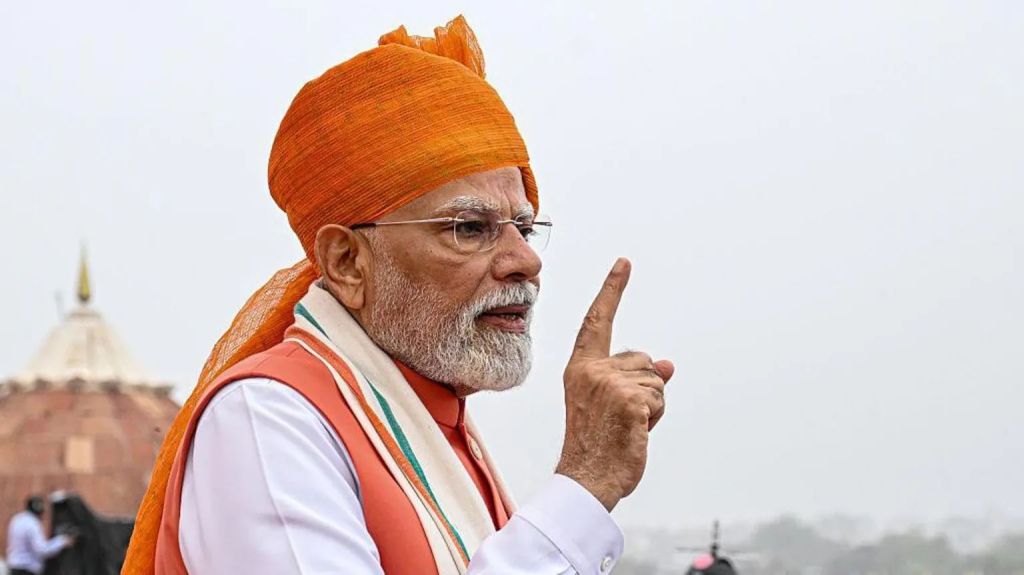
Draped in a bright saffron turban and addressing crowds from the historic Red Fort during India’s Independence Day celebrations, Modi urged shop owners and businesses to proudly display signs that read Swadeshi or Made in India.
“We must become self-reliant—not out of desperation, but out of pride,” he declared. “Economic selfishness is on the rise globally. We must not sit and cry about our challenges—we must rise above and ensure no one can hold us in their clutches.”
He has since echoed this message in multiple public speeches, signaling a coordinated narrative push in response to Trump’s tariffs, which are expected to disrupt millions of livelihoods across India’s export-driven sectors—ranging from garments and gems to seafood.
Modi’s message is clear: Make in India. Spend in India.
Yet the “Make in India” mission remains a steep climb. The share of manufacturing in India’s GDP has stubbornly hovered around 15%, despite years of subsidies and production-linked incentives.
Still, tax reforms could offer some immediate relief. Following a $12 billion income tax giveaway unveiled in the budget earlier this year, Modi is now eyeing an overhaul of India’s indirect tax system—promising a reduction and simplification of the Goods and Services Tax (GST) to boost consumption and ease the burden on small businesses.
With trade tensions rising and economic headwinds intensifying, Modi appears to be betting on homegrown resilience to weather the storm triggered by Washington’s latest move.
Eight years after India introduced the Goods and Services Tax (GST) to replace a complex web of indirect taxes, the system is now set for a major revamp.
While GST was designed to streamline compliance and lower the cost of doing business, experts have long criticized its convoluted structure—burdened with too many thresholds, rates, and exemptions. Calls for simplification have grown louder in recent years, and now Prime Minister Narendra Modi appears ready to act.
India’s finance ministry has unveiled a proposal for a simplified two-tier GST structure, with the potential to unlock billions in consumer spending.
“Combined with the income tax cut effective April 2025, the GST rate reforms—likely worth around $20 billion (£14.7 billion)—should together provide a meaningful push to consumption,” analysts at U.S. brokerage Jefferies said in a note following the announcement.
Private consumption is the backbone of India’s economy, contributing nearly 60% of GDP. While rural spending has remained resilient—thanks to a strong harvest—urban demand continues to lag, weighed down by stagnant wages and job losses in sectors like IT, particularly in the wake of the pandemic.

Modi’s proposed tax cuts are being widely interpreted as a form of fiscal stimulus aimed at jumpstarting growth. According to investment bank Morgan Stanley, the combined impact of income and GST tax cuts could simultaneously boost GDP and ease inflation.
“This is particularly crucial amid headwinds from ongoing global geopolitical tensions and adverse tariff developments that could impair external demand,” the firm noted.
Consumer-facing sectors are expected to be among the biggest beneficiaries. These include two-wheelers, small cars, garments, and building materials like cement—products that typically see increased demand during the festive Diwali season.
Although full details of the proposed GST changes are yet to be announced, most analysts believe the revenue shortfall from lower rates can be offset. Higher-than-expected tax collections and increased dividends from the Reserve Bank of India are likely to provide a fiscal cushion.
Swiss investment bank UBS added that GST cuts may have a stronger “multiplier effect” than previous corporate and income tax reforms. Unlike upstream incentives, GST reductions directly impact prices at the point of purchase, encouraging immediate consumer spending.
With rising global uncertainties and export challenges, Modi’s bet on domestic demand through tax reform signals a clear shift in India’s economic strategy—placing the consumer front and center.
Prime Minister Narendra Modi’s sweeping tax relief measures could increase the likelihood of further interest rate cuts by India’s central bank, analysts say. The Reserve Bank of India has already reduced rates by 1% in recent months, and additional easing could spur credit growth and fuel domestic investment.
Combined with a planned salary hike for nearly five million government employees and 6.8 million pensioners set to take effect early next year, these measures are expected to help India sustain its economic momentum despite mounting external pressures.
India’s stock markets have responded positively to the announcements. Earlier this month, in a significant vote of confidence, S&P Global upgraded India’s sovereign credit rating for the first time in 18 years. A sovereign upgrade typically lowers a government’s borrowing costs and enhances the country’s appeal to foreign investors—especially important at a time of growing global uncertainty.
But even as Modi pushes ahead with long-delayed economic reforms, the broader outlook remains mixed. India’s growth has slowed considerably from the 8% levels seen just a few years ago, and the country is facing its most severe trade challenge in over a decade.
Tensions with the United States—particularly over India’s continued energy and defense ties with Russia—have escalated. Trade negotiations between Washington and New Delhi, expected to begin earlier this week, were abruptly called off.
Meanwhile, the 50% tariff imposed by former President Donald Trump on Indian goods has effectively functioned as a trade sanction, experts say—straining ties between two of the world’s largest and fastest-growing economies.
“A tariff at this scale is akin to a trade embargo,” said one trade analyst. “Just months ago, such a scenario would have seemed implausible.”
With external demand faltering and geopolitical risks mounting, Modi’s government appears to be turning inward—leaning heavily on fiscal stimulus, domestic consumption, and structural reform to anchor India’s growth story.
Invest or Donate towards HICGI New Agency Global Media Establishment – Watch video here
Email: editorial@hicginewsagency.com TalkBusiness@hicginewsagency.com WhatsApp +256713137566
Follow us on all social media, type “HICGI News Agency” .
 HICGI News Agency