
Updated by Faith Barbara N Ruhinda at 1635 EAT on Tuesday 25 November 2025
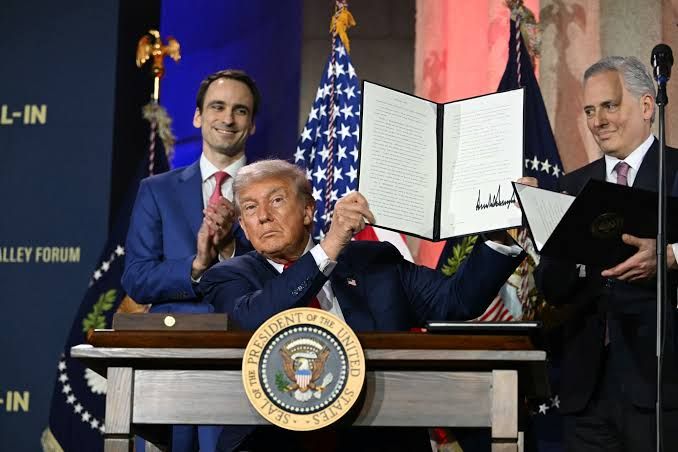

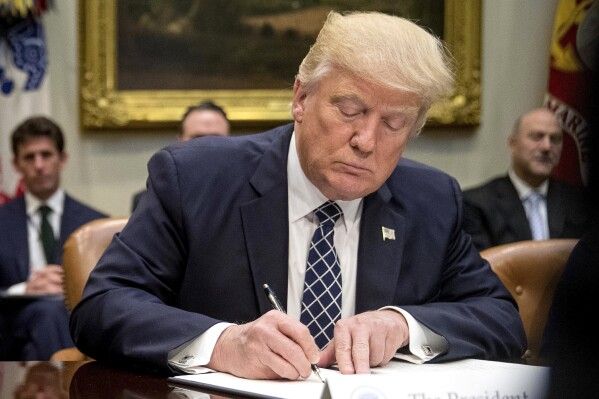
The White House on Monday unveiled a new program enabling the Department of Energy’s national laboratories to work with major technology companies and academic institutions on using artificial intelligence to advance scientific research.
The initiative—called the Genesis Mission and created by executive order—directs the Department of Energy to build a new AI platform that will use federal scientific data to train models and agents designed specifically for research applications. The move highlights President Donald Trump’s intensified focus on AI in his second term and follows his sweeping AI Action Plan released in July.

The Genesis Mission aims to harness advances made by the tech and business sectors and apply them to research in health, energy, manufacturing and other fields, Energy Secretary Chris Wright told reporters on Monday. He added that the program is also intended to help reduce energy costs for consumers, a growing challenge as investment in AI surges.
For decades, the Department of Energy’s laboratories have conducted research spanning energy, health, advanced materials and quantum science. Under the new Genesis Mission, however, a dedicated AI platform will allow DoE labs, private companies and universities to share data more efficiently, giving researchers new tools to apply AI to fields such as physics and chemistry.

“The private sector has launched artificial intelligence at huge scale, but with a different focus — on language, business processes and consumer services,” Wright said. “What we’re doing here is pivoting those efforts toward scientific discovery and engineering advancements.”
The platform will enable “multiple federal research agencies” and “the private sector” to collaborate in order to “win and stay ahead in the AI race,” according to a White House fact sheet.
Key focus areas for the program include biotechnology, critical materials, nuclear fission and fusion energy, space exploration, quantum information science, and semiconductors and microelectronics.

Tech companies have already begun collaborating more closely with the Department of Energy. In October, Nvidia and Oracle announced a partnership to build supercomputers for Argonne National Laboratory, while PC maker Dell is developing a supercomputer for Berkeley Lab, according to a May announcement. The Genesis Mission is intended to facilitate more deals of this type.
Academics and tech firms have also been exploring AI applications in healthcare for years; Google, for instance, introduced a suite of AI models fine-tuned for the healthcare industry in 2023.

However, the push to apply AI to scientific research comes as the technology continues to grapple with “hallucinations,” a tendency for AI systems to generate inaccurate or fabricated information.
The White House has also introduced unconventional arrangements involving government partnerships with private companies as part of Trump’s push for American leadership in artificial intelligence. In August, the U.S. government acquired a 10% stake in chipmaker Intel and reached an agreement with AMD and Nvidia to take a 15% share of chip sales to China in exchange for export licenses.
At the heart of Trump’s AI push is a drive to maintain U.S. supremacy over China amid rising trade tensions between the two economic powers. Chinese tech startup DeepSeek rattled U.S. markets in January with the launch of its R1 model, raising concerns that China may be further ahead in AI development than previously anticipated.

Trump and some tech companies, including OpenAI, have argued that state-level regulation could stifle innovation. In response, Trump recently drafted a separate executive order aimed at preventing such regulations, after Congress rejected an earlier effort to block state-level AI oversight, CNN reported.
However, calls to ease regulation have sparked concerns among lawmakers and online safety advocates. Reports this year have highlighted risks that AI technologies could contribute to self-harm and mental distress.
Invest or Donate towards HICGI New Agency Global Media Establishment – Watch video here
Email: editorial@hicginewsagency.com TalkBusiness@hicginewsagency.com WhatsApp +256713137566
Follow us on all social media, type “HICGI News Agency” .
 HICGI News Agency