By Dr. Kivumbi Earnest Benjamin, L.H.D. (Hon.) updated at 0826 EAT on Wednesday 11th December 2025
Five-year agreement strengthens disease prevention, boosts domestic health financing, and advances long-term health system self-reliance.
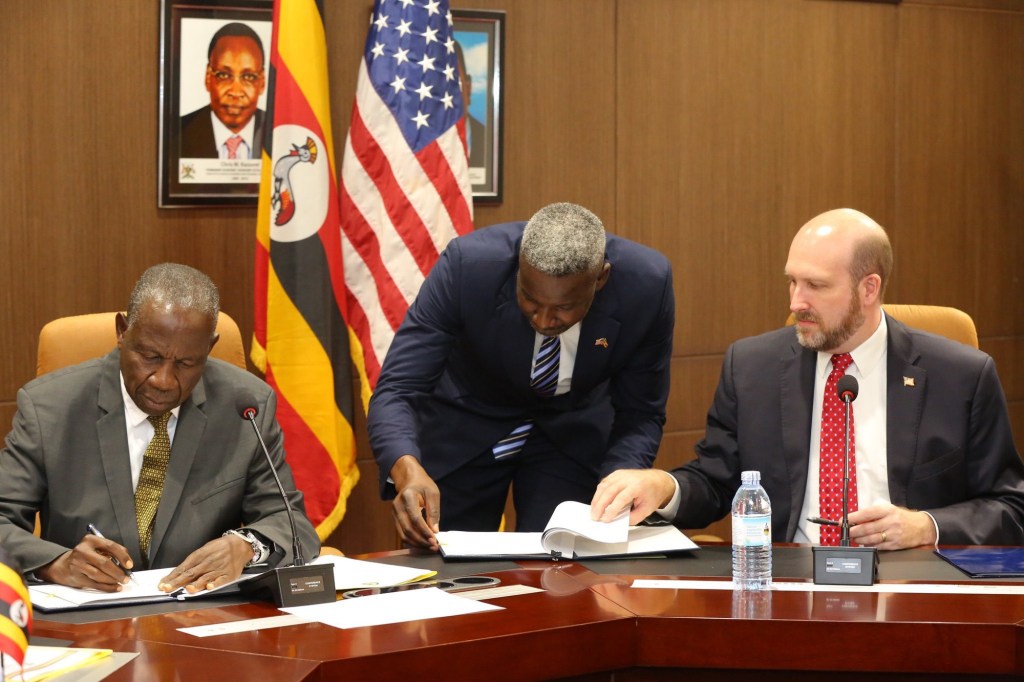
Uganda’s Healty Minister Hon Jane Ruth Aceng, Minister of Finance and Economic Planning Hon Matia Kasaijja & US Envoy H.E William W. Popp- Courtesy photo
The Governments of the United States and Uganda have today signed a landmark five-year, $2.3 billion bilateral health cooperation Memorandum of Understanding (MOU) that sets out a shared vision to save lives, strengthen Uganda’s health system, and advance global health security. The pact reinforces the longstanding U.S.–Uganda partnership and aims to build a resilient national health system capable of preventing and responding to emerging and existing infectious disease threats.
Under the agreement, the United States plans to support priority health programs—HIV/AIDS, tuberculosis, malaria, maternal and child health, polio eradication, global health security, human resources for health, disease surveillance, and emergency preparedness. Over the five years, the U.S. Government expects to contribute up to $1.7 billion, while the Government of Uganda has committed to increasing domestic health expenditure by more than $500 million as it gradually assumes greater financial responsibility. The MOU also includes continued support for Uganda’s faith-based healthcare providers.
Advert
Statements From the United States Government
Speaking at the signing ceremony alongside Uganda’s Minister of Finance, Planning and Economic Development, Hon. Matia Kasaija, U.S. Ambassador William W. Popp said:
“This agreement represents a significant commitment by the United States and Uganda to co-invest in our shared global health priorities. Today, we are building on prior successes and making a significant shift toward promoting self-reliance in the health sector through strong community health systems, clear performance metrics, and a foundational commitment to data systems and global health security that will prevent and stop outbreaks from threatening Uganda, the United States, and the world.”
Statements From the Government of Uganda
Hon. Matia Kasaija commended the renewed partnership and emphasized Uganda’s commitment to increased domestic investment:
“The Government of Uganda acknowledges the critical importance of preventing the spread of emerging and existing infectious disease threats globally. We note the United States Government’s commitment of $1.7 billion between 2026 and 2030, and we equally commit to increasing our own budgetary contribution to more than $500 million over the same period as U.S. support decreases. This collaboration will yield not only disease-specific outcomes but also significant improvements in national systems, institutions, and workforce capacity.”
Advert
Key Provisions of the MOU
The framework includes several innovative measures designed to strengthen Uganda’s long-term health system sustainability:
• Commodity Procurement:
Responsibility for procuring most health commodities will gradually transition from the U.S. Government to the Government of Uganda. The shift is expected to strengthen national supply chain systems and institutions.
• Frontline Health Workers:
Health workers currently funded by the U.S. Government will be mapped to Uganda’s official health worker cadres and progressively transitioned to the Government payroll.
• Data and Surveillance Systems:
The United States will make significant investments in data systems, digitization, and disease surveillance. This includes improving electronic medical records, integrating national data platforms, and supporting the Government of Uganda’s broader digital health agenda.
• Faith-Based Health Providers:
With support from the United States, the Government of Uganda will increase assistance to faith-based facilities through performance-based service agreements, higher primary health care grants, and digitization and community health insurance initiatives.
• Co-Investment:
Uganda’s commitment to enhance domestic health spending by over $500 million is a central pillar of the MOU, aimed at ensuring sustainability and advancing national health self-reliance.
A Partnership Spanning Six Decades
The United States remains Uganda’s largest health partner, bilaterally and through global institutions. For more than 60 years, U.S. support has strengthened health systems, saved lives, and advanced shared health priorities. The new MOU underscores a mutual commitment to protect previous gains and ensure that Uganda’s health system becomes increasingly self-sustaining and nationally led.
Advert
Context: America First Global Health Strategy
The agreement aligns with the America First Global Health Strategy, which outlines a vision to make the United States safer and more prosperous by preventing global disease threats from reaching American shores, strengthening bilateral partnerships through multi-year compacts requiring co-investment, and promoting American health innovation.
In a press statement, U.S. Secretary of State Marco Rubio highlighted recent progress in implementing the strategy, noting the signing of Kenya’s bilateral health compact earlier this year.
“Kenya’s agreement is a prime example of what these incentive-based bilateral health compacts aim to achieve,” Rubio said. “They shift more resources into national systems, reduce reliance on parallel NGO structures, improve data and procurement capacity, and include meaningful co-investment aligned with realistic performance benchmarks.”
He added that several additional agreements are expected to be finalized in the coming weeks as the United States continues to overhaul its foreign assistance architecture.






 HICGI News Agency