
Updated by Faith Barbara N Ruhinda and Eric Kikomeko at 1548 EAT on Wednseday 17 Decemeber 2025


Fifteen years ago, a Tunisian fruit seller, Mohamed Bouazizi, despairing over official corruption and police harassment, set himself on fire in the center of his hometown, Sidi Bouzid—an act that ignited a wave of uprisings across the region.
Much of the hope sparked by his protest now lies in ruins. The revolutions that followed in Tunisia, Libya, Egypt, and Syria have claimed tens of thousands of lives and, in many cases, descended into chaos or paved the way for the return of authoritarian rule.
Tunisia was long seen as the sole success story of the “Arab Spring,” with global observers praising its democratic gains, often overlooking persistent economic and political challenges that had fueled public discontent.

Today, many of those post-revolutionary gains have been eroded following President Kais Saied’s dramatic consolidation of power in July 2021. Opponents have described the move as a coup, which ushered in a new era of hardline rule in the country.
In the years that followed, Saied temporarily shuttered parliament—only reopening it in March 2023—rewrote the constitution, and oversaw a relentless crackdown on critics and political opponents.
“They essentially came for everyone: judges, civil society members, and people from all political backgrounds, especially those seeking to unify opposition against the coup regime,” said Kaouther Ferjani, whose father, 71-year-old Ennahdha leader Said Ferjani, was arrested in February 2023.

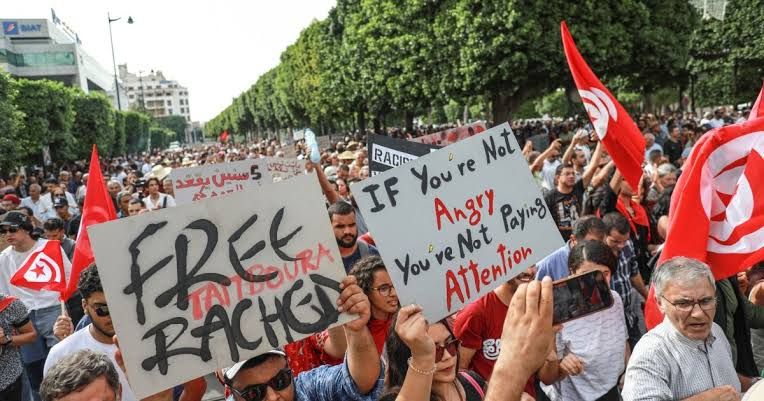
While many Tunisians have been cowed into silence by Saied’s crackdown, they have also increasingly abstained from elections, now widely seen as little more than a procession for the president.
In the country’s first post-revolution presidential election in 2014, roughly 61 percent of eligible voters turned out. By last year’s election, turnout had fallen by half.
“Kais Saied’s authoritarian rule has definitively buried the hopes and aspirations of the 2011 revolution by systematically crushing fundamental rights and freedoms and putting democratic institutions under his thumb,” Bassam Khawaja, deputy director at Human Rights Watch, told Al Jazeera English.
Following the revolution, many Tunisians became politically active, seeking to shape a new national identity. Civil society flourished, with thousands of organisations forming to lobby against corruption and advocate for human rights, transitional justice, press freedom, and women’s rights.

At the same time, political parties and movements competed for influence, debating the direction the country’s emerging identity should take.
“It was an amazing time,” a political analyst who witnessed the revolution and remains in Tunisia said, speaking on condition of anonymity. “Anybody with anything to say was saying it.
“Almost overnight, we had hundreds of political parties and thousands of civil society organisations. Many of the parties shifted or merged over time, but Tunisia retained an active civil society and freedom of speech all the way up to 2022.”
That freedom has since been severely curtailed. Saied’s Decree 54 of 2022, which criminalises electronic communication deemed false by the government, has largely muzzled criticism of the ruling elite in both traditional media and on social networks.

“Freedom of speech was one of the few lasting benefits of the revolution,” the analyst continued. “The economy failed to pick up, services didn’t really improve, but we had debate and freedom of speech. Now, with Decree 54, as well as commentators being arrested for virtually any reason, it’s gone.”
In 2025, both Amnesty International and Human Rights Watch condemned Tunisia’s crackdown on activists and non-governmental organisations (NGOs).
Ahead of the prosecution of six NGO workers and human rights defenders with the Tunisian Council for Refugees in late November, Amnesty highlighted 14 Tunisian and international NGOs whose activities had been suspended by court order over the previous four months.
Dozens of political figures from Tunisia’s post-revolutionary governments have been arrested, regardless of party affiliation or political ideology.
In April 2023, 84-year-old Rached Ghannouchi, former leader of Tunisia’s main political bloc, the Ennahdha Party, was detained on charges of “plotting against state security.” His daughter, Yusra, said that following a series of convictions, Ghannouchi now faces an additional 42 years in prison.

Later that year, Abir Moussi, leader of the Free Destourian Party and a prominent critic of Ghannouchi, was also jailed on multiple charges. Critics argue that these arrests target individuals based on their ability to rally opposition to President Kais Saied rather than any legitimate criminal conduct.
“This is not just about my father,” Yusra said, pointing to other figures, including post-coup opposition leader Jawhar Ben Mubarak.
“Politicians, judges, journalists, and ordinary citizens alike have been handed severe sentences, often without evidence or due process. Tunisia has, sadly, been pulled back toward the same authoritarianism that sparked the 2010 uprising.”
Rached Ghannouchi and Abir Moussi, along with dozens of former elected lawmakers, remain in jail, while the political parties that once competed for power in Tunisia’s parliament are largely absent, Al Jazeera reported.
Since President Kais Saied’s revised 2022 constitution weakened the legislature, parliament has become a body no longer seen as a threat to the president.
“The old parliament was incredibly fractious and did itself few favours,” said Hatem Nafti, essayist and author of Our Friend Kais Saied, a book critical of Tunisia’s new regime. He referred to the ammunition provided to parliament’s detractors by a chaotic and occasionally violent legislature.
“However, it was democratically elected and blocked legislation that its members felt would harm Tunisia. In the new parliament, members feel the need to talk tough and even be rude to ministers,” Nafti continued. “But it’s really just a performance… Nearly all the members are there because they agree with Kais Saied.”
Hopes that the judiciary might act as a check on Saied have also faltered. The president has continued to reshape the judicial system to suit his agenda, including the sacking of 57 judges in 2022 for failing to deliver verdicts he wanted.
Invest or Donate towards HICGI New Agency Global Media Establishment – Watch video here
Email: editorial@hicginewsagency.com TalkBusiness@hicginewsagency.com WhatsApp +256713137566
Follow us on all social media, type “HICGI News Agency” .
 HICGI News Agency