
Updated by Faith Barbara N Ruhinda and Eric Kikomeko at 1213 EAT on Monday 19 January 2026
Syria’s President Ahmed al-Sharaa is scheduled to meet with Mazloum Abdi, the head of the Syrian Democratic Forces (SDF), on Monday to finalize a ceasefire agreement following days of intense fighting. The clashes, which involved Syrian government forces and allied tribal groups, saw a significant push across the northern part of the country, from Aleppo to Raqqa.
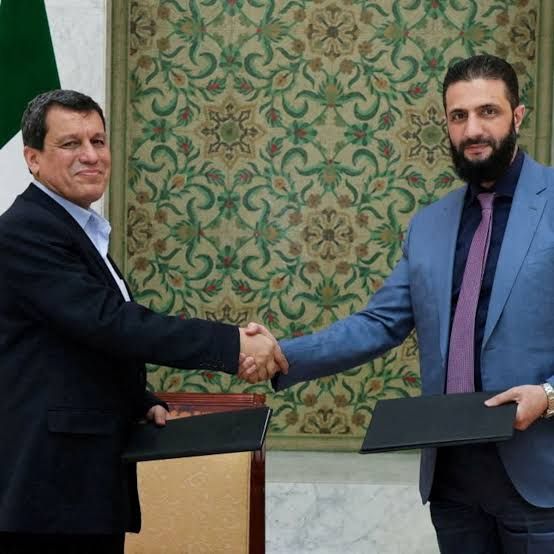

The meeting, originally set for Sunday but postponed due to bad weather, comes after a dramatic escalation in the conflict. Syrian government forces managed to reclaim large swathes of territory in the northeast, prompting the SDF to agree to a truce and a comprehensive deal. This agreement places Kurdish civilian and military authorities under the control of the central state, marking a significant shift in the region’s power dynamics.
On Sunday, Mazloum Abdi, also known as Mazloum Kobani, announced his acceptance of the ceasefire declared and signed by President al-Sharaa, which was broadcast on camera. In a televised address, Abdi described the conflict as one that had been “imposed” on the Syrian Democratic Forces (SDF) and orchestrated by various parties. He added that he would outline the full terms of the agreement upon his return from Damascus.

Reporting from Damascus, Al Jazeera’s Ayman Oghanna described how the announcement of the ceasefire agreement sparked widespread public celebration across the capital.
“Last night, after the deal was reached, the streets were filled with jubilant scenes. There were fireworks, car horns blaring, and people dancing in the streets,” Oghanna reported.
He noted that while many expressed a sense of “relief and cautious joy,” there was also an undercurrent of skepticism following weeks of intense and deadly fighting.
This skepticism, Oghanna pointed out, stems from fears that the ceasefire may not hold, especially in a country still reeling from nearly 14 years of devastating civil war.

Despite lingering doubts, exhaustion seems to dominate public sentiment. “Everyone we spoke to here in Damascus, including many Syrian Kurds, just wants a peaceful resolution,” Oghanna reported. He added that Syrians are “fatigued by ongoing conflict and eager for a diplomatic solution to the crisis in the north.”
Economic hardship has also become a major concern. “Across the city, people are deeply worried about their livelihoods and the state of the economy,” Oghanna said, highlighting that “90 percent of Syrians now live below the poverty line.” Many hope that the ceasefire will bring much-needed stability, allowing the country to shift its focus to economic recovery and rebuilding.

Abdi explained that the SDF’s decision to withdraw from Deir Az Zor and Raqqa to Hasakah was driven by a desire to prevent further bloodshed and avert a full-scale civil war. He acknowledged the heavy losses suffered by the SDF but emphasized the group’s commitment to defending what he called its hard-won gains.
Sipan Hamo, a senior commander with the SDF and a key figure in the People’s Protection Units (YPG), told Reuters that the group was not seeking independence from Syria. He called for international guarantees, particularly from the United States and other global powers, to secure the SDF’s position. Hamo denied receiving support from Iran or Russia but expressed hope that Israel might intervene to support Syria’s Kurdish population.
The Syrian presidency has stated that the ceasefire agreement guarantees the integration of SDF fighters into state institutions and the deployment of government authorities in the cities of Raqqa, Deir Az Zor, and Hasakah.

President al-Sharaa emphasized that the deal outlines the full integration of the SDF into Syria’s military forces and called on tribal factions to support its execution.
In response to Al Jazeera’s inquiry about the timeline for implementation and the status of a previous agreement from March of last year, al-Sharaa remarked that the current deal reflects the underlying principles of that earlier accord.
Reporting from Aleppo, Al Jazeera’s Zein Basravi noted that the focus is now shifting from the announcement of the ceasefire to the practical governance of areas that have recently returned to Syrian state control.
Basravi added that the meeting between al-Sharaa and Mazloum Abdi is expected to shed light on the remaining uncertainties surrounding the agreement. However, he stressed that the immediate challenge lies on the ground. “In the next 24 to 48 hours, the Syrian government must address the practical aspects of this deal. They have emerged victorious and secured their objectives,” Basravi stated.
With government forces now firmly in control, Basravi pointed out that the onus is on them to ensure the protection of minority groups in these areas, particularly as they transition from active conflict zones to civilian territories.

Speaking from Beirut, Middle East geopolitical analyst Joe Macaron suggested that Syria’s regained control over oil and gas resources could significantly reshape the ongoing ceasefire dynamics and enhance Damascus’s political leverage.
“This is a major source of revenue that was previously controlled by the Syrian Democratic Forces (SDF),” Macaron told Al Jazeera, noting that while these assets are now under state control, the benefits won’t be immediate. “They have to secure the infrastructure first,” he added, emphasizing that these revenues could eventually play a pivotal role in Syria’s reconstruction and mark a “new phase” in the country’s recovery.
However, Macaron cautioned that the ceasefire itself remains fragile. The most pressing challenge, he argued, is the integration of SDF fighters into the broader Syrian military framework. “It’s well-known that those who fought with the SDF are not just Kurds, but also foreign fighters,” Macaron said, describing the integration process as a major risk to the ceasefire agreement.
Macaron also pointed out that the negotiation dynamic has shifted decidedly in favor of Damascus. “The balance of power has changed,” he remarked, explaining that Syria’s Deputy Foreign Minister Faisal al-Sharaa now insists that fighters join the army as individuals after their status is cleared.
Beyond the Kurdish territories, Macaron highlighted the complex tribal politics that Damascus now inherits. “These are Syria’s problems now,” he said, warning that the demands of local tribal groups could prove to be a long-term challenge for the Syrian government. “They’re going to be tested moving forward.”
In a significant diplomatic development, al-Sharaa met US envoy Tom Barrack in Damascus on Sunday. Barrack later described the agreement as a turning point, writing on social media platform X that it paves the way for renewed dialogue and cooperation toward a unified Syria.
The US, which maintains a military presence in northern Syria, is particularly focused on preventing any resurgence of the Islamic State (ISIS) in the region. This follows a deadly attack on US soldiers and civilian contractors in Palmyra in December. In response, the US launched a new series of “large-scale” attacks against ISIS last week after the ambush that resulted in the deaths of two US soldiers and a civilian interpreter.
Meanwhile, the Syrian Ministry of Defence announced a ceasefire on all fronts, stating that the truce would allow safe corridors for civilians to return home and enable state institutions to resume their functions. The agreement follows a two-day Syrian military operation that reclaimed key areas in the east and northeast, after earlier understandings with the SDF broke down.
– Aljazeera
Invest or Donate towards HICGI New Agency Global Media Establishment – Watch video here
Email: editorial@hicginewsagency.com TalkBusiness@hicginewsagency.com WhatsApp +256713137566
Follow us on all social media, type “HICGI News Agency” .
 HICGI News Agency