
Updated by Faith Barbara N Ruhinda at 1846 EAT on Wednesday 28 January 2026
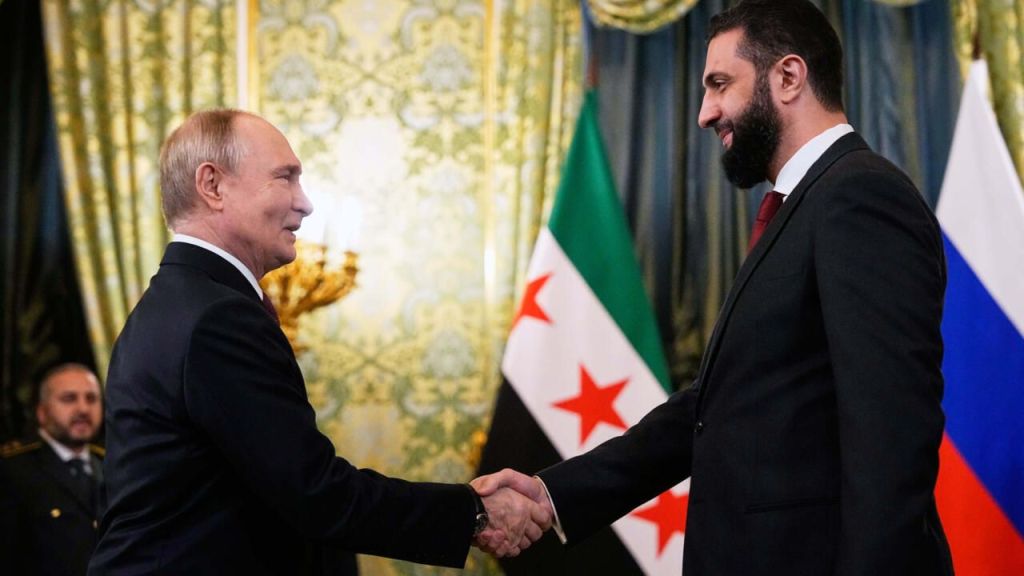
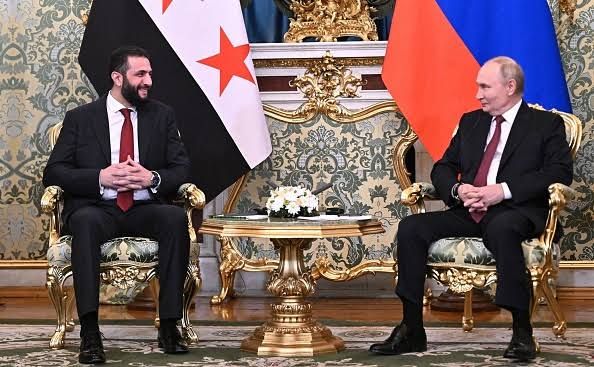
Syrian President Ahmed al-Sharaa is holding talks with Russian President Vladimir Putin in Moscow as the Kremlin moves to preserve its influence in Syria, including its military footprint, more than a year after al-Sharaa toppled Russia’s longtime ally, Bashar al-Assad, at the end of 2024.
Ahead of the meeting on Wednesday, al-Sharaa praised Russia’s role in Syria, thanking Putin for backing the country’s unity and describing Moscow’s involvement as “historic” in promoting regional stability.

President Vladimir Putin voiced his support for Ahmed al-Sharaa’s efforts to stabilise Syria, congratulating him on what he described as growing momentum toward “restoring the territorial integrity of Syria.”
Putin and al-Sharaa spent more than a decade on opposing sides of the Syrian civil war, a history that has fuelled concerns in Moscow over the future of Russia’s military presence in the country.
Ahead of the talks, Kremlin spokesman Dmitry Peskov said discussions would include “the presence of our soldiers in Syria,” referring to Russian forces stationed at the Hmeimim airbase and the Tartus naval facility on Syria’s Mediterranean coast.

Earlier this week, Russia reportedly withdrew its forces from Qamishli airport in Kurdish-held northeastern Syria, leaving it with only the two Mediterranean bases—now its sole military outposts outside the former Soviet Union.
Amberin Zaman, a correspondent for Middle East news outlet Al Monitor, published footage on Monday that she said showed the abandoned Russian base in Qamishli.
Syria has historically been one of Moscow’s closest regional allies, with ties dating back to the Cold War, when the Soviet Union provided extensive military and political support to the Baathist government in Damascus.

Moscow had been concerned that a “populist, anti-Russia” government could emerge in Damascus following the overthrow of Bashar al-Assad, Samuel Ramani, an associate fellow at the London-based Royal United Services Institute (RUSI), told Al Jazeera.
“They feared he would squeeze them out, but the Russians have been pleasantly surprised—even if they have had to downgrade their relationship from what it was before,” Ramani said.
Ramani said President Ahmed al-Sharaa has adopted a pragmatic foreign policy, seeking to cultivate ties with extra-regional powers as a hedge against political shifts in Washington.

“Republicans are more lenient toward Syria engaging Russia as long as Iran is kept out,” Ramani said. “Democrats, by contrast, have been more sceptical and have favoured a slower approach on lifting sanctions and other issues.”
“Al-Sharaa also needs Russia, and that is why he is engaging,” he added.
During his first visit to Moscow in October, al-Sharaa downplayed Russia’s role in Syria’s civil war and struck a conciliatory tone, despite Moscow having granted refuge to former president Bashar al-Assad and his wife after they fled the country as opposition forces advanced on Damascus in December 2024.
Al-Sharaa has since called for Assad’s extradition and said at an event last month that justice would be delivered for Syrians who were victims of the former president’s repression.

Putin, meanwhile, is keen to preserve Russia’s presence in Syria after losing another ally this month, when the United States sent special forces to abduct Venezuelan President Nicolás Maduro.
On Tuesday, Russian Defence Minister Andrey Belousov said after talks with his Chinese counterpart that Moscow was closely monitoring developments in Venezuela and Iran. Tehran, a close Russian ally, has faced renewed threats of US military action in recent weeks.
Syria’s new leadership has begun reorienting the country’s foreign policy away from Moscow, signalling a desire to build a strategic relationship with Washington—a move that has been cautiously reciprocated by the Trump administration.
Although the United States appeared not to act on earlier warnings to Damascus over engagement with the Kurdish-led Syrian Democratic Forces, it later helped broker a truce that brought an end to the fighting.
A fragile ceasefire is now in place and has largely held.
Credit to Aljazeera.
Invest or Donate towards HICGI New Agency Global Media Establishment – Watch video here
Email: editorial@hicginewsagency.com TalkBusiness@hicginewsagency.com WhatsApp +256713137566
Follow us on all social media, type “HICGI News Agency” .
 HICGI News Agency