
Updated by Erick Kikomeko 1556 EAT on Friday 6 February 2026
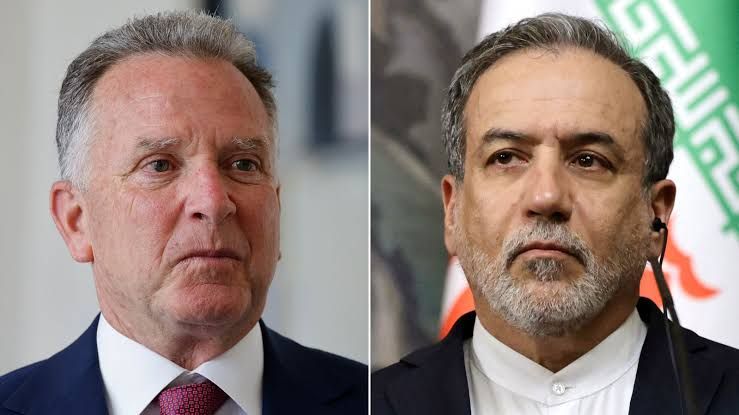
Senior US and Iranian officials are meeting in Oman for talks amid a crisis that has raised fears of a potential military confrontation between the two countries.
The discussions follow a US military build-up in the Middle East, prompted by Iran’s violent crackdown on nationwide anti-government protests last month, which human rights groups say left thousands dead.
The exact scope of the talks, believed to be indirect, remains unclear, with both sides deeply divided and mutual mistrust running high.
Officials hope that, if successful, the discussions could lay the groundwork for broader negotiations.

AFP via Getty Images: A composite photo of US special envoy Steve Witkoff (left) and Iranian Foreign Minister Abbas Araghchi.
Senior US and Iranian officials are meeting in Oman for talks amid a crisis that has heightened fears of a potential military confrontation between the two nations.
The discussions follow a US military build-up in the Middle East, triggered by Iran’s violent crackdown on nationwide anti-government protests last month, which human rights groups say left thousands dead.
The exact scope of the talks—believed to be indirect—remains unclear, with both sides deeply divided and mutual mistrust running high. Officials hope that, if successful, the discussions could lay the groundwork for broader negotiations.
The US, led by special envoy Steve Witkoff, is demanding that Iran freeze its nuclear programme, dismantle its stockpile of enriched uranium, and address concerns over its ballistic missiles, support for regional armed groups, and treatment of citizens.

Iran, headed by Foreign Minister Abbas Araghchi, has said the talks will be limited to its nuclear programme, and it remains uncertain whether these differences will be resolved.
Oman confirmed that its foreign minister held separate meetings on Friday with Araghchi, Witkoff, and US presidential envoy Jared Kushner to “prepare the appropriate conditions for resuming diplomatic and technical negotiations.” The last round of talks over Iran’s nuclear programme, scheduled for June 2025, collapsed after Israel’s surprise attack on Iranian targets.
In recent weeks, former President Trump has threatened military action if Iran fails to reach a deal. The US has deployed thousands of troops and what Trump described as an “armada” to the region, including an aircraft carrier, additional warships, and fighter jets.

Iran has vowed to respond to any attack with force, warning it would target American military assets in the Middle East as well as Israel.
AFP via Getty Images: A composite photo of US special envoy Steve Witkoff (left) and Iranian Foreign Minister Abbas Araghchi.
Senior US and Iranian officials are meeting in Oman for talks amid a crisis that has raised fears of a potential military confrontation between the two countries.
The discussions follow a US military build-up in the Middle East, triggered by Iran’s violent crackdown on nationwide anti-government protests last month, which human rights groups say left thousands dead.
The scope of the talks—believed to be indirect—remains unclear, with both sides deeply divided and mutual mistrust running high. Officials hope that, if successful, the discussions could provide a framework for broader negotiations.
The US delegation, led by special envoy Steve Witkoff, is pressing Iran to freeze its nuclear programme and dispose of its stockpile of enriched uranium.

Washington has also demanded that the talks address Iran’s ballistic missiles, support for regional armed groups, and human rights record.
Iran, headed by Foreign Minister Abbas Araghchi, has insisted the discussions will focus solely on its nuclear programme, and it is unclear whether these differences will be resolved.
Oman confirmed that its foreign minister held separate meetings on Friday with Araghchi, Witkoff, and US presidential envoy Jared Kushner to “prepare the appropriate conditions for resuming diplomatic and technical negotiations.” The last round of talks over Iran’s nuclear programme, scheduled for June 2025, collapsed after Israel launched a surprise attack on Iranian targets.
In recent weeks, former President Trump has threatened military action if Iran fails to reach a deal. The US has deployed thousands of troops and what Trump described as an “armada” to the region, including an aircraft carrier, additional warships, and fighter jets.
Iran has vowed to respond to any attack with force, warning it would target American military assets in the Middle East as well as Israel.

For Iran’s embattled leaders, these talks could be a last chance to avert US military action that could further destabilize the regime, which analysts say is in its weakest position since the 1979 Islamic Revolution.
Trump’s threats come amid a brutal security crackdown on large-scale demonstrations triggered by Iran’s deepening economic crisis, with protesters calling for the end of the Islamic Republic. The Human Rights Activists News Agency, a Washington-based group, has confirmed at least 6,883 deaths and warned that the toll could be much higher, with more than 50,000 people arrested.
The crisis has renewed international focus on Iran’s nuclear programme, which has long been a point of contention with the West. Iran maintains its programme is peaceful, while the US and Israel accuse Tehran of seeking nuclear weapons. Iran insists on its right to enrich uranium domestically and has rejected calls to transfer its stockpile of 400kg (880lb) of highly enriched uranium to a third country.
Source: BBC
Invest or Donate towards HICGI New Agency Global Media Establishment – Watch video here
Email: editorial@hicginewsagency.com TalkBusiness@hicginewsagency.com WhatsApp +256713137566
Follow us on all social media, type “HICGI News Agency” .
 HICGI News Agency