
Updated by Faith Barbara N Ruhinda and Erick Kikomeko at 1525 EAT on Monday 9 February 2026
On February 12, Bangladesh will go to the polls to elect its next government, 18 months after Prime Minister Sheikh Hasina was ousted by a student-led movement.
Hasina, the daughter of Sheikh Mujibur Rahman, the country’s independence leader, previously served as prime minister from 1996 to 2001 and again from 2009 until August 2024. She was forced to flee to India following a violent crackdown on protesters, which reportedly left around 1,400 people dead.
The 2026 elections are shaping up to be among the most consequential in Bangladesh’s 55-year history, following the country’s independence from Pakistan in 1971.
With a population exceeding 173 million, Bangladesh is the world’s eighth most populous country. Over the past 25 years, its economy has been one of the fastest-growing globally, although growth has slowed in recent years.
Bangladesh is predominantly Muslim, with more than 90 percent of the population adhering to Islam, around 8 percent practising Hinduism, and the remainder following other faiths.
The country’s gross domestic product (GDP) is estimated at $461 billion, with a per capita income of $1,990. According to Bangladesh Bank, GDP grew by 3.97 percent in the fiscal year ending June 2025, slightly down from a 4.22 percent rise the previous year.
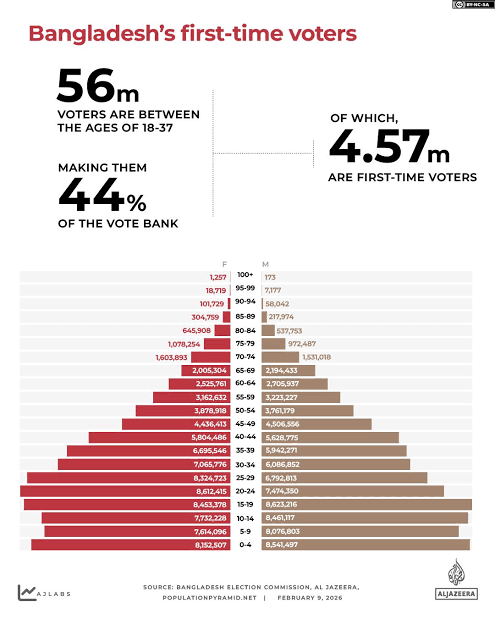
Of Bangladesh’s eligible voters aged 18 and above, roughly 56 million—or 44 percent—are between 18 and 37 years old, while nearly 5 million will be casting their ballots for the first time.

Bangladesh is one of the most densely populated countries in the world, with 1,366 people per square kilometre (3,538 per square mile)—nearly three times the population density of India and four times that of Pakistan.
The country’s largest city, the capital Dhaka, is home to over 37 million people—more than the entire populations of Malaysia, Saudi Arabia, or Australia.
Bangladesh is a parliamentary republic, where executive power rests with an elected government led by the prime minister and cabinet.
The president serves as the ceremonial head of state and is indirectly elected by parliament for a five-year term.

The prime minister, as leader of the majority party or coalition in parliament, appoints the cabinet, sets government policy, and oversees the civil service.
Legislative authority in Bangladesh rests with the Jatiya Sangsad, the country’s parliament, which comprises 350 seats. Of these, 300 are directly elected, while 50 are reserved for women and allocated proportionally based on party vote share. Members serve five-year terms.
Administratively, Bangladesh is divided into eight divisions, 64 districts, and 495 upazilas (councils). Local governments oversee municipal services, education, and rural development, but remain heavily dependent on funding and authority from the central government.
In the 2026 election cycle, Bangladesh has 59 registered political parties, not including the Awami League, Prime Minister Sheikh Hasina’s party, which has had its registration suspended by the election commission, preventing it from fielding candidates.

Of the remaining parties, 51 are actively contesting the elections. In total, 1,981 candidates are running, including 249 independents.
Bangladesh Nationalist Party (BNP) – Led by Tarique Rahman, the son of the late former Prime Minister Khaleda Zia, the BNP is one of Bangladesh’s two major traditional parties. It positions itself as a nationalist and conservative alternative to the Awami League.
Jamaat-e-Islami – Led by Shafiqur Rahman, this Islamic party advocates for governance based on religious principles. It has formed an electoral alliance with the National Citizen Party (NCP) and other Islamic parties.
National Citizen Party (NCP) – Formed by student leaders of the 2024 uprising, the NCP is a centrist party focused on citizen-led governance and political reform. It has attracted attention from younger voters and civil society groups amid growing dissatisfaction with the country’s established parties.

Jatiya Party (JP-Quader) – A centre-right faction of the Jatiya Party, led by Ghulam Muhammed Quader.
Jatiya Party (JP-Ershad) – Another centre-right faction, led by Anisul Islam Mahmud, with roots in the military rule of former President Hussain Muhammad Ershad during the 1980s.
Left Democratic Alliance – A coalition of left-wing parties, including the Communist Party of Bangladesh and several socialist groups.
Amar Bangladesh Party (AB Party) – A centrist party positioning itself as a reform-oriented alternative to the established political blocs, appealing to voters seeking a break from traditional party politics.
Previous election results
Bangladesh’s electoral landscape over the past two decades has been dominated by the Awami League. The party returned to power in 2009 following a decisive defeat of the Bangladesh Nationalist Party (BNP), which had governed from 2001 to 2006.
democratic institutions.

Source: Aljazeera
Invest or Donate towards HICGI New Agency Global Media Establishment – Watch video here
Email: editorial@hicginewsagency.com TalkBusiness@hicginewsagency.com WhatsApp +256713137566
Follow us on all social media, type “HICGI News Agency” .
 HICGI News Agency