
Updated by Faith Barbara Ruhinda N at 1629 EAT on February 2026
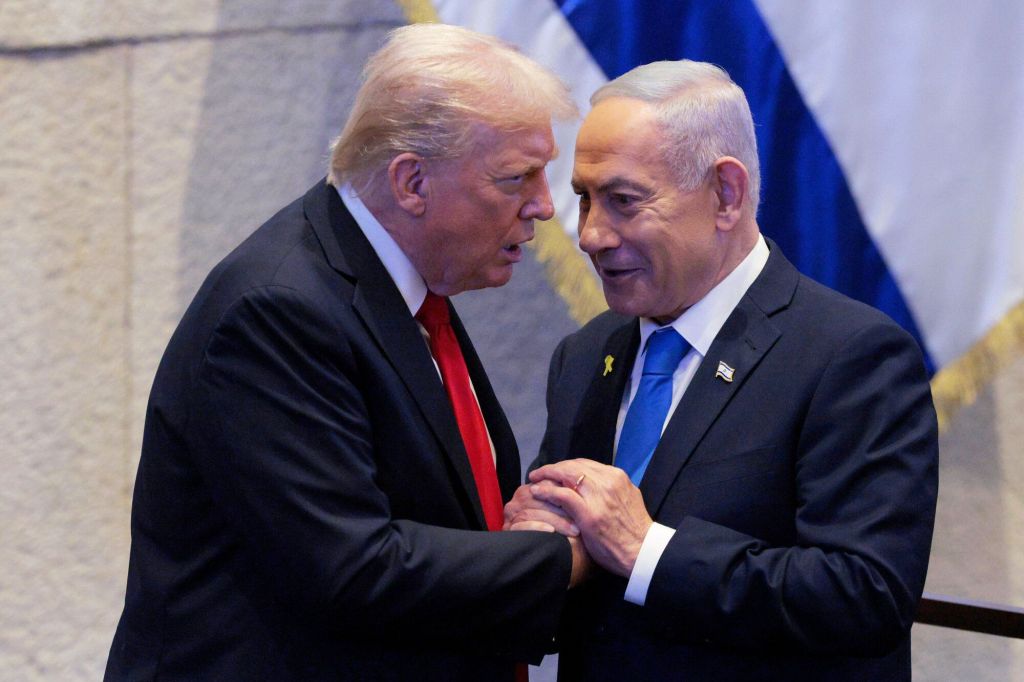
President Donald Trump will host Israeli Prime Minister Benjamin Netanyahu at the White House on Wednesday, as tensions mount across the Middle East and negotiations over Iran’s nuclear programme intensify.
Netanyahu is expected to urge Trump to pursue a deal that would not only curb Iran’s uranium enrichment but also restrict its ballistic missile programme and limit support for proxy groups such as Hamas and Hezbollah.
“I will present to the president our outlook regarding the principles of these negotiations,” Netanyahu said before departing for the United States.

Iran has indicated it is willing to limit its nuclear programme in exchange for sanctions relief but has rejected other demands, including restrictions on its missile programme and regional activities.
Ahead of his White House meeting, Iranian President Masoud Pezeshkian warned Tehran would “not yield to their excessive demands.”
Israeli Prime Minister Benjamin Netanyahu is visiting Washington for the sixth time since Donald Trump took office, more than any other world leader. A close Trump ally, Netanyahu has repeatedly warned that Iran poses an existential threat to Israel and pushed for U.S. action to limit Tehran’s regional influence.

“The prime minister believes that any negotiations must include limiting ballistic missiles and ending support for the Iranian axis,” Netanyahu’s office said ahead of his trip.
After arriving in Washington on Tuesday, Netanyahu met Trump’s special envoy Steve Witkoff and son-in-law Jared Kushner, who briefed him on the first round of negotiations with Iran last Friday.
The visit comes as the U.S. strengthens its military presence in the Middle East. Trump has warned Tehran of strikes if it fails to reach a deal on its nuclear programme and stops suppressing protests.

On Tuesday, the president said he was “thinking” about sending a second aircraft carrier strike group to the region. The USS Abraham Lincoln carrier group was deployed last month following Trump’s threat of military action in response to Iran’s deadly crackdown on nationwide protests.
“We have an armada that is heading there and another one might be going,” Trump told Axios. “Iran wants to make a deal very badly,” he added, while emphasizing that a diplomatic solution remained possible. Speaking to Fox Business, Trump said a strong deal would mean “no nuclear weapons, no missiles.”
In a speech at a rally in Tehran on Wednesday marking the 47th anniversary of Iran’s Islamic Revolution, President Masoud Pezeshkian said, “Our Iran will not yield in the face of aggression, but we are continuing dialogue with all our strength with neighbouring countries to establish peace and stability in the region.”
Pezeshkian also reiterated that Iran “is not seeking to acquire nuclear weapons. We have stated this repeatedly and are ready for any verification,” he added.

Israeli officials, however, have emphasized that their country reserves the right to take military action against Iran if it fails to reach a nuclear agreement with the United States.
Netanyahu faces pressure from far-right allies in his government to use his ties with Trump to secure a broad U.S.-Iran deal that addresses Israel’s security concerns, experts say.
“Israel is concerned that in the haste to get a deal with Iran, the president might embrace a deal that doesn’t address Iran’s missile programme, support for proxy groups, or that leaves some remnants of its nuclear programme,” said Daniel Byman, professor at Georgetown University’s School of Foreign Service. “One worry Israel and other allies have under Trump is that he wants a deal more than he wants a particular outcome.”

Analysts note that Iran’s leadership is in a weaker position following last year’s mass protests and a 12-day U.S.-Israel air campaign targeting nuclear and military sites.
“The Iranian regime today is really vulnerable,” said Mohammed Hafez, a professor at the Naval Postgraduate School and Middle East politics expert. “The U.S. and Israel feel they hold all the cards, Iran is on its back foot, and they can make these maximalist demands.”
Trump withdrew the United States from the Obama-era nuclear deal with Iran during his first term and reinstated sanctions that have severely strained the country’s economy. His administration resumed talks last year in an effort to reach a new agreement before tensions escalated between Israel and Iran.
Source: BBC
Invest or Donate towards HICGI New Agency Global Media Establishment – Watch video here
Email: editorial@hicginewsagency.com TalkBusiness@hicginewsagency.com WhatsApp +256713137566
Follow us on all social media, type “HICGI News Agency” .
 HICGI News Agency