
Updated by Faith Barbara N Ruhinda at 1259 EAT on Thursday 12 February 2026
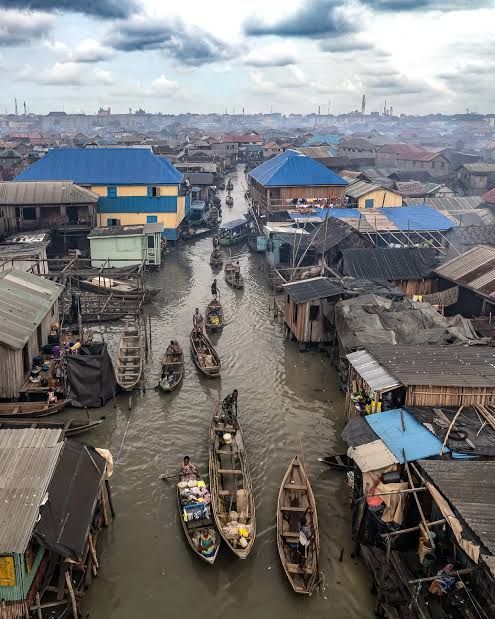
Lagos, Nigeria – Tunde Agando was paddling back to the Makoko floating settlement in his canoe one January afternoon after taking his mother to the market when he saw an amphibious excavator tearing into his family’s home.
By the time he could get close, the large stilted house where he lived with 15 relatives had been reduced to rubble. Everything inside — clothes, furniture, his brothers’ carpentry tools used to build wooden canoes, and even his phone left charging — had been swallowed by the lagoon.

Residents, angered by the demolition, attempted to confront the operators, but police officers accompanying them fired tear gas to disperse the crowd.
“We now sleep on mats under a shed outside our pastor’s house as we try to recover what we can and figure out what to do next,” said Agando, 30, who is grappling with sudden homelessness. His barber shop was also torn down later that day.
Agando is among thousands of Makoko residents forcibly evicted by the Lagos State government in a demolition drive that began in late December. The operation was halted earlier this month after the Lagos State House of Assembly ordered a suspension.
State authorities said the demolitions were necessary because parts of the community lie too close to an overhead power line and residents needed to relocate at least 100 metres (109 yards) away. However, non-profit organisations working in Makoko say the clearance extended far beyond that limit — between 250 and 500 metres (about 270 to 550 yards) into the settlement. They say the demolitions destroyed homes, displaced thousands of people and resulted in the deaths of more than 12 residents, including two infants.

During the weeks of demolitions, the surrounding waters were crowded with canoes piled high with beds, cooking pots and other household belongings, as anxious residents scrambled to salvage their valuables in case the operation reached their homes. No plans have been announced to resettle or compensate those affected.
“They did not stop where they said they would — they just kept demolishing,” said Innocent Ahisu, a community leader.
“This is where we live and earn our livelihood. We are all distressed and uncertain about what the future holds for us.”
Makoko, often dubbed the “Venice of Africa,” is a historic fishing community dating back to the 19th century, built on stilts along the Lagos lagoon. Overlooking the Third Mainland Bridge — which links the affluent Lagos Island to the mainland — the settlement is home predominantly to fishing families who have lived and worked on these waters for generations.

An economic hub in its own right, Makoko supplies markets across the city with fresh and dried seafood, sustaining both local livelihoods and Lagos’s broader food network.
Home to an estimated 200,000 people, Makoko has long struggled with poverty and limited government investment in basic services and infrastructure, conditions that have led many to classify it as a slum. Yet its maze of waterways — where canoes ferry residents and vendors sell daily necessities and food — and its distinct cultural identity have made it a draw for visitors. While much of the community is built on water, sections of it extend onto land.
On a typical day, the glow of sunset reflecting off the lagoon, smoke rising from wooden homes and children swimming nearby lend Makoko a striking, if rugged, beauty — a landscape shaped as much by hardship as by resilience.

In recent weeks, however, parts of the settlement have resembled the aftermath of a storm, with splintered wooden frames jutting from the water where homes once stood.
At one of Makoko’s many dried-fish processing hubs, women said they feared the demolitions would devastate their livelihoods.
“We hope they can see that we are human and stop demolishing our homes,” said an elderly woman, who declined to be named, speaking in the local Egun dialect.
Observers warn that the evictions are likely to deepen hardship for residents already disproportionately affected by Nigeria’s cost-of-living crisis.
This Makoko is everything we have. My family lives here, my children go to school here, and we have nowhere else to go,” she said, her voice edged with frustration.
Victoria Ibezim-Ohaeri, executive director of Spaces for Change, a Lagos-based civil society organisation that advocates for urban governance, gender rights and environmental justice, said the demolitions have had a devastating impact on residents like Ekpoesi.
“There has been disruption to children’s education, rising homelessness and heightened vulnerability — especially among women, people with disabilities and elderly members of the community,” she said.
Beyond the immediate displacement, critics warn of longer-term social and cultural losses. Deji Akinpelu, co-founder of Rethinking Cities, an NGO that campaigns against the exclusion of the urban poor, said the demolitions threaten communal land ties and a shared sense of belonging.

“Heritage will be lost. History will be lost,” he said.
Many residents say the absence of a clear resettlement plan has compounded their hardship. Some are staying with friends and relatives, while others sleep in their canoes or in the remains of their damaged homes.
Although the state government pledged on February 4 to provide financial assistance, Lagos State Commissioner for Information Gbenga Omotoso told Al Jazeera that compensation would be determined only after affected residents are counted and documented.
Akinpelu argued that compensation and resettlement should have been addressed before the demolitions began, not considered afterward.
Advocates such as Ibezim-Ohaeri contend that the failure to negotiate and provide prompt compensation violates constitutional protections, which prohibit the demolition of property without due process and adequate redress.
Lagos State Governor Babajide Sanwo-Olu has defended the operation, saying: “What we are doing is not demolishing the whole of Makoko. We are clearing areas to ensure they do not encroach on the Third Mainland Bridge and to keep residents away from high-tension lines.”
Although the government has cited safety concerns for the demolitions, activists argue that other interests may be driving the operation. Last year, local media reported that the state had signed an agreement with a private developer to build a housing estate in Makoko and subsequently began sand dredging and land reclamation opposite the community.
“The unofficial reason is that Makoko occupies highly coveted waterfront land,” Ibezim-Ohaeri said. “It sits along the lagoon, visible from the Third Mainland Bridge. That intersection of urban poverty and high-end real estate development creates enormous pressure.”
Forced evictions and demolitions are not new in Nigeria’s commercial capital. Critics say they reflect a longstanding pattern in which informal settlements and waterfront communities are cleared to make way for upscale residential and commercial projects
Source: Aljazeera.
Invest or Donate towards HICGI New Agency Global Media Establishment – Watch video here
Email: editorial@hicginewsagency.com TalkBusiness@hicginewsagency.com WhatsApp +256713137566
Follow us on all social media, type “HICGI News Agency” .
 HICGI News Agency