
Updated by Faith Barbara N Ruhinda at 1351 EAT on Thursday 12 February 2026
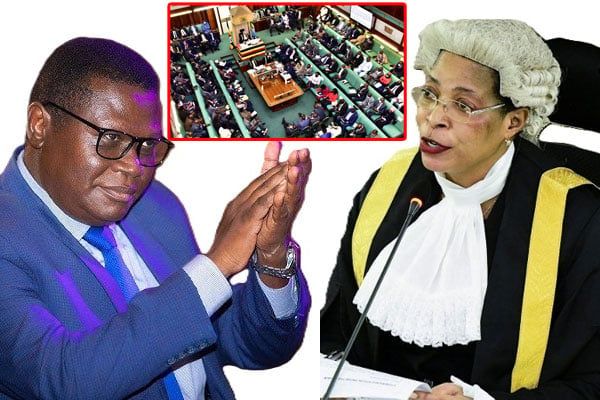
The contest for Uganda’s 12th Parliamentary Speakership has exposed a subtle but high-stakes struggle within the ruling National Resistance Movement (NRM), with incumbent Speaker Anita Among quickly emerging as the focal point of the party’s narrowing consensus.
When Norbert Mao suggested in media interviews that the Speakership should be open to wider competition, his remarks sparked an immediate reaction. Within days, pro-NRM voices flooded the airwaves, lauding Among as a “steady hand” and cautioning against what some legislators called “destabilising experiments” during a delicate political period.

The rapid response highlighted the party’s intentions. Senior NRM figures avoided outright endorsements, but their repeated calls for “discipline” and “unity” were widely interpreted as a signal that the establishment was rallying behind the incumbent.
Among, for her part, has embraced the optics of continuity, appearing alongside key NRM figures and portraying her tenure as evidence that Parliament can be both efficient and aligned with the government’s agenda.
What began as a speculative comment by Mao has since evolved into a broader debate over who controls the institutional nerve centre of Uganda’s legislature. The Speakership contest is no longer merely procedural; it has become an early test of how power will be negotiated, defended, and consolidated within the NRM as the 12th Parliament takes shape.

Over the past decade, the Speakership has grown beyond a routine parliamentary election. It now serves as a revealing lens through which to observe the tension between constitutional design and political practice in Uganda’s semi-dominant party system.
Any assessment of a potential Mao bid must go beyond personalities and grapple with the structural realities: the consolidation of power within the NRM, the growing institutional influence of Speaker Anita Among, and the precedents set by previous speakership battles, most notably the turbulent Oulanyah–Kadaga contest.
The Speakership as an Institutional Pivot
The Constitution positions the Speaker as a guardian of parliamentary independence, responsible for presiding over debates and ensuring procedural fairness across party lines. In theory, the office serves as a buffer against executive overreach.

In practice, however, it has increasingly become a space where ruling-party negotiations and executive preferences intersect with parliamentary procedure. This is characteristic of dominant-party systems, where formal electoral competition exists alongside entrenched incumbency.
Control over agenda-setting, committee assignments, and disciplinary mechanisms gives the Speaker authority that extends well beyond ceremonial duties. In this context, speakership elections become moments of internal recalibration rather than neutral, procedural exercises.
Norbert Mao: Credentials and Constraints
Norbert Mao occupies a distinctive place in Uganda’s political landscape. A long-time opposition figure and president of the Democratic Party, his career has been defined by constitutional advocacy, debates over decentralisation, and governance reform.
His legal training and experience as a former district chairperson provide the procedural expertise expected of a Speaker. Yet in Uganda, parliamentary politics are rarely determined by credentials alone.

Mao’s recent overtures to the ruling establishment complicate his positioning. For some, they represent pragmatic bridge-building in a deeply polarised legislature; for others, they raise doubts about his independence and trustworthiness.
A Mao speakership would be seen less as a neutral appointment and more as a test of how flexible the line between opposition identity and ruling-party accommodation has become.
His task would not only be to win votes but also to reassure entrenched NRM networks that his leadership would not unsettle a system built on predictability and strict internal discipline.
The late Jacob Oulanyah’s victory over Rebecca Kadaga offers a revealing precedent. The contest exposed how speakership battles often mirror deeper factional struggles within the NRM, highlighting regional alliances, generational rivalries, and succession concerns.
It also showed how executive preferences can influence parliamentary outcomes without formally overriding constitutional rules. Speakership elections in Uganda are technically democratic, but the range of viable candidates is largely shaped by internal party consensus—the arena is carefully managed, not truly open.

Anita Among and the Logic of Consolidation
Since assuming office, Anita Among has shed the image of a transitional figure, emerging as a central political actor in her own right. Her leadership—widely regarded as assertive and disciplined—has helped her maintain party cohesion and consolidate her influence within the ruling NRM.
Her rise reflects a broader pattern of incumbency consolidation. In dominant-party systems, incumbents who embed themselves within organisational and patronage networks build resilience against challengers.
Among’s conduct during the most recent electoral cycle reinforced perceptions of loyalty and institutional reliability—qualities that carry considerable weight in internal calculations.
This shifts the playing field for any challenger. Unlike the Oulanyah–Kadaga race, which pitched two insiders against each other, a Mao bid would face an incumbent whose authority is still expanding. The imbalance lies not only in party affiliation but also in the depth of her networks.
Predictability Over Experiment
President Yoweri Museveni’s long tenure has consistently prioritised institutional predictability. From this perspective, the Speakership is too consequential to be left to volatile contestation.
Executive preferences may not dictate outcomes outright, but they set the parameters of acceptable competition. A Mao speakership would only be viable if framed as reinforcing, rather than destabilising, the prevailing equilibrium. In dominant-party systems, compatibility often outweighs innovation.
What the Contest Reveals
The emerging dynamics favour consolidation over recalibration. Anita Among embodies continuity and embeddedness, while Norbert Mao represents symbolic broadening and negotiated repositioning.
Source: Observer
Invest or Donate towards HICGI New Agency Global Media Establishment – Watch video here
Email: editorial@hicginewsagency.com TalkBusiness@hicginewsagency.com WhatsApp +256713137566
Follow us on all social media, type “HICGI News Agency” .
 HICGI News Agency