
Updated by Faith Barbara N Ruhinda at 1355 EAT on Monday 16 February 2026
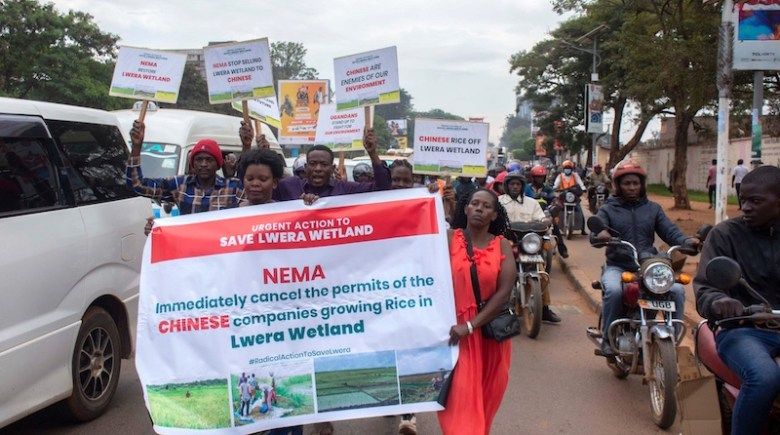
When eight environmental activists walked into the headquarters of Uganda’s National Environment Management Authority (NEMA) last October, they believed they were exercising a basic civic right.
Carrying a petition and acting peacefully, their demand was straightforward: halt what they described as state-backed degradation of the Lwera wetland. By nightfall, however, they were in custody.
The activists aimed to draw attention to the ongoing destruction of Lwera wetland, a fragile ecosystem that stretches nearly 20 kilometres along the Kampala–Masaka highway. They warn that the wetland, vital for biodiversity and local communities, is under increasing threat.

Instead of addressing their petition, police arrested the activists at NEMA’s offices, charging them with causing a public nuisance. The following day, they were taken to court and remanded to prison, where they spent a full month before securing bail. For the activists, prison marked not the end of their ordeal, but the beginning.
Since their release, several have reported being threatened, assaulted, and intimidated into silence. Unknown callers warned them to abandon the Lwera campaign, while others claim they have been physically attacked, raising troubling questions about who benefits from the wetland’s continued exploitation.
“I was coming back from the shop at the trading centre when I found some strangers,” said Zaina (surname withheld), one of the activists arrested at NEMA.

“They beat me and took my phone,” said Zaina (surname withheld), one of the activists arrested at NEMA. “All they wanted to know was why we continued to fight for the Lwera wetland and what stake we had in it.” The threats, she says, have left her and her colleagues constantly on edge.
“We are still facing the charges brought against us, and now we are being intimidated and threatened as well,” Zaina added. “Please help us—we live in constant fear.”
Lwera Wetland Destruction Threatens Local Livelihoods, Activists Say
For residents near Lwera, the wetland is not an abstract environmental concern — it directly affects their livelihoods and health.
Fiona Nalusiba, another activist, said that illegal activities, particularly sand mining and rice farming, have worsened flooding in nearby villages.

“These days we are very vigilant,” she said. “We have received numerous phone calls telling us to drop the Lwera issue once and for all.”
Nalusiba explained that wetlands naturally serve as buffers, trapping excess water and preventing floods, making them essential for community safety and environmental stability.
“But when sand is mined from the lake shores, those natural barriers are removed,” said Fiona Nalusiba, an activist.
“During the rainy season, all the water floods into our gardens,” she added, noting that chemicals used in rice farming have worsened the problem.
“The chemicals contaminate the water we all share,” she said. “On the days they spray rice, the entire village — children and adults alike — suffers from runny stomachs.”

Nalusiba also accused the Uganda Wildlife Authority of ignoring warning signs. “Sometimes you find heaps of dead birds after drinking from the same water,” she said. “That should be a clear sign that there is a problem. But no one seems to care.”
For some activists, the price of protest has been both economic and physical.
Nasser Jafali, a resident of Kamuwunga in Masaka, said that after returning from prison, he discovered he had lost his job at a factory run by Chinese managers.
“By the time I came back, my colleagues told me I had been fired,” he said. “We are not the ones degrading the wetland, yet we are the ones suffering.”
He highlighted the impact on his family: “My mother’s clinic was destroyed by flooding caused by illegal sand mining in the wetland.”
The campaign to protect Lwera Wetland has not spared even those representing the activists.

Joachim Mumbere, executive director of the Weka Afri Sustainable Biodiversity and Food Security Foundation, says he has received anonymous threats from unknown individuals.
“Not once, not twice,” Mumbere said. “These people have agents in the villages.” He claims some callers have even offered bribes to make me stay silent.
“They asked me to name my price so we would drop the Lwera issue,” he added. Mumbere alleges that illegal sand-mining licences are being issued to powerful companies.
“Most of these operations are corrupt,” he said. “They bypass legal procedures and continue without environmental impact assessments.”
Efforts to get local leaders to speak publicly about the wetland have hit a wall. Attempts to reach the chairperson of Kamuwunga village were unsuccessful. Through intermediaries, the chairperson reportedly said he did not want to discuss Lwera with the media.
“The silence is loud,” said Nasser Jafali, one of the activists. He claims repeated attempts to organise a joint petition with local leaders have failed. Joachim Mumbere believes bribery is behind the inaction.
“It starts at LC1 level,” he said. “We have tried to work with them, but they are not cooperative. Corruption goes from the bottom to the top.”
A Long, Unfinished Fight
The struggle over Lwera Wetland did not begin last year. Residents say they have heard promises before. President Yoweri Museveni once pledged to cancel land titles of individuals occupying the wetland — a promise that, they say, remains unfulfilled.
For now, the activists remain caught between the law and fear, punished for speaking out and threatened for refusing to stop. Lwera’s reeds still sway beside the highway, hiding a quiet battle fought by villagers who say they are paying a heavy price for defending land that once protected them.
Source: Observer
Invest or Donate towards HICGI New Agency Global Media Establishment – Watch video here
Email: editorial@hicginewsagency.com TalkBusiness@hicginewsagency.com WhatsApp +256713137566
Follow us on all social media, type “HICGI News Agency” .
 HICGI News Agency