
Updated by Faith Barbara N Ruhinda at 1232 EAT on Monday 16 March 2026
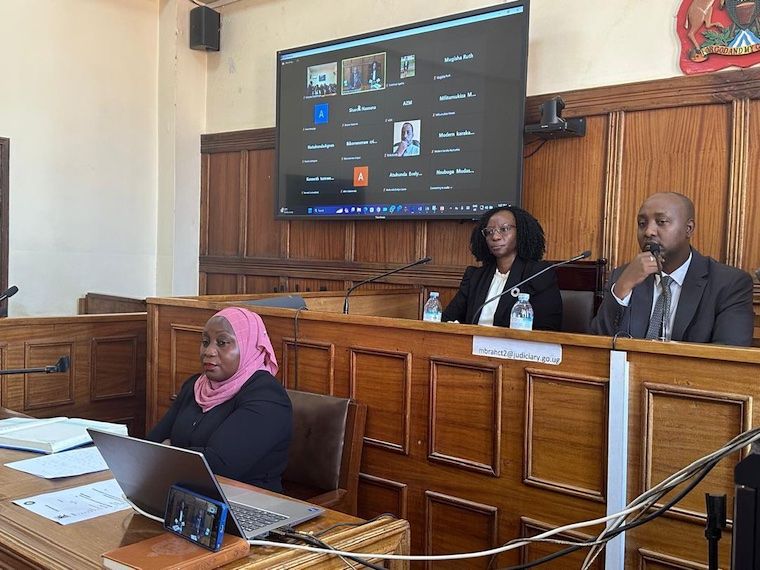
The High Court has affirmed that judges possess inherent authority to regulate media coverage of court proceedings.
Justice Collins Acellam emphasized that courts must strike a balance between the constitutional right to freedom of expression and the right to a fair trial, while also considering the broader public interest.
The ruling followed a judicial review application filed by journalist Livingstone Matovu, who challenged a directive from the Mengo Chief Magistrate’s Court prohibiting media houses from audio and video recording during the ongoing criminal trial of a city pastor.

The High Court has ruled that judges have the inherent authority to regulate media coverage of court proceedings, including limiting live broadcasts.
Justice Collins Acellam delivered the ruling in a case brought by journalist Livingstone Matovu, who challenged a directive issued by the Mengo Chief Magistrate’s Court. The directive barred media houses from audio and video recording during the ongoing criminal trial of a city pastor and required journalists to undergo verification before being allowed into the courtroom.
Matovu argued that the restrictions were arbitrary and interfered with the work of the media. He contended that the order risked undermining transparency in the judicial process and could lead to a miscarriage of justice. Matovu further claimed that the magistrate’s decision ignored the legal principles governing the exclusion of the public or press from court proceedings.

However, Justice Acellam held that while the principle of open justice guarantees public access to court proceedings, it does not automatically grant the media a constitutional right to broadcast or transmit proceedings live. He emphasised that a courtroom open to the public should not automatically be treated as a media studio for live coverage.
The judge cited Article 43 of the Constitution, noting that rights may be limited where such restrictions are demonstrably justifiable in a free and democratic society and do not exceed what is acceptable. In this case, he observed that the magistrate’s measures were regulatory, intended to protect the integrity of the trial process, and fell within the statutory powers of the court.
Justice Acellam highlighted Section 40(1) of the Magistrates Courts Act, which grants magistrates authority to regulate their proceedings, including excluding members of the public where necessary in the interests of justice. Beyond statutory provisions, he said courts also possess inherent jurisdiction to control their own processes to maintain order, protect the rights of the accused, and prevent prejudice during a trial.

Importantly, the judge noted that the magistrate’s order did not close the courtroom to the public but simply prohibited live audio and video recording, while requiring media personnel to be verified and accredited before attending.
He described these measures as a way to regulate conduct in court rather than deny public access.
Justice Acellam also observed that courts across common law jurisdictions have increasingly recognised the risks associated with electronic broadcasting of proceedings, citing concerns over trial integrity and the potential for undue influence.
Such risks, Justice Acellam noted, include witness intimidation, the rapid spread of prejudicial commentary on social media during an ongoing trial, and the permanence and potential distortion of digital recordings once they circulate online.
He concluded that Matovu had failed to prove that the magistrate acted beyond the scope of her statutory or inherent authority. The judge added that the prosecution’s concerns over potential prejudice from social media commentary were legally relevant considerations for the magistrate when making her decision.

The court also found no evidence of bias, bad faith, or procedural impropriety in the magistrate’s actions. Justice Acellam therefore ruled that the judicial review application lacked merit, reaffirming that courts retain the authority to regulate the broadcasting of proceedings where necessary to protect the fairness and integrity of a trial.
-Observer
Invest or Donate towards HICGI New Agency Global Media Establishment – Watch video here
Email: editorial@hicginewsagency.com TalkBusiness@hicginewsagency.com WhatsApp +256713137566
Follow us on all social media, type “HICGI News Agency” .
 HICGI News Agency