
Updated by Faith Barbara N Ruhinda at 1215 EAT on Monday 23 March 2026
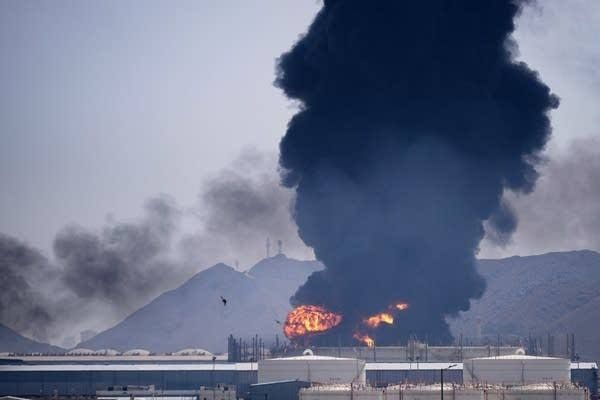
Israel and the United States have launched a new series of strikes against Iran, as Tehran responded with renewed attacks on its Gulf neighbours and warned of potential retaliatory strikes on power plants in Israel and other regional countries.
The escalation comes amid growing tensions in the region, with Iranian officials pledging to target energy infrastructure if their own facilities are attacked.
On Monday, the Israeli military announced it had “begun a wide-scale wave of strikes” on infrastructure targets in Tehran, without immediately providing further details.

US Central Command (CENTCOM) chief, Admiral Brad Cooper, claimed in an interview that Iran was launching missiles and drones from populated areas, implying that those locations could be targeted. Israel, however, has provided no evidence to support its assertions. Similar claims have previously been used to justify attacks on civilian areas in Gaza, which have suffered extensive destruction during more than two years of conflict.
The US military said it struck a turbine engine production facility in Qom province, north-central Iran, which is reportedly involved in producing components for drones and aircraft linked to the Islamic Revolutionary Guard Corps (IRGC).
Al Jazeera Arabic’s correspondent in Tehran, Suhaib al-Asa, described the explosions in the Iranian capital as “unprecedented,” particularly on the eastern side of the city, noting their scale and intensity.
Iranian air defence systems were activated in the eastern part of Tehran, according to Al Jazeera Arabic correspondent Suhaib al-Asa, suggesting a response to US and Israeli drones operating over that area.

Iran’s Fars news agency reported that a strike on a residential building in Khorramabad, west of Tehran, killed one child and injured several others. In Tabriz, at least six people were killed in attacks on residential homes.
Majid Farshi, director general of crisis management for Iran’s East Azerbaijan province, confirmed that the city of Tabriz experienced two deadly attacks, highlighting the human toll of the ongoing strikes.
A radio station in Bandar Abbas was struck, killing one person, while residents in Isfahan, Karaj, and Ahvaz reported hearing massive explosions. In Ahvaz, one hospital was reportedly damaged, Al Jazeera correspondent Suhaib al-Asa said from Tehran.
The Iranian Red Crescent Society reported that more than 80,000 civilian units have been affected, with some completely destroyed. This includes hospitals, schools, academic institutions, and Red Crescent facilities, highlighting the scale of the damage.
Across the border in Israel, Iranian missile strikes continued overnight, sending shrapnel across southern and central areas.
“In the past hour, sirens sounded in northern Israel amid what authorities believe is a coordinated attack by Hezbollah and Iran targeting the region simultaneously,” said Al Jazeera’s Nida Ibrahim.

She added that Israeli officials are signaling their intent to continue operations against Iran, expressing concern that the US may seek a premature end to the conflict. According to Ibrahim, the fighting with Hezbollah is only beginning, and further escalation is expected.
The latest wave of strikes came after US President Donald Trump issued a 48-hour ultimatum on Saturday, demanding that Tehran reopen the Strait of Hormuz to all shipping. Trump warned that failure to comply could result in the “obliteration” of Iran’s power plants.
Tehran has vowed to respond by fully closing the Strait of Hormuz, a critical chokepoint through which one-fifth of global oil passes, in retaliation for any threats.
On Monday, the Islamic Revolutionary Guard Corps (IRGC) warned that, should the US act, it would target power plants supplying electricity to US bases, along with economic, industrial, and energy infrastructure with American stakes.
“Do not doubt that we will do this,” the IRGC said in a statement broadcast on Iranian state television, emphasizing that any threat would be met with an equivalent response and cautioning that the US underestimates Iran’s capabilities.

According to Iran’s Ministry of Health, the death toll in the conflict has now surpassed 1,500. In Israel, 15 people have reportedly been killed by Iranian attacks.
The escalation of tit-for-tat strikes on civilian infrastructure has rattled global oil markets, with prices opening unevenly in Asian trading. Fatih Birol, head of the International Energy Agency, described the situation as “very severe,” warning that the current Middle East crisis is more serious than the two energy crises of the 1970s combined.
An Indian national living in the United Arab Emirates was injured by falling shrapnel after authorities intercepted a ballistic missile over an industrial area near Al-Dhafra Airbase on Monday.
The Islamic Revolutionary Guard Corps (IRGC) said its Khatam al-Anbiya headquarters had carried out attacks on Prince Sultan Airbase and the US Fifth Fleet in Bahrain using a combination of missiles and drones.
The escalation triggered warning sirens across Bahrain and Kuwait. Saudi authorities reported intercepting a missile aimed at Riyadh and neutralizing drones over the kingdom’s Eastern Province, a vital oil-producing region.
-Aljazeera
Invest or Donate towards HICGI New Agency Global Media Establishment – Watch video here
Email: editorial@hicginewsagency.com TalkBusiness@hicginewsagency.com WhatsApp +256713137566
Follow us on all social media, type “HICGI News Agency” .
 HICGI News Agency