
Updated by Faith Barbara N Ruhinda at 1334 EAT on Wednesday 25 March 2026
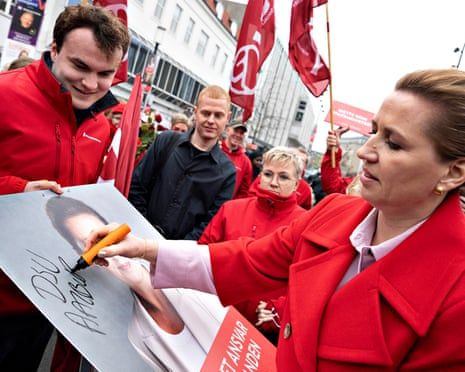
Prime Minister Mette Frederiksen’s Social Democrats emerged as the largest party in Tuesday’s Danish general election, but slumped to their weakest showing since 1903, leaving her left-wing coalition short of a majority.
With 21.9% of the vote, the Social Democrats retain the most seats in parliament, yet fall far short of the 90 needed to govern alone. The result raises questions over how Frederiksen will form a stable government.
Frederiksen, who has led the party since 2019, addressed supporters with a mix of regret and defiance. “I am sorry that we did not get more votes,” she said, but added: “There is nothing today that can make me sad that the Social Democrats have once again become the Danes’ absolute favourite political party.”


The Social Democrats’ main right-wing rival, the Liberal party Venstre, also recorded its worst result in a century, securing just 10.1% of the vote and falling behind the Green Left (SF).
Despite the historic lows for both major parties, Prime Minister Mette Frederiksen still has a path to a third term. Denmark’s coalition-based system, however, means prolonged negotiations—potentially lasting days or weeks—are now expected.
Twelve parties were on the ballot in a fiercely contested election. The left-wing “red bloc” claimed 84 seats, narrowly ahead of the right-wing “blue bloc,” which won 77 seats. Both blocs remain short of the 90-seat majority needed in Denmark’s 179-seat parliament, leaving the formation of a stable government uncertain.
“I have been responsible for this wonderful country for almost seven years,” Frederiksen told supporters. “I am still ready to take on responsibility as Denmark’s prime minister.”
The small centrist Moderates, holding 14 seats, now hold the balance of power. All eyes are on their leader, former Prime Minister Lars Løkke Rasmussen, whose decision could determine the next government.


Former Prime Minister Lars Løkke Rasmussen has quickly taken center stage in the post-election negotiations, gaining attention for his handling of the Greenland stand-off with the United States and going viral for a fist-bump with Vice President JD Vance and Secretary of State Marco Rubio in Washington.
With his signature pipe in hand, Rasmussen addressed supporters on Tuesday night, signaling his willingness to forge a centrist government. “We’re standing in the middle,” he said. “We’re ready.”
However, Troels Lund Poulsen, leader of the Liberals—the largest party in the right-wing blue bloc—has ruled out partnering with the Social Democrats again, urging Rasmussen instead to join the center-right. “It is possible to get a new direction in Denmark,” he said.
DR’s political correspondent, Christine Cordsen, has suggested that the most likely outcome is a center-left coalition comprising the Social Democrats, the Red-Greens, the Moderates, and the Danish Social Liberal Party.
The election marks a challenging outcome for Prime Minister Mette Frederiksen, whose popularity has waned after six years in office. Many Danes still credit her with successfully navigating international crises, including US President Donald Trump’s repeated attempts to acquire Greenland, a semi-autonomous Danish territory. Frederiksen, 48, called the election months earlier than scheduled, hoping that her handling of the Greenland situation would secure her a third term.
Ultimately, domestic issues dominated the campaign. Key voter concerns included the cost of living, the state of the economy, and welfare, alongside rising awareness of environmental issues such as high pesticide levels in drinking water from pig farming and the climate footprint of agriculture.
-BBC
Invest or Donate towards HICGI New Agency Global Media Establishment – Watch video here
Email: editorial@hicginewsagency.com TalkBusiness@hicginewsagency.com WhatsApp +256713137566
Follow us on all social media, type “HICGI News Agency” .
 HICGI News Agency