
Updated by Faith Barbara N Ruhinda at 1148 EAT on Wednesday 8 April 2026
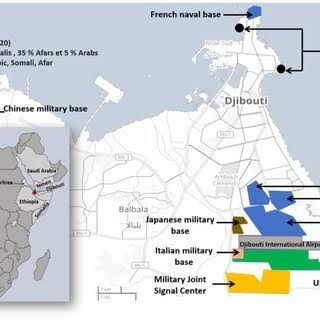
Djibouti, a small nation of fewer than one million people with limited natural resources, has emerged as a strategic focal point on the global stage.
Despite its size, it hosts the world’s densest concentration of foreign military bases. Forces from the United States, China, France, Japan and Italy operate in close proximity along its coastline, underscoring the country’s critical geopolitical importance.
Countries seeking a foothold for both commercial and security interests have found a willing partner in President Ismail Omar Guelleh. In power for more than two decades, Guelleh has leveraged Djibouti’s strategic location to advance national — and political.

As Djiboutians head to the polls on Friday, with Guelleh widely expected to secure a sixth term, that strategy has rarely appeared more consequential.
At the heart of Djibouti’s importance lies a critical maritime chokepoint just off its coast.
The Bab-el-Mandeb — or “Gate of Tears” — is a narrow passage barely 30 kilometres wide at its tightest point. Yet it carries roughly 12 percent of global maritime trade each day. Along the same route, undersea cables transmit nearly 90 percent of internet traffic between Europe and Asia.
“This region sits at the centre of many things — from global trade and shipping to fibre optic connectivity and energy — and is closely linked to the Suez Canal and the Indo-Pacific,” said Federico Donelli.
With the United States and Israel at war with Iran since February 28, and the Strait of Hormuz under Iranian control, Djibouti’s position at the entrance to the Red Sea has come into sharper focus.
Camp Lemonnier, a former French Foreign Legion outpost on the outskirts of Djibouti City, now serves as the headquarters of the United States’ Horn of Africa task force. It remains the only permanent US military base on the continent and hosts more than 4,000 personnel.
France, Djibouti’s former colonial power, had already maintained a military presence following independence in 1977. French President Emmanuel Macron recently described Djibouti as central to Paris’s Indo-Pacific strategy, with a mutual defence pact between the two countries renewed in 2024.
The rise of piracy off Somalia’s coast in the late 2000s drew additional powers, including Japan, Italy and eventually China, to establish a presence in the country.
“Many countries with military bases in Djibouti emphasise protecting their commercial and investment interests,” President Ismail Omar Guelleh said in a 2024 interview with Asharq Al-Awsat.
As a major trading nation, Japan has been particularly exposed to instability in the Red Sea, a critical route for its exports.
According to a government report published in March, about one-fifth of Japan’s vehicle exports and roughly 1,800 Japan-linked commercial vessels pass through the Bab-el-Mandeb each year.

Djibouti has also monetised its strategic location. In 2017, Finance Minister Ilyas Dawaleh disclosed that the United States was paying $65 million annually for its base, France $30 million, China $20 million, while Italy and Japan each paid just over $3 million.
“Our geography is our main national resource,” a Djiboutian official told Al Jazeera, speaking on condition of anonymity. “Like oil for Gulf states.”
Djibouti’s base-for-cash model is not purely extractive; it forms part of a broader national development strategy.
According to Larry Andre, the establishment of China’s military base was tied to a wider “package deal” that included major infrastructure investments. Chief among them was a railway linking landlocked Addis Ababa to Djibouti’s ports, a corridor that now handles about 90 percent of Ethiopia’s external trade.
“Eighty-five percent of Djibouti’s GDP is derived from servicing Ethiopian trade,” Andre told Al Jazeera, underscoring the country’s economic reliance on its neighbour.
The deal was accompanied by significant investment from Chinese firms in Djibouti’s ports and other infrastructure, as well as a substantial loan that was later renegotiated.

These developments marked the beginning of a broader economic and political pivot towards China. The shift was initially triggered when Djibouti nationalised a port previously operated by DP World following a dispute with the Emirati state-owned firm.
In September 2024, Chinese President Xi Jinping and President Ismail Omar Guelleh elevated bilateral ties to a “comprehensive strategic partnership”, Beijing’s highest level of diplomatic relations.
The Red Sea — transformed from a geographic cul-de-sac into a vital global trade corridor after the opening of the Suez Canal in 1869 — is no longer the reliable passage it once was.
Between late 2023 and the ceasefire in Israel’s war on Gaza in late 2025, Yemen’s Houthi movement waged a sustained campaign against shipping in the strait. The group launched more than 520 attacks targeting at least 176 vessels, according to conflict monitor ACLED.
The disruption has had a lasting impact. According to the UN Conference on Trade and Development’s Review of Maritime Transport 2025, shipping volumes through the Suez Canal were still about 70 percent below 2023 levels as of May 2025.
“In some ways, Djibouti is even more indispensable in this moment than it was when shipping, trade and geopolitics were functioning normally,” said Jatin Dua, who specialises in East African security and logistics.

“There is a recognition that they are a safe haven in what is an increasingly unstable neighbourhood,” he added.
Yet the instability has also begun to challenge Djibouti’s regional dominance as a hub for foreign military bases.
The Mediterranean Foundation for Strategic Studies has warned that the Red Sea is at a “strategic inflection point,” shifting from “episodic rivalries” to “structured competition” — a trend it links to developments such as Israel’s recognition of Somaliland.
Somaliland’s leadership has promoted the port of Berbera Port to the United States in exchange for greater diplomatic recognition, while also leaving open the possibility of hosting an Israeli base — despite threats from the Houthis, who control northwestern Yemen.
Meanwhile, Somalia — which claims Somaliland as part of its territory — has warned that it cannot allow its land to become “a launching pad for military operations.”
President Ismail Omar Guelleh, whose country borders Somaliland, has also voiced concern, warning that Somaliland’s new leadership appears willing to accept support “even if it’s the devil’s.”
-Aljazeera
Invest or Donate towards HICGI New Agency Global Media Establishment – Watch video here
Email: editorial@hicginewsagency.com TalkBusiness@hicginewsagency.com WhatsApp +256713137566
Follow us on all social media, type “HICGI News Agency” .
 HICGI News Agency