
By Faith Barbara N Ruhinda Updated at 1554 EAT on Monday 7 July 2025
Bill Mann was travelling in a Tube carriage on his way to work in Paddington when a bomb exploded as the train pulled into Edgware Road station.
“My first memory is actually of flying through the air to the opposite doorway,” he recalls. “I thought: Is this it? Is this where it all ends?“
He describes a brief, eerie silence that followed then the screaming.
“I’ll always remember it because there were two distinct kinds of screams. I could hear people in the carriage who were hysterical. But I also heard the screams of those who were badly injured and dying—and they were very, very different.”
Although Mann escaped with only minor injuries, he says the experience profoundly changed his perspective on life.
“The only things I wanted to live for were the things money couldn’t buy,” he says.
“I wanted to be there to have dinner with my kids in the evening, read them books, put them to bed. And I realised I could do all those things regardless of what house I lived in or what car I drove.”
For survivors of the 7/7 bombings, the journey to today’s memorial events across central London carries deep personal meaning.

Liz Owen shared that today marked the first time she had travelled to Edgware Road by Tube since the attacks.
“It’s very emotional,” she says.
“I just took a picture of the glass roof, because I think I’m not alone in remembering how, when we were stretchered off the train, we looked up at the sky. The brilliant light coming through the glass ceiling it’s quite a moving thing to experience.”
Ms Owen said she reunited this morning with two others who were injured alongside her in the same carriage, as well as a man who had been on the next train. She recalled how he “broke windows and opened doors” to help passengers escape.
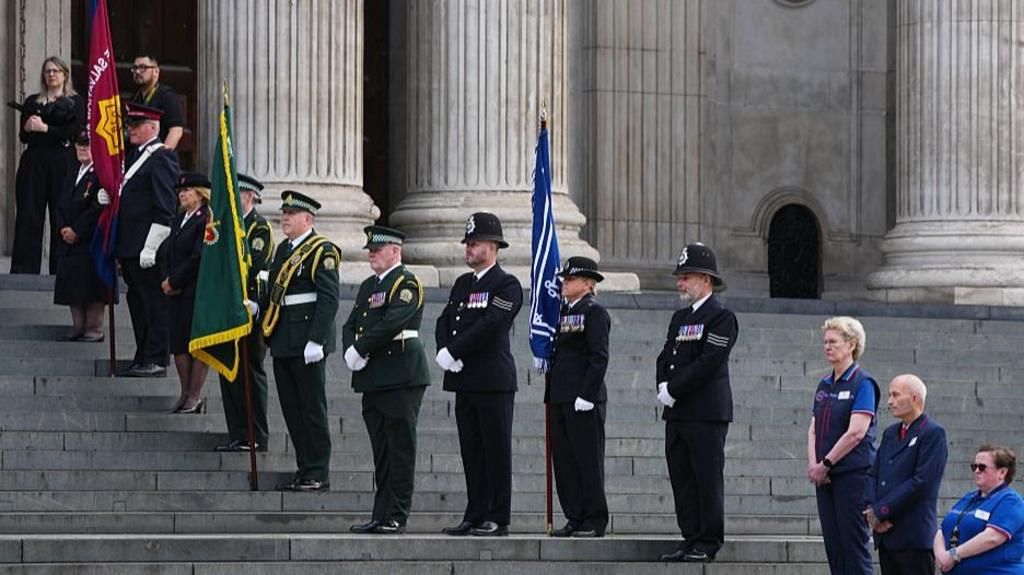
The Bishop of London, Dame Sarah Mullally, concluded the memorial service with a solemn prayer.
The service was followed by a stirring rendition of the national anthem, God Save the King, sung by the congregation and choir.
As the final notes faded, candles were gently lifted and carried back along the central aisle of St Paul’s Cathedral, marking a quiet and reflective end to the ceremony.
We now hear from the Bishop of London, Dame Sarah Mullally, who opens her address by reflecting on the “beautiful and heartfelt words” shared throughout the morning’s memorial service.
“Words which have reminded us of the miracle of being human and being together,” she says.
“Words which have gone some way to expressing the immeasurable loss, grief and pain experienced by so many here.”
In the final part of her message, Bishop Mullally centres her reflections on a single word: hope.

“The good that is in Londoners is not erased by hatred or threat,” she says.
“Hope presents itself as a survival tool for the tenacity of the spirit that is in all of us.”
Fifty-two thousand white petals fell silently from the dome and balconies of St Paul’s Cathedral one for each life lost in the 7/7 attacks as the daughter of a victim began reading the names of those killed on the Piccadilly Line between King’s Cross and Russell Square.
Saba Edwards’ voice cracked with emotion as she reached the name of her mother, Behnaz Mozakka.
Next, survivor Thelma Stober stepped forward to read the names of the seven people who died in the Circle Line bombing between Liverpool Street and Aldgate, followed by the six victims at Edgware Road.
She then read the names of those killed in the final blast, which struck a bus at Tavistock Square.
As the readings concluded, the organ swelled gently once more, and the soft glow of flickering candles filled the cathedral a poignant close to a solemn moment of remembrance.
Between short, solemn bursts of choral music, the service continues with a series of readings reflecting on the locations devastated by the 7/7 bombings two decades ago.
The first speaker recounts the history of Aldgate, setting the scene for the area’s place in London’s story.
He is followed by a woman who speaks about Edgware Road its deep roots and rich cultural diversity.
“Edgware Road is cosmopolitan and proud of its ethnic mix and diverse resources,” she says, highlighting the neighbourhood’s long-standing role as a meeting point of communities.
A third speaker reflects on Tavistock Square, noting the symbolic significance of the bronze statue of Mahatma Gandhi that stands there, as well as the presence of the British Medical Association’s headquarters both reminders of peace, service, and public good.
Invest or Donate towards HICGI New Agency Global Media Establishment – Watch video here
Email: editorial@hicginewsagency.com TalkBusiness@hicginewsagency.com WhatsApp +256713137566
Follow us on all social media, type “HICGI News Agency” .

