
Updated by Faith Barbara N Ruhinda at 1203 EAT on Thursday 16 April 2026
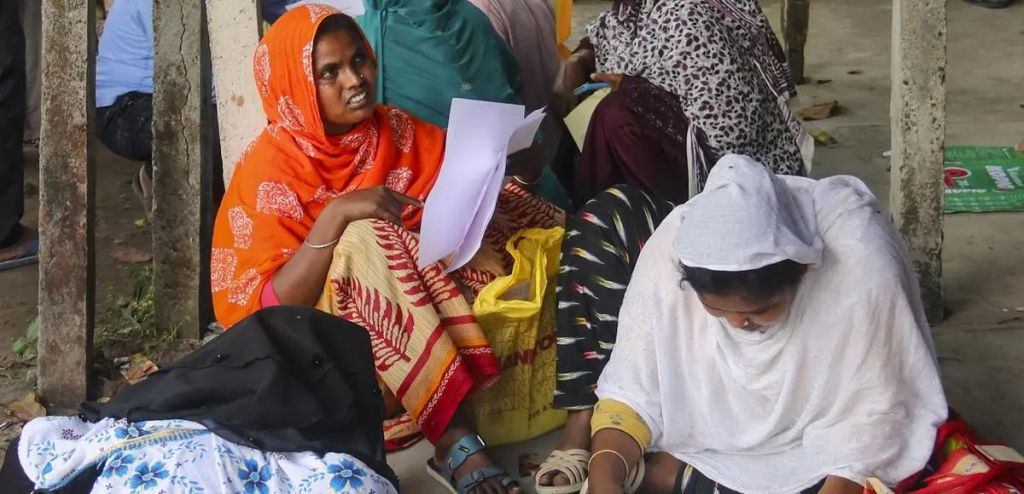
Nabijan Mondal, 73, has cast her ballot in every Indian election — national, state and local — for the past five decades.
Now, she says she has been left off the voter roll published by the Election Commission of India (ECI) in her home state of West Bengal, just weeks before the state heads into a two-phase assembly election on April 23 and April 29, with counting scheduled for May 4.
In the run-up to the polls, the Election Commission of India (ECI) carried out a Special Intensive Revision (SIR) of electoral rolls this month — a controversial exercise already implemented in more than a dozen states and federally administered territories.
Nabijan’s husband, their three sons and a daughter, along with their spouses, all appear on the final voter list. She does not.

The discrepancy, she has since learned, stems from inconsistencies in her official records. While her voter card lists her as “Nabijan” — a name she has long used — other government documents, including her Aadhaar biometric ID and ration cards, record her as “Nabirul.”
Nabijan is among more than nine million people who have lost their voting rights in West Bengal — nearly 12 percent of the state’s 76 million registered voters — following the Special Intensive Revision (SIR) process concluded earlier this month.
Of those removed, nearly six million have been classified as absentee or deceased, while about three million have been excluded pending verification and will only be able to vote if special tribunals clear their cases.
That prospect appears increasingly unlikely. The tribunals are not expected to process such a high volume of cases before polling begins, and the process of filing claims — which requires multiple supporting documents — is proving burdensome for many affected voters.
Earlier this week, the Supreme Court of India ruled that individuals with cases pending before the tribunals cannot be allowed to vote in the April election.

However, the court indicated it may permit the Election Commission of India (ECI) to publish supplementary voter lists ahead of polling.
An analysis of voter deletions across West Bengal suggests that Muslims have been disproportionately affected by the Special Intensive Revision (SIR), particularly in districts where they form a significant share of the population and could influence electoral outcomes.
Murshidabad recorded about 460,000 deletions, followed by roughly 330,000 in North 24 Parganas and 240,000 in Malda.
Al Jazeera spoke to nearly a dozen Muslim families in Gobindapur, Gobra and Balki villages in North 24 Parganas. Many said their names had been removed despite having the required documentation, while others described difficulties in proving their eligibility. Common challenges included establishing residential status, documenting surname changes after marriage or remarriage within families, inconsistencies in name spellings, proof of migration to other states, or demonstrating inclusion in the last SIR list published in 2002.
Like Nabijan, Sohidul Islam, 49, from Sagarpara village in Murshidabad, had participated in previous elections but now finds himself excluded from the voter roll.

“I am in deep pain. Who will I approach? I never thought my name would be deleted from the list,” he told Al Jazeera by telephone. “But now I want to focus on getting my name included. Even if I lose money and time, I have to think ahead.”
The Election Commission of India (ECI) says the Special Intensive Revision (SIR) is intended to remove duplicate or deceased entries and to include eligible voters who may have been left off electoral rolls.
However, the exercise has triggered widespread controversy and legal challenges. Opposition parties and several Muslim organisations allege that the revision is being used to systematically exclude voters perceived as unlikely to support the ruling Bharatiya Janata Party (BJP), led by Prime Minister Narendra Modi. Critics argue that Muslims have been disproportionately affected, pointing to a broader pattern of policies and political rhetoric they say have marginalised the community since the BJP came to power in 2014.
Bimal Sankar Nanda, a leader of the Bharatiya Janata Party (BJP), told Al Jazeera that while every eligible Indian must be included on voter rolls, ineligible names should also be removed. He accused the All India Trinamool Congress (TMC) of retaining “dead and shifted voters” on the lists.
“It is also true that the demographic character of the border areas [with Bangladesh] has been changing in a calculated manner. It is in the public domain, and television channels have shown people who were not Indian citizens leaving the state in border areas after the SIR exercise began,” he said.
Questions over ‘hurried’ SIR
Since 2014, Muslim voters in India have largely backed parties or alliances seen as capable of defeating the BJP. In West Bengal, that role has primarily been played by the TMC. Chief Minister Mamata Banerjee approached the Supreme Court of India in February, alleging bias by the Election Commission of India (ECI) after the Special Intensive Revision (SIR) began in October last year.
“The SIR process was selectively applied in West Bengal to benefit the BJP,” Banerjee said at a campaign rally this week. “The BJP is attempting to capture votes through fraudulent means because it cannot win democratically.”
The BJP rejects those claims, saying the exercise is intended to identify and remove “illegal infiltrators” from voter rolls, often referring to “Bangladeshis” and “Rohingya” in its campaign rhetoric. West Bengal shares a 2,200km (1,367-mile) border with Bangladesh, while nearly one million Rohingya refugees remain displaced after fleeing violence in Myanmar in 2017.
The issue of alleged “illegal migration” has long been central to the BJP’s political messaging, particularly among its largely Hindu support base. The party has recently foregrounded similar concerns in Assam, where assembly elections were held earlier this month, with results due alongside those of West Bengal and other states on May 4.
Sabir Ahamed of the Kolkata-based SABAR Institute told Al Jazeera that while electoral roll revisions are routine and typically conducted over one to two years, the exercise in West Bengal appeared unusually rushed.

“There seems to be some motive behind such a hurried activity,” he said. “Micro-observers with no local knowledge were brought in from other states. The process also lacked transparency, with lists being published in the middle of the night.”
The institute analysed voter deletions in two key constituencies — Nandigram and Bhabanipur — both of which are being contested this year by Suvendu Adhikari, the BJP’s leader of the opposition in the West Bengal Legislative Assembly. In Bhabanipur, he is up against Chief Minister Mamata Banerjee, who lost Nandigram to Adhikari in the 2021 election. Indian electoral law allows candidates to contest from two constituencies in state or national polls.
According to the SABAR analysis, although Muslims constitute about 25 percent of Nandigram’s population, more than 95 percent of the deleted names there belonged to Muslims. In Bhabanipur, where Muslims account for roughly 20 percent of residents, they make up about 40 percent of those removed from the voter list.
The controversy over the Special Intensive Revision (SIR) has intensified political tensions in West Bengal, with questions over electoral integrity, transparency and inclusion now central to the campaign.
While the Election Commission of India maintains that the exercise is a necessary clean-up of voter rolls, critics argue it risks disenfranchising millions — particularly among vulnerable communities — at a decisive electoral moment.
With limited time before polling and legal remedies unlikely to be resolved in time, many affected voters face uncertainty over their participation in the democratic process. The outcome of the elections may ultimately hinge not only on political contestation, but also on who is able to cast a ballot.
-Aljazeera
Invest or Donate towards HICGI New Agency Global Media Establishment – Watch video here
Email: editorial@hicginewsagency.com TalkBusiness@hicginewsagency.com WhatsApp +256713137566
Follow us on all social media, type “HICGI News Agency” .
 HICGI News Agency