
Updated by Catherine Asiimwe at 1450 EAT on Thursday 30 April 2026
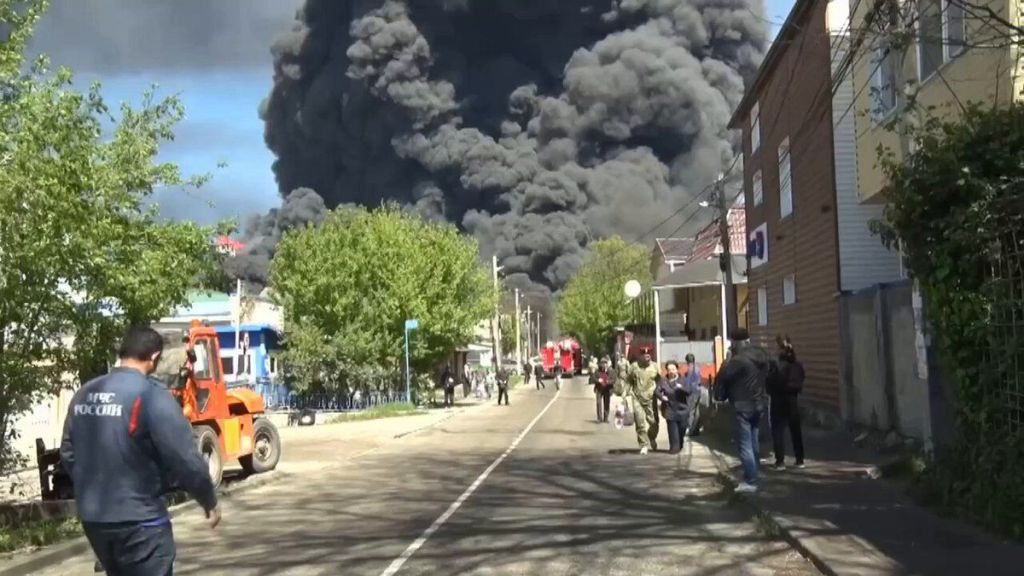
When cleanup volunteer Sergei Solovev arrived in the Black Sea port town of Tuapse in southern Russia, he was met by a sharp chemical smell and streets coated in a layer of black residue.
“I saw train carriages covered in residue from the black rain and animals. It’s all very toxic,” he told Al Jazeera. “And the smell was oily.”
“Black rain” is an unnatural weather phenomenon in which water droplets are contaminated with soot and ash, falling from the sky. It was first widely documented in Hiroshima, Japan, after the atomic bombing in 1945, and has also been reported in events such as the burning of Kuwaiti oil fields during the 1991 Gulf War, as well as more recently in Iran’s capital, Tehran.
Now, similar conditions are being reported in parts of Russia.
Over the past two weeks, the Black Sea port town of Tuapse has been hit by a series of three Ukrainian drone strikes targeting one of Russia’s largest oil refineries. The attacks, aimed at disrupting Russia’s energy sector, have also triggered environmental damage, underscoring the growing ecological toll of the war.


The first strike on 16 April sparked a fire that burned for two days. Four days later, on 20 April, the refinery was hit again, sending a thick plume of smoke billowing into the sky. That blaze lasted for five days.
The fires released toxic emissions, and a subsequent air quality analysis around the town found concentrations of benzene, xylene and soot at levels three times higher than safety thresholds.
No further official data has been released since then, but residents were advised to remain indoors, keep windows closed and wear masks if they needed to go outside
“The rain covered all the cars and animals,” said local volunteer Elena Lugovenko. “All the animals are covered in oil. Volunteers have set up animal cleanup centres.”
Rescue teams and volunteers have been collecting affected wildlife, including cats, dogs and birds, washing off the toxic residue before transferring them to shelters. Environmental groups warn that oil spills are especially dangerous for birds, whose feathers become matted and lose their ability to insulate or enable flight. The substance is also toxic if ingested, as birds often swallow it while attempting to preen.
By the end of the 20 April attack, at least eight storage tanks at the refinery had been destroyed, with leaked petroleum seeping into the nearby Tuapse River before flowing into the Black Sea and spreading along the coastline.
Authorities deployed more than a dozen vessels to contain the spill offshore, while protective booms were installed along beaches. Emergency crews and volunteers have also been working along rocky shorelines, using excavators where possible, while collecting contaminated material in barrels and plastic bags.
“It’s an environmental disaster,” said volunteer Sergei Solovev, who travelled from Sochi, about 116km (70 miles) away, to join the cleanup effort.
“There’s oil already along a 20-kilometre radius of coastline. It still hasn’t been fully cleared; everything is covered in oil. The soil has to be removed, and in many areas it’s mixed with rocks in hard-to-reach places where machinery can’t reach.”
He added that cleanup work itself carries health risks. Fine oil particles in the air can be hazardous when inhaled, while volunteers are advised to use protective gear and eye drops at the first sign of irritation.
“You have to take absorbents every two hours while cleaning it up,” Solovev said. “Wear a mask and chemical protection.”
‘Could last for years’
Local environmentalists told the independent Russian outlet Important Stories that, in some cases, authorities have reportedly covered contaminated beaches with fresh pebbles, effectively concealing rather than removing pollution.
Even if containment efforts succeed, Ruslan Khvostov, chairman of the Green Alternative party, warned that long-term ecological damage could persist for years.
“Oil products settle in the bottom sediments of the Black Sea, disrupting the food chain, and everyone will suffer,” Khvostov told Al Jazeera.
“The oil slick blocks oxygen, causing mass mortality of fish, shellfish and bottom-dwelling organisms. Biodiversity recovery can take five to 10 years or longer, as seen in the 2024 Kerch spill. Toxins accumulate in organisms, threatening birds and marine mammals, including dolphins.”
After the third and final strike on Tuesday, conditions in Tuapse reportedly deteriorated to the point where parts of the town were evacuated.


The environmental impact of Russia’s invasion of Ukraine has been widely documented, with conservation groups warning of long-term damage across the Black Sea region. Thousands of dolphins and porpoises have been found dead along the coastline, with researchers linking the deaths in part to underwater sonar activity associated mainly with Russian naval operations, which can disrupt marine mammals’ hearing.
Because these animals rely on echolocation to navigate, feed and communicate, disruption to their hearing can leave them disoriented and unable to locate food or avoid hazards.
In June 2023, the Kakhovka Dam in Ukraine’s Kherson region was destroyed by an explosion while the area was under Russian control. The reservoir water, already contaminated with industrial and agricultural pollutants, flooded dozens of settlements downstream, destroying habitats including that of the endangered sandy blind mole-rat, whose near-total range was inundated. The disaster also released large volumes of polluted water into the Black Sea, while most fish and other aquatic life in the reservoir were wiped out.
Western and Ukrainian officials have attributed the dam’s destruction to Russian forces, though Moscow has denied responsibility, blaming Ukrainian sabotage.
With no clear path to peace or even a ceasefire in sight, analysts say Ukraine is likely to intensify strikes on Russia’s oil industry — a sector that has continued to generate strong revenues amid wider volatility linked to the Middle East crisis.
“Tactically, refineries make good targets for an attritional drone campaign — they are large, fixed, and difficult to defend,” said Witold Stupnicki, senior analyst for Europe and Central Asia at the Armed Conflict Location & Event Data Project (ACLED).
“The repeated strikes on Tuapse — three times in under two weeks — show Ukraine is operating in sustained campaign mode, where cumulative damage prevents recovery,” he said, adding that similar patterns were seen in attacks on the Primorsk and Ust-Luga ports in the Baltic Sea in March. “Ukraine is likely to continue and probably escalate this campaign, particularly as domestic drone production scales up and as these attacks systematically degrade Russian air defences, enabling strikes deeper into Russian territory.”
The Tuapse incident is not the first major environmental emergency in the region. In December 2024, two Russian oil tankers sank during a storm in the Black Sea, spilling thousands of tonnes of petroleum that later washed up near the resort town of Anapa. Emergency crews and tens of thousands of volunteers, including Sergei Solovev, were deployed to one of Russia’s worst environmental clean-up operations in recent years.
In a social media post, environmental activist Arshak Makichyan blamed Russia’s fossil fuel industry and the political system surrounding it for repeated ecological crises.
“If we are surprised by oil rains in Tuapse and Sochi, we ought to remember the black snow in the Kemerovo region in 2019, which happened without any war — because of the Russian regime, because of coal sludge that was never removed, and the lack of any regulation at all, because what Russia needed first was to make money by destroying nature,” he wrote.
“Environmental disasters will continue in Russia until people begin demanding systemic change, rather than simply blaming Ukraine for what has happened.”
-Aljazeera
Invest or Donate towards HICGI New Agency Global Media Establishment – Watch video here
Email: editorial@hicginewsagency.com TalkBusiness@hicginewsagency.com WhatsApp +256713137566
Follow us on all social media, type “HICGI News Agency” .

