
Updated by HICGI News Agency at 1417 EAT on Monday 4 May 2026
When Vice President Jessica Alupo visited a science museum in Moscow, Russia, last year, she expected a routine tour. Instead, she found herself inside a virtual flight simulator, watching the city’s skyline from above — an experience that, she said, showed how scientific innovation can attract large paying audiences.
“I saw thousands of tourists paying money to enter the museum,” she said last week, using the anecdote to highlight the commercial potential of science and technology.
Speaking at Uganda’s National Science Week 2026 at Kololo Independence Grounds, Alupo set the tone for what officials describe as a pivotal phase in the country’s drive toward a science-led economy.
Over the past five years, Uganda has increased public investment in science, technology and innovation, aiming to shift from a commodity-dependent economy to one anchored in industrial production and knowledge systems.
According to Science, Technology and Innovation Minister Monica Musenero Masanza, the investments have generated productive capacity valued at $1.52 billion — about 4.5 times the initial government outlay. The sector now supports more than 150,000 jobs, including over 50,000 technical positions.


Electric buses
The government has pointed to progress in several strategic industries, including transport, where Uganda has begun manufacturing electric buses at the Kiira Vehicle Plant in Jinja.
The flagship Kayoola Electric Coach recently completed a 13,700-kilometre journey from Kampala to Cape Town, while export orders worth $183 million have been secured from markets including Nigeria, South Africa and Ethiopia.
Pharmaceuticals
In the pharmaceutical sector, Uganda is seeking to reduce long-standing import dependence. The country previously imported more than 90 percent of its medicines and all vaccines. Officials say a domestically developed vaccine platform is now in place, alongside a growing pool of research scientists.
The biotech company Dei BioPharma, valued at $5 billion, has developed treatments targeting cancer, diabetes and sickle cell disease. Government data indicates that import substitution in diagnostics alone has generated savings of Shs135.8 billion.
Uganda has also entered the space economy. Since launching its first satellite in 2022, the country has expanded its capabilities through partnerships, including the deployment of a climate-monitoring camera to the International Space Station. The Mpoma Satellite Earth Station has been upgraded to support satellite assembly and operations.
President Yoweri Museveni, in remarks delivered by Vice President Jessica Alupo, framed the strategy in explicitly economic terms.
“From the beginning of our struggle, we understood that the prosperity of nations does not come by accident. It comes through correct ideology, political stability, and the deliberate application of knowledge to production,” he said.
“Science, Technology and Innovation are not luxuries. They are necessities for national survival and prosperity.”
The administration has set an ambition to expand the economy tenfold, driven by industrialisation, value addition and productivity gains. Officials say embedding science into production systems is central to achieving that goal.
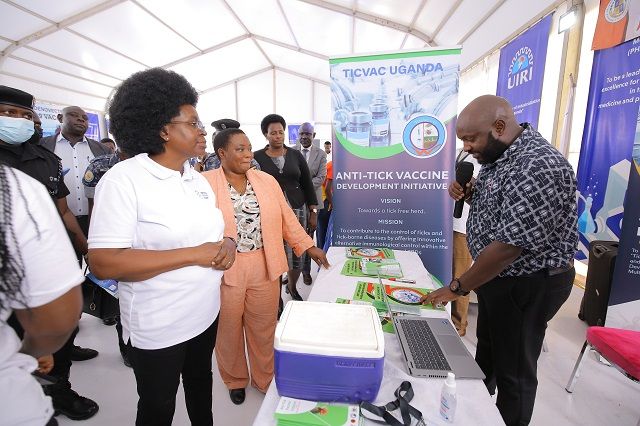
Early-stage entrepreneurship is also beginning to reflect the policy shift. At the science expo, young innovators showcased projects in electric mobility, energy and manufacturing.


“Our expectation is to pitch and win the funding of our innovation and step it up,” said engineer Benjamin Ojede, who is developing an electric vehicle prototype.
Budget constraints
Despite the progress, structural constraints remain. Uganda currently allocates about 0.17 percent of GDP to science, technology and innovation — well below its 2.5 percent target under Vision 2040, and significantly behind global innovation leaders such as Israel and South Korea. Analysts say the funding gap could limit the transition from pilot projects to scalable industries.
Officials also acknowledge a bottleneck in commercialisation. Sixty-four ventures are currently stalled in what policymakers describe as the “valley of death,” where projects struggle to secure the capital and regulatory support needed to reach full production.
“The runway has been built,” Science, Technology and Innovation Minister Monica Musenero said. “The takeoff has not yet happened.”
To address this, the government is planning a series of industrial platforms, including a national biosciences park, an automotive industrial hub and a high-tech innovation city near Kampala. These are expected to underpin the next phase of growth, with projected output running into tens of billions of dollars and the creation of hundreds of thousands of jobs.
For Uganda, the challenge will be execution — converting state-backed innovation into competitive industries capable of boosting exports, reducing imports and sustaining long-term growth.
As Museveni’s remarks suggest, the policy direction is unlikely to shift. The question now is whether investment levels, institutional capacity and private-sector participation can keep pace with the ambition.
-Independent
Invest or Donate towards HICGI New Agency Global Media Establishment – Watch video here
Email: editorial@hicginewsagency.com TalkBusiness@hicginewsagency.com WhatsApp +256713137566
Follow us on all social media, type “HICGI News Agency” .

