
Upadetd by Faith Barbara N Ruhinda at 1512 EAT on Wednesday 6 April 2026
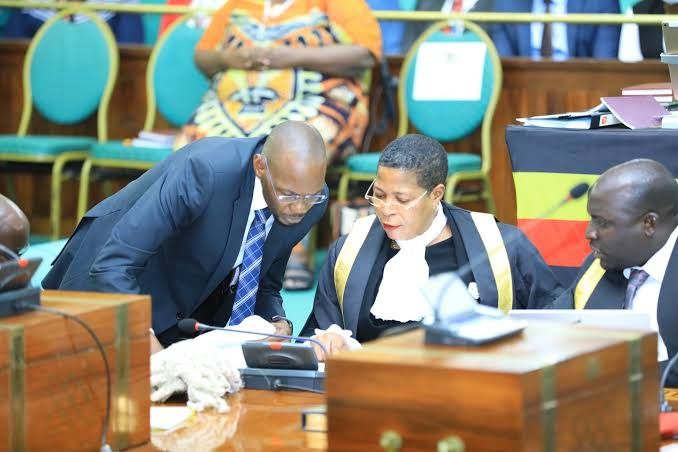
Parliament on Tuesday night passed the contentious Protection of Sovereignty Bill, 2026, after nearly eight hours of heated exchanges.
The move concluded a swift 20-day legislative process that has drawn scrutiny over Parliament’s ability to exercise independent oversight. The focus now shifts to the wider constitutional arena, amid growing concerns over executive influence and the boundaries of state authority.
Introduced by Attorney General Kiryowa Kiwanuka on April 15, the Bill’s passage relied heavily on the numerical advantage of the ruling National Resistance Movement, with backing from Speaker Anita Annet Among.


Government legislators defended the Bill as a necessary legal instrument to shield Uganda from what they described as growing foreign interference in domestic political, civic and economic processes.
During the debate, Attorney General Kiryowa Kiwanuka argued that “sovereignty is not an abstract concept; it must be actively protected in a global environment where foreign actors can shape internal political outcomes through funding and influence.”
However, opposition lawmakers, led by Nakawa West MP Joel Ssenyonyi, warned that the law risks entrenching state overreach under the guise of national protection.
“This Bill opens the door to criminalising legitimate civic engagement and dissent,” Ssenyonyi said, cautioning that its broad provisions could be used to target civil society organisations, media actors and political opponents.
At the centre of the controversy are clauses critics describe as overly broad and vulnerable to abuse. The Bill introduces expansive definitions of “foreign interference,” potentially covering funding, partnerships or advocacy linked to international entities, without clearly defined thresholds.
Individuals or organisations found in violation face stiff penalties, including heavy fines and possible imprisonment, raising concerns over proportionality and enforcement discretion.
The legislation also grants wide discretionary powers to government agencies to investigate and sanction actors deemed to undermine sovereignty, with limited judicial safeguards.
In addition, some provisions tighten oversight of NGOs and advocacy groups—particularly those receiving foreign funding—echoing concerns previously raised under the Non-Governmental Organisations Act, 2016.
Busiro East MP Medard Lubega Ssegona warned that such provisions could tilt the balance of power in favour of the executive.
“Oversight is not retrospective; it is preventive. Parliament must ensure that laws do not create fertile ground for abuse,” Busiro East MP Medard Lubega Ssegona said, underscoring the legislature’s constitutional duty to rigorously scrutinise proposed legislation.


A major flashpoint in the process was the suspension of Rule 170 of Parliament’s Rules of Procedure, moved by Government Chief Whip Denis Hamson Obua. The rule ordinarily guarantees clause-by-clause consideration of Bills and requires scrutiny of public submissions at committee level, a key pillar of participatory lawmaking.
Its suspension enabled Parliament to fast-track the Bill, effectively limiting deeper scrutiny and stakeholder input.
Presiding over the proceedings, Speaker Anita Annet Among called for two division votes following procedural objections—an unusual step that reflected the depth of disagreement in the House.
Both votes confirmed the numerical strength of the ruling National Resistance Movement, ultimately sealing the Bill’s passage.
The process also drew attention after President Yoweri Museveni reportedly distanced himself from aspects of the Bill, cautioning against provisions that could be interpreted as curtailing legitimate freedoms or undermining Uganda’s international standing.
Sources within government indicated that Museveni was particularly concerned about clauses that could strain diplomatic relations with development partners, affect Uganda’s commitments under international law, including human rights frameworks, and reinforce perceptions of a shrinking civic space.
His reported reservations have fuelled speculation over whether the final text reflects his concerns or whether Parliament proceeded largely under party pressure.
The President now faces a constitutional decision under Article 91 of the 1995 Constitution: to assent to the Bill, return it to Parliament for reconsideration, or decline to sign it into law.
-Observer
Invest or Donate towards HICGI New Agency Global Media Establishment – Watch video here
Email: editorial@hicginewsagency.com TalkBusiness@hicginewsagency.com WhatsApp +256713137566
Follow us on all social media, type “HICGI News Agency” .

