
Updated by Faith Barbara N Ruhinda at 1221 EAT on Wednesday 20 May 2026
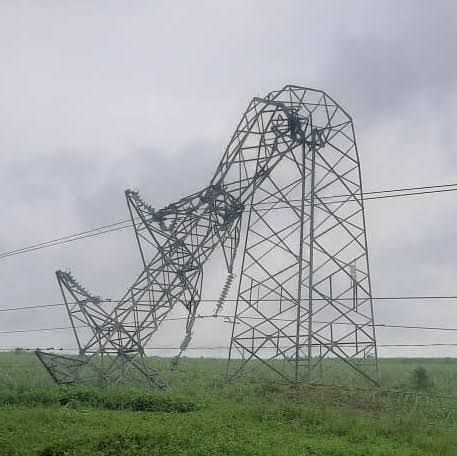
Outspoken Amuru District MP Gilbert Olanya recently took to social media to criticise the leadership at the Ministry of Energy, accusing officials of complacency and presiding over substandard infrastructure projects.
In a video widely circulated online, Olanya is seen walking through bush-covered sections along the Karuma–Pakwach highway while pointing to collapsed high-voltage electricity pylons. The footage quickly went viral, sparking heated debate across social media platforms.
However, public attention soon shifted from allegations of poor workmanship to another issue that has become increasingly difficult to ignore in Uganda — vandalism. The Uganda Electricity Transmission Company Limited (UETCL) was eventually compelled to issue a statement addressing the matter.
Uganda today finds itself grappling with a troubling paradox. The country has invested billions of shillings in public infrastructure — including hydroelectric dams, transmission lines and an expanding national electricity grid — yet the same infrastructure is repeatedly vandalised, dismantled and converted into private gain.
The contradiction raises a deeper national question: what kind of state is Uganda becoming? One that builds and protects public goods, or one in which public assets are continuously stripped, looted and extracted for individual profit?

Communities were mobilised and sensitised on the dangers of sabotaging government infrastructure projects.
Ronald Bogere, head of security, described it as “shameful” that some community members were participating in the destruction of public utilities.
He warned that vandals, once apprehended, face strict penalties, including up to 12 years in prison or fines of up to Shs1 billion.
“This is not isolated destruction but a systemic problem,” he said.
He added that understanding vandalism in Uganda requires looking beyond it as a purely criminal act and examining the broader political economy, particularly the dynamics of rent-seeking systems.
In classical development theory, the state is expected to mobilise resources, deliver public goods, and protect them. However, in rent-seeking environments, this logic shifts, and public goods can become targets of extraction.
Infrastructure, in this context, becomes a resource to be exploited, with the boundary between legal and illegal activity increasingly blurred. Uganda’s vandalism challenge, he suggested, reflects aspects of this broader structural reality.
The drivers behind the problem are widely recognised. A growing scrap metal economy has created a ready market for stolen copper and aluminium, according to multiple Electricity Regulatory Authority (ERA) reports reviewed during preparation of this article.
Weak enforcement mechanisms have allowed stolen infrastructure to circulate through markets that often appear legitimate, while rising economic hardship has pushed sections of unemployed youth into risky but potentially lucrative informal activity.
The result is an expanding shadow economy in which electric poles, wires and transformers are no longer treated solely as public assets, but as tradable commodities. The costs of this extraction are not evenly distributed.
A 2024 study by the Quadracci Sustainable Engineering Lab found that rural communities experience longer and more frequent outages because vandalism-related disruptions take significantly more time to repair than routine technical faults.

Small businesses, in turn, absorb rising operational costs linked to unreliable electricity supply, while government is forced to divert public resources originally intended for health, education and road infrastructure toward replacing stolen equipment.
An analysis by the Electricity Regulatory Authority further indicates that escalating repair costs are ultimately reflected in higher consumer tariffs. As one Makerere University economist noted, “the poor subsidise the destruction of public goods through higher costs and lost opportunities.”
At first glance, persistent vandalism may appear to reflect a weak state unable to enforce rules or protect strategic infrastructure. However, officials and analysts argue that this explanation is incomplete. Uganda has strengthened laws prescribing penalties of up to 15 years’ imprisonment for vandalism, established specialised courts and task forces, and carried out arrests and prosecutions targeting organised groups.
Yet incidents continue, and in some areas appear to be worsening.
This suggests not merely institutional weakness, but a deeper structural challenge often described as a “dual state” — one that is strong in infrastructure delivery but weaker in protection; capable of investment but constrained in enforcement and accountability.
In political economy terms, this reflects what scholars call an extractive institutional equilibrium, where enforcement is uneven, markets for stolen goods operate with partial impunity, and networks of formal and informal actors derive benefit from systemic leakage.

The Ugandan case cannot be fully understood in isolation from wider regional dynamics. Scrap metal trade does not respect district or national boundaries. Stolen materials move along cross-border trade routes, regional markets absorb illicit goods, and smuggling networks often overlap with broader informal economies across East Africa.
This shifts vandalism from a purely local criminal issue into a wider transnational illicit system involving local actors, brokers, scrap dealers, transporters and regional trade networks.
As long as profitable markets for stolen infrastructure remain in place, the incentive structure sustaining the theft is likely to persist. Uganda’s response has so far been largely reactive and legalistic, centred on arrests, prosecutions, tougher penalties and public awareness campaigns.
While these measures are necessary, analysts argue they do not fully address the deeper economic and institutional incentives driving the problem. Without tighter regulation of scrap markets, stronger material traceability systems, and disruption of value chains that profit from stolen infrastructure, enforcement risks remaining largely superficial.
Countries that have successfully reduced infrastructure vandalism have tended to adopt broader structural approaches rather than relying on punishment alone. Some have introduced strict licensing regimes and traceability systems for scrap dealers. Others have targeted entire criminal value chains rather than isolated offenders. In addition, investments in smart monitoring technologies, low-resale-value infrastructure materials, and stronger community ownership models have helped improve protection of public assets.
Uganda now finds itself at a critical crossroads. On one side is an expanding energy sector, industrialisation ambitions, and significant public infrastructure investment. On the other is persistent vandalism, leakage of public resources, and weak control over illicit economic networks.

The contradiction ultimately returns to a central question: is Uganda consolidating a developmental state, or drifting toward an extractive one? Vandalism, in this sense, is no longer merely about damaged power lines.
It has become a reflection of deeper structural dynamics within the state itself. A system that builds but struggles to protect risks encouraging informal extraction, eroding public trust, and undermining its own development agenda.
A state that allows public goods to be routinely converted into private gain risks entrenching systemic leakage and slowing long-term transformation. The lesson is increasingly clear: development is not only about constructing infrastructure, but about protecting it from capture.
Until Uganda shifts from reacting to vandalism toward restructuring the political economy that sustains it, the cycle is likely to continue—build, loot, repair, repeat. And the question of what kind of state is emerging will remain unresolved, even as it is increasingly answered in practice.
-Observer
Invest or Donate towards HICGI New Agency Global Media Establishment – Watch video here
Email: editorial@hicginewsagency.com TalkBusiness@hicginewsagency.com WhatsApp +256713137566
Follow us on all social media, type “HICGI News Agency” .

